
Published on May 14, 2026 | 7 min

The United States needs a federal consumer data privacy law, but not one like the recently proposed SECURE Data Act.

On April 22, Republicans on the House Energy and Commerce Committee introduced the SECURE Data Act (H.R. 8413), making it the first attempt at comprehensive privacy legislation in years; unfortunately, the bill is a disaster, as it would erase too much state-level progress.

The main problem with the SECURE Data Act is the issue of federal preemption. The bill would preempt all state legislation, effectively eviscerating strong state legislation like California’s CCPA (2018) and CPRA (2020).

The preemption problem

Nobody, myself included, wants businesses to have to deal with a patchwork of data privacy laws. We absolutely need a federal data privacy law on the books. That said, any federal law should build on top of state-level laws; it shouldn’t dilute existing laws, rendering them unenforceable, and erasing years of state-level legislative work.

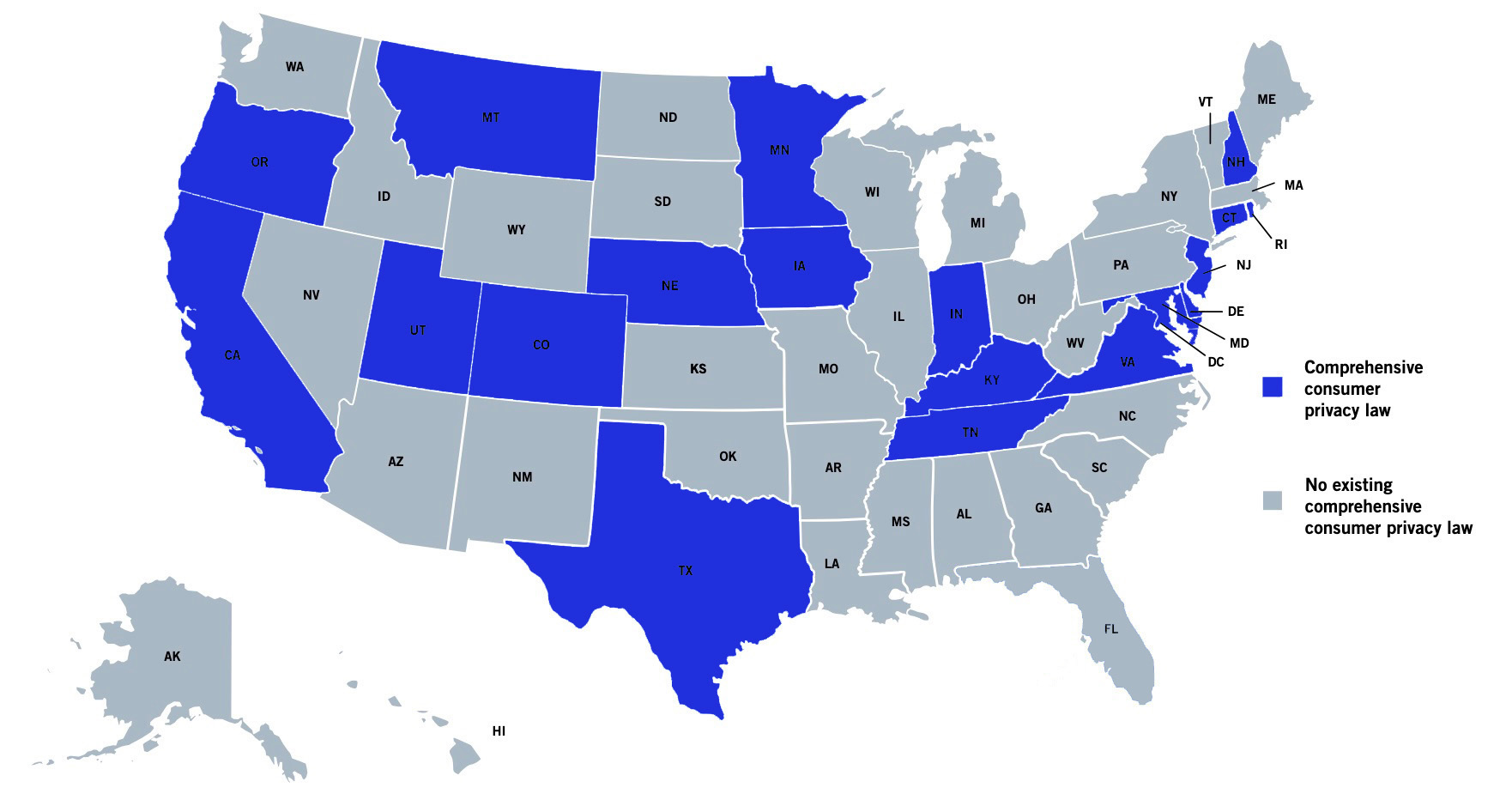
As of May 2026, the U.S. has comprehensive privacy legislation in 21 states: Alabama, California, Colorado, Connecticut, Delaware, Indiana, Iowa, Kentucky, Maryland, Minnesota, Montana, Nebraska, New Hampshire, New Jersey, Oklahoma, Oregon, Rhode Island, Tennessee, Texas, Utah, and Virginia.

Of course, there is a great deal of nuance here, as some states have stronger laws than others. Nevertheless, any proposed federal law should be treated as a floor to build on top of these state-level laws, rather than a ceiling.

I agree with the Electronic Frontier Foundation’s Mario Trujillo, who writes, “Federal privacy laws should allow states to build ever stronger rights on top of the federal floor. Many federal privacy laws allow this, including the Health Insurance Portability and Accountability Act (HIPAA).”

Which businesses are affected

The proposed bill would apply to all businesses subject to the FTC Act, as well as all businesses in the U.S. that process the personal data of 200,000 U.S. consumers or more.

Additionally, there’s another standard that would affect other businesses; any business that processes the data of more than 100,000 U.S. consumers and derives more than 25% of revenue from selling that data would also be subject to the SECURE Data Act.

As it stands, the proposed bill exempts businesses with less than $25m in adjusted gross annual revenue.

Key provisions of the bill

The SECURE Data Act mandates that U.S. consumers be given a clear mechanism to opt out of targeted advertising practices as well as the sale of their personal data.

Were the bill to pass, many businesses that process and control consumer data would be forced to obtain opt-in consent before they processed any sensitive consumer data, including geolocation, financial information, and health data. Also, the bill would require businesses to get parental consent before processing the personal data of kids aged 13-16.

Data broker registry

This is my favorite part of the proposed bill. The SECURE Data Act would create a federally mandated data broker registry. Maintained by the FTC, this registry would require many data brokers to register every year and disclose all of their data collection and sales activities.

All data brokers that make over 50% of their profits by selling our personal data would be forced to register in the FTC’s public database. This is a wonderful development.

Enforcement

Here is where things get problematic for privacy advocates. The SECURE Data Act mandates that all enforcement be handled by the FTC and state attorneys general.

Particularly problematic for most privacy advocates, the proposed bill doesn’t include a private right of action, meaning that consumers cannot file civil suits against law-breaking companies. Only the FTC and state attorneys general can enforce the SECURE Data Act.

Moreover, the proposed bill includes a “45-day notice-and-cure provision,” which basically means that if a company is caught breaking the law, they have 45 days to “cure” any violation with no penalty.

Personally, for me, the lack of a private right of action isn’t a deal-breaker. And I think future iterations of this bill can reach a compromise on this issue.

No private right of action

Although privacy rights activists are up in arms about the lack of a private right of action, Electronic Privacy Information Center (EPIC) Deputy Director and Policy Director Caitriona Fitzgerald suggests that a compromised version of a private right of action could be reached down the line.

As Fitzgerald writes, “Previous bipartisan privacy proposals, such as the American Data Privacy and Protection Act and the American Privacy Rights Act, proposed a compromise version of a private right of action that allowed for injunctive relief so that consumers could force companies to stop violating the law, but did not allow for statutory damages.”

I think such a “compromise version” of a private right of action could get future iterations of this bill across the finish line.

The issue of “notice and choice” and burying fine print in the privacy policy

Another important issue to highlight is “notice and choice”; this is a common model in data privacy that allows companies to collect our data as long as they tell us what they’re doing with it (and they give us an option to opt-out.)

The problem with “notice and choice” is that sometimes exactly how the data is being used is buried in the companies’ privacy policies. And who reads these?

Also, many times, the consumers’ choice to allow data collection is bundled with the service itself, creating a take-it-or-leave-it situation.

Alternatively, companies sometimes combine user consent for necessary data collection (e.g., a navigation app needing our location data in order to provide us with directions) with totally unrelated uses (e.g., selling our location data to third-party advertisers or data brokers).

A far better policy is to mandate that companies adhere to data minimization requirements. For example, some state-level laws prevent companies from collecting consumer data beyond what is necessary to fulfill the requested service. This way, even if the consumer technically gives his or her consent, it is still illegal for companies to surreptitiously over-collect and profit from that user’s data in other ways.

The SECURE Data Act perpetuates the notice-and-choice model, as opposed to requiring that companies adhere to data minimization. This is a shame.

Maryland’s data privacy law has an excellent data minimization standard, as did two other previous bipartisan federal bills: American Data Privacy and Protection Act (ADPPA) and American Privacy Rights Act (APRA). It’s too bad the SECURE Data Act didn’t have such a standard.

Support for the SECURE Data Act

I’d be remiss if I didn’t point out that many folks are happy with the proposed bill. As an example, Adam Thierer, a senior fellow at the R Street Institute, was excited to see the bill not include a private right of action. Thierer writes, “Importantly, the SECURE Data Act wisely does not include a PRA, which would only exacerbate America’s growing over-litigation problem.”

And of course, many lobbyists and lawmakers are rejoicing at the chance to dilute the CPRA and other state laws. For example, advocacy group Americans for Tax Reform and twenty-three other center-right groups are particularly excited by the prospect of the SECURE Data Act passing.

The self-proclaimed center-right groups collectively write, “If all 50 states move forward with their own privacy laws, it could cost the American economy over $1 trillion in the next decade, with $200 billion of that burden falling on small businesses.” These 24 groups want to see “strong preemption, with no private right of action and no open-ended rule-making authority for federal agencies or additional state regulations.”

My take

I agree with the EFF’s contention that “the bill is weaker than congressional proposals in prior years, as well as most of the 21 state consumer privacy laws already on the books.”

The fact that the SECURE Data Act preempts existing state-level laws ultimately makes this a bad bill.

Aside from the federal preemption problem, which is a deal-breaker in and of itself in my mind, there are several other issues with the SECURE Data Act. As it stands, the bill perpetuates the “notice and choice” status quo, allowing organizations to obfuscate how they process consumer data, as they bury the specifics deep in their corporate privacy policies. Given that few consumers bother to read or understand corporate privacy policies, data minimization provisions would be much better than this “notice and choice” approach.

Unlike other privacy advocates, I am less concerned about the bill’s failure to include a private right of action. That’s not a deal-breaker for me. However, I am inclined to agree with EPIC’s Fitzgerald, who writes, “The combination of minimal consumer protections, weak enforcement, and insanely expansive preemption of state laws makes the SECURE Act a disaster for Americans’ privacy.”

That said, there are some great things inside the proposed SECURE Data Act. I particularly like the call for a federal data broker registry. It’s refreshing to see politicians on both sides of the aisle ready to crack down on the data brokerage industry, a particularly pernicious part of the data surveillance apparatus.


Related reading

John Donegan

John Donegan

Enterprise Analyst, ManageEngine

Want to read<br>this article on the go?

Want to read
this article on the go?

Do it on the ManageEngine
Insights app.

Published on November 21, 2025 | 6 min

The government shutdown may be over, but there won’t be much federal data privacy legislation being passed in 2026. Given the current dysfunction in Congress, the onus will continue to fall onto the states.

In fact, 8 states—Delaware, Iowa, Maryland, Minnesota, Nebraska, New Hampshire, New Jersey, and Tennessee—have already enacted new data privacy laws in 2025. According to the IAPP Weston Research Center, there are now 19 states with comprehensive data privacy laws on the books. As a quick caveat, different trackers have different qualifications; some trackers list 20 states and include Florida.

As seen above, the 19 states are California, Colorado, Connecticut, Delaware, Indiana, Iowa, Kentucky, Maryland, Minnesota, Montana, Nebraska, New Hampshire, New Jersey, Oregon, Rhode Island, Tennessee, Texas, Utah, and Virginia.

Although similar bills in Alabama, Georgia, Oklahoma, Maine, and Vermont failed to pass in 2025, other states—Massachusetts, Michigan, North Carolina, Pennsylvania, and Wisconsin—are currently considering data privacy legislation. Moreover, new laws from Indiana, Kentucky, and Rhode Island are expected to arrive in 2026.

Of the 19 states with comprehensive data privacy laws, 9 states (more specifically, 10 regulators across 9 states) have joined the Consortium of Privacy Regulators, a bipartisan initiative formed last April to protect consumers across different jurisdictions.

State-level data privacy bills generally include both protections for consumers and obligations for businesses. On the consumer side, these state laws allow consumers to control how their data is collected, stored, and shared with other parties. These rights—e.g., consumers’ right to delete, correct, and opt-out of data collection—are similar in nature to provisions in the GDPR and CCPA. On the business side, organizations are often obligated to adhere to various data minimization requirements.

Of course, not all states’ data privacy bills are created equal

Big Tech lobbyists have historically been extremely adept at watering down state-level bills. Speaking at the Capitol Forum’s 2025 Tech Conference, the Electronic Privacy Information Center’s Sara Geoghegan opines that Big Tech lobbyist involvement often results in watered-down bills.

Geoghegan describes the current landscape of state-level data legislation as a “mixed bag.” As Geoghegan explains, “Unfortunately, some states’ laws have kind of been written by Amazon and Big Tech; so it really depends a lot on the state. Some states have some really interesting proposals, and then Big Tech gets involved during the process and the final result is watered-down. But some [other] states have passed bans on the sale of geolocation information, special protections for things like abortion care. So, it’s kind of a mixed bag.”

With artificial intelligence progressing at a rapid pace, many state lawmakers are calling for more forms of data privacy regulation, particularly in regard to the data brokerage industry and surveillance pricing.

States are cracking down on the data brokerage industry

Recently, Texas and Oregon joined California and Vermont in requiring data brokers to register in their respective states and disclose their activities. (Data brokers are third-party entities that purchase our personal data, often unbeknownst to us.) All data brokers that process data not collected directly from the data subjects themselves now have to register with these four states. However, as of today, it is not exactly straightforward for data subjects to delete their information from these brokers’ databases.

On the Capitol Forum’s recent “Anticipated Trends for the Data Broker Industry and Enforcement” panel, cybersecurity and data privacy consultant Justin Sherman makes the case that we need a one-stop deletion request tool across the board.

Speaking specifically about states with data broker registries, Sherman says, “It’s not realistic to say to a consumer, here’s this registry in Vermont or Oregon—four states, Vermont, Oregon, Texas, and California, [each] has 500 or 600 entries—to go click on each one individually. No one is doing that, right? […] Having a one-stop shop is essential for actually effectuating those rights.”

He makes a good point. There should be a single button where one can have his or her information removed from all registered brokers in the state. California’s new Delete Act (SB 362) provides such a mechanism for Californians; this law, which is set to take effect in August 2026, is a welcome development—one that other states should follow.

Of course, there are other carve-outs and loopholes that need to be rectified as well. For example, Montana, which has been ahead of the data privacy legislation curve, recently became the first state to close the infamous data broker loophole for law enforcement. In May 2025, Montana signed their bill SB 282 into law.

Essentially, SB 282 prevents law enforcement from purchasing citizens’ data from data brokers when ordinarily they would need a warrant to access such information. This is another welcome step in the right direction.

Efforts are also being made to combat surveillance pricing at the state level

As I’ve written about in the past, surveillance pricing is the practice of surreptitiously collecting behavioral data on individuals and using that information to set prices. On the surface, it seems legitimate; much like dynamic pricing, surveillance pricing is a subset of algorithmic pricing that allows businesses to react quickly to market changes. However, by definition, surveillance pricing also includes surreptitious data collection.

Essentially, surveillance pricing is the use of one’s personal data—collected through geographic locations, credit scores, or browsing patterns—to set different prices for different users for the exact same products or services. As an example, think of a mechanic that charges different prices for the same car service depending on the customers’ location or browsing history.

In another panel at the Capitol Forum Tech Conference, “Personalization or Discrimination: Outlook for Surveillance Pricing Law,” a group of pundits addressed recent state-level developments on surveillance pricing.

Brad Weber, an attorney at Troutman Pepper Locke, points out that “over twenty states now have data privacy laws that somehow implicate surveillance pricing.” Another panel member, Javier Mabrey, a member of the Colorado House of Representatives, suspects that this number will increase.

Mabrey says, “I have very little faith in the institution of the United States Congress to step in and provide any meaningful protections for consumers any time soon […] Of course, we no longer have consumer friendly cops on the beat at the FTC and the CFPB. And, so if we’re going to do anything to protect the people in Colorado, we need to do it at the state level.” Maybrey recently brought a bill to ban surveillance pricing in Colorado; however, it didn’t pass. A similar bill proposed in California also did not pass.

Even without new state laws on the books, Mabrey makes the case that, given the size and scope of many of these companies, surveillance pricing might already be in violation of existing federal antitrust law.

Transparency alone is not an adequate policy solution

Some states have opted for transparency, rather than outright bans on surveillance pricing. As an example, New York’s recent Algorithmic Pricing Disclosure Act requires companies to disclose when they use consumers’ personal data to set a price.

Hannah Garden-Monheit, senior fellow at the American Economic Liberties Project, takes umbrage with this pivot to transparency. Garden-Monheit opines, “Transparency cannot be an end, in itself […] When you see something that is taking advantage of people, and your policy solution is ‘Let me tell you more information about how you’re being taken advantage of,’ but then you don’t actually stop it, that fundamentally undermines citizens’ trust that their institutions are capable of standing up for them.”

From a policy perspective, transparency is not as good as an outright ban on the practice; however, it certainly is yet another step in the right direction.

Breaking down the larger issue at hand, Garden-Monheit hits the nail on the head with her call for an assessment of the current mass collection of our personal data. She says, “I think we need to be thinking too about the mass collection of data in our society. One of my biggest regrets from my time in the last administration is that we didn’t succeed in passing comprehensive data minimization laws in this country; surveillance pricing is the latest pernicious symptom of an economy in which companies are amassing huge amounts of data to understand our innermost thoughts, wishes, and desires—and manipulate us with it.”

To be sure, getting companies to stop surreptitiously amassing large quantities of our personal data will not happen overnight. However, if and when these companies are reined in, one thing is certain: it will be the states leading the charge.

Related reading:

John Donegan

John Donegan

Enterprise Analyst, ManageEngine

Want to read<br>this article on the go?

Want to read
this article on the go?

Do it on the ManageEngine
Insights app.

Published on June 27, 2024 | 5 min

Everything’s bigger in Texas—even the state’s recent initiative to protect consumer data.

On Monday, July 1, 2024, the Texas Data Privacy and Security Act (TDPSA) goes into effect. Signed into law by Gov. Abbott back in June 2023, the TDPSA is one of the most comprehensive data privacy laws in the country.

Under the TDPSA, nearly all consumer-facing companies doing business in Texas will soon face data collection, processing, and disclosure requirements similar to those in California’s CCPA and CPRA. Although Texas and California are usually on different ends of the political spectrum, the states are apparently quite like-minded when it comes to data privacy.

The fact that Texas has decided to join California in passing one of the most stringent data privacy laws in the country suggests a few things: (1) consumer data privacy has become a bipartisan, hot-button issue; (2) consumers are paying more attention than ever to how companies are collecting, using, and selling their personal data, and (3) many state legislators don’t have much confidence in our dysfunctional Congress passing an effective federal data privacy law.

One of the TDPSA’s authors, Giovanni Capriglione (R-TX), certainly didn’t have faith in federal lawmakers taking the initiative back in 2019. While advocating for an earlier iteration of the TDPSA, Texas House Bill 4390, Capriglione bluntly told his colleagues, “I disagree that this is the duty of the federal government, mostly because I don’t have much faith that they will do it.”

Businesses affected by the Texas Data Privacy and Security Act

Most large organizations doing business in Texas will be affected. Unlike nearly all the other states with comprehensive data privacy laws in place, the TDPSA doesn’t exclude organizations that don’t meet volume thresholds (such as processing data of at least 100,000 residents). In Texas, there’s no minimum volume threshold.

According to the language in the TDPSA, the new law applies to any entity that (1) conducts business in Texas or produces a product or service consumed by residents of Texas; (2) processes or engages in the the sale of personal data, and (3) is not a small business as defined by the U.S. Small Business Administration.

As a quick aside, whether a business qualifies as “small” varies by industry; it’s usually based on annual revenue, number of employees, or both of these variables. Also, under the TDPSA, even “small” businesses are required to obtain consent before selling sensitive personal data.

Exceptions

In addition to the small business exception, the TDPSA doesn’t apply to (1) state agencies or political subdivisions; (2) financial institutions subject to the Gramm-Leach-Bliley Act (which already requires covered entities to safeguard sensitive data and explain their data sharing practices to customers); (3) covered entities or business associates already governed by the Health Insurance Portability and Accountability Act (HIPAA), and any other applicable federal and state healthcare laws; (4) non-profit organizations; (5) institutions of higher education; or (6) electric utility, power generation companies, or retail electric providers. 

Compliance obligations

Under the letter of the law, data controllers now must: (1) only process information that is completely necessary to deliver the product or service; (2) notify consumers of their privacy rights, including the type of personal information collected, consumers’ rights to opt out, and the purposes of the collecting and processing consumer data; (3) not discriminate against consumers for exercising their privacy rights; (4) not process any personal data that violates existing state and federal discrimination laws; (5) gain consent before collecting sensitive data; (6) ensure security of personal data through reasonable data security practices; (6) conduct data protection assessments; (7) respond to consumer data requests within 45 days; (8) maintain contracts with third-party data processors and ensure that these third parties are compliant with the TDPSA as well; and (9) disclose any data breach within 60 days.

TDPSA compliance will be enforced by the Texas Attorney General. Texas residents can’t initiate a private right of action (file a civil case); however, they can inform the Texas AG about the alleged violations. Businesses face fines of up to $7500 per violation.

How businesses should prepare

If you’re already in compliance with the CCPA and CPRA, you should be well on your way toward TDPSA compliance. However, in some respects, the TDPSA goes beyond the scope of the CCPA. As a quick example, the TDPSA includes provisions for privacy policy disclosures related to the sale of biometric data, and there’s also a mechanism in place for consumers to appeal a denial of a request.

To prepare for TDPSA enforcement, businesses should organize and assess all of the data they’re collecting. It is vital that all consumer consent requirements are compliant with TDPSA. Adjustments may need to be made to corporate policies and procedures;  moreover, all vendor agreements and privacy policies should be reviewed.

The growing patchwork of state laws

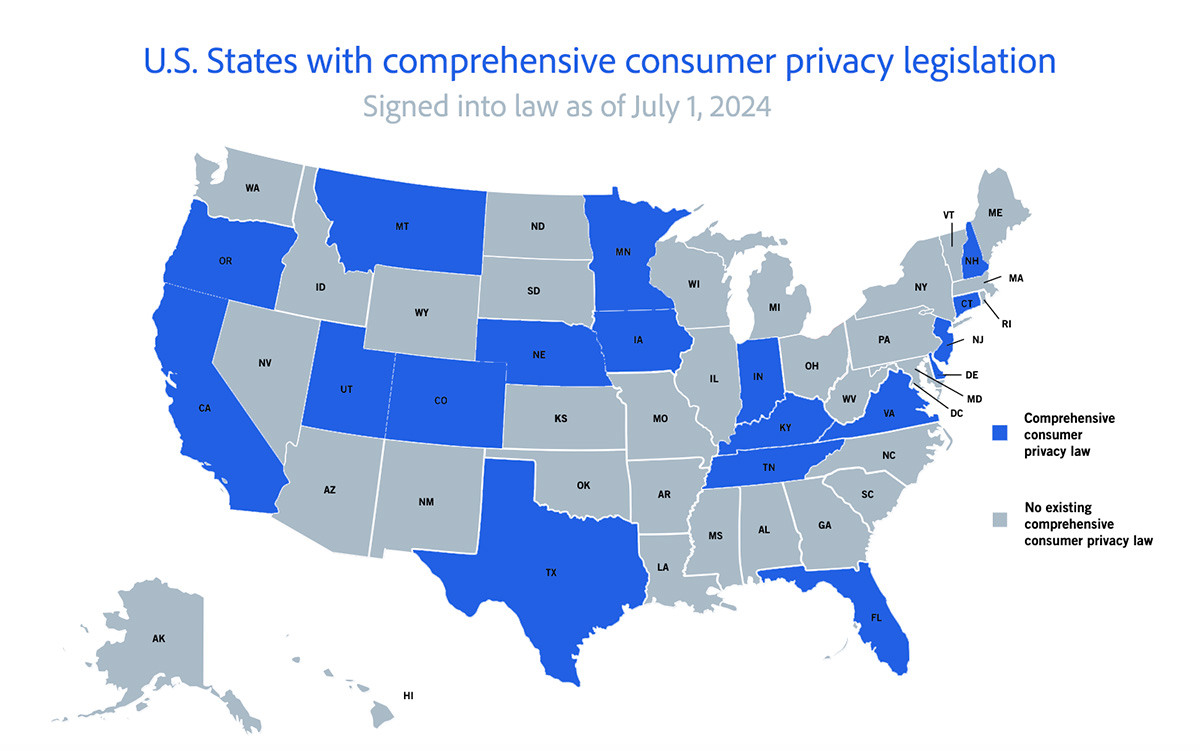
According to the International Association of Privacy Professional’s privacy legislation tracker, eighteen states currently have signed comprehensive consumer privacy bills into law: California, Colorado, Connecticut, Delaware, Indiana, Iowa, Kentucky, Maryland, Minnesota, Montana, Nebraska, New Hampshire, New Jersey, Oregon, Tennessee, and now, Texas.

Texas Data Privacy Act

Rhode Island appears to be next up, as its Data Transparency and Privacy Protection Act passed on June 24, 2024. And Illinois, Louisiana, Massachusetts, Michigan, North Carolina, Ohio, and Pennsylvania all have data privacy bills in either committee, cross chamber, or cross committee.

Interestingly, Vermont’s Data Privacy Act, which passed 139-3 in the House, appears to be dead on arrival after a recent veto by Republican Gov. Phil Scott. Nevertheless, with so many bills coming down the pike, the pressure is certainly on Capitol Hill to enact privacy legislation at the federal level.

Key takeaways

Texas just passed one of the strongest privacy laws in the country, signaling to the folks on Capitol Hill that the state is serious about consumer data privacy.

If legislators in Washington don’t enact a federal data privacy law soon, the headache of complying with a patchwork of state laws will continue for many businesses.  The Texas law is particularly stringent; in fact, as of July 1, it won’t be uncommon for companies to be subject to California and Texas’ data privacy laws, and not many others.

In the wake of the TDPSA, hopefully folks in D.C. are realizing it’s past time for a federal law.  After all, when California and Texas—two state legislatures that don’t often see eye-to-eye—agree that consumer data privacy protections are sorely needed, odds are, they’re onto something.

John Donegan

John Donegan

Enterprise Analyst, ManageEngine

Want to read<br>this article on the go?

Want to read
this article on the go?

Do it on the ManageEngine
Insights app.

Published on October 07, 2023 | 7 min

Introduced by Senator Josh Becker (D-CA), Senate Bill 362, now referred to as the Delete Act, was created to close loopholes in the California Consumer Privacy Act (CCPA).

Under the CCPA, Californians are able to ask individual data brokers to delete any personal information that these brokers have obtained directly from them; however, neither the CCPA—nor the CPRA—requires brokers to delete personal information that has been acquired from third-party sources. Clearly, this is a loophole that does, indeed, need to be remedied.

Becker’s bill cleared the California legislature on September 14. Now, Governor Gavin Newsom has until next week (Oct. 14) to sign the bill, and there’s every indication he will do so.

What will the Delete Act entail?

Assuming Newsom signs the bill, the Delete Act will provide California residents with a one-stop system for data deletion. With a single request, Californians will be able to ensure that ALL their personal data is erased by ALL data brokers operating in the state.

Also, under the Delete Act, the regulation of data brokers will be transferred from the California Attorney General to the California Privacy Protection Agency (CPPA).

Creating this system is a tall task; however, the CPPA has some time. In fact, they have until January 1, 2026, to create the website or mechanism that allows residents to place their deletion requests. Tasked with administrating the Delete Act, the CPPA will enforce data broker registration and ensure that all brokers are deleting Californians’ personal information every 45 days after receiving a valid request.

New obligations for the data brokerage industry

Although it certainly provides new affordances for Californians, the Delete Act also brings a host of new obligations to businesses operating within the surveillance economy. The hundreds, if not thousands, of data brokerages operating in California will see additional workflows and costs.

Essentially, the Delete Act layers on top of the CPRA and strengthens existing data broker legislation. Importantly, the definition of “data broker” will not change under the new law. A data broker is a “business that knowingly collects and sells to third parties the personal information of a consumer with whom the business does not have a direct relationship.” Thus, if a broker has a direct relationship with the consumer, they will most likely not have new obligations under the Delete Act.

As a quick caveat, brokers covered by the Fair Credit Reporting Act, Gramm-Leech-Bliley Act, or the Insurance Information and Privacy Protection Act are exempt.

On an annual basis, all non-exempt data brokerages will now have to disclose metrics, including the number of deletion requests and rejected requests. Every three years—starting in 2028—brokerages will have to undergo an independent audit, proving they have been in compliance with the new law.

Then, most taxing of all, is the brokers’ ongoing deletion obligation. Every 45 days, the brokerage will have to ensure that they have complied with all valid deletion requests. Needless to say, there has been a great deal of pushback from a host of entities in the surveillance realm.

Does the Delete Act go too far?

In my estimation, the short answer is no. However, I would be remiss if I didn’t give the law’s detractors their chance to weigh in. The Consumer Data Industry Association (CDIA), which is a lobbyist group for data brokerage companies, credit bureaus, and background check companies, has been particularly vocal in their opposition to the Delete Act. The CDIA’s website, “No to SB 362,” argues that the new law will harm Californian businesses—and supposedly, Californians as well.

The CDIA claims that small and mid-sized businesses in California will be unable to reach new customers, which will likely be true for some companies, including some digital advertising businesses. The CDIA’s website lists some other potential effects of the Delete Act, such as “blocking law enforcement agencies from using data to investigate crimes,” “erasing the data sets needed by academics to conduct research,” and “preventing government agencies from using data to evaluate and improve public services.” Of course, the CDIA isn’t the only entity claiming that there will be unintended downstream effects of the Delete Act.

Potential unintended consequences of the Delete Act

On September 21, the International Association of Privacy Processionals (IAPP) hosted a LinkedIn Live event with Jessica Lee, a partner at Loeb & Loeb, LLP and Jason Sarfati, chief privacy officer at Gravy Analytics—an enterprise location technology company that provides businesses with data about peoples’ physical movements, among other things.

Despite his clear alliance with the data brokerage industry, Sarfati makes some persuasive arguments during this event. He laments, “It’s regrettable that the benefits to consumers that data brokers provide is so frequently lost in this conversation, and if someone later in time submits a mass opt out request, I regret to say that I don’t think they’re going to be fully aware of the downstream consequences of that.”

Sarfati claims that some data brokerage companies do positive work in the anti-fraud and identity verification spaces. “By number, most data brokers are not part of the advertising or mar-tech ecosystem. There are a host of other data brokers that do great work in the anti-fraud or identity verification world.”

Sarfati continues,

“I truly believe that if an individual submits a mass opt-out request, they are going to be at greater risk at credit card fraud down the line, or they’re going to encounter frequently issues around job applications and verifying their identity because there’s a lot of other companies that just do a lot of work in the background on behalf of others.”

There’s no way to know if those risks are real. It will depend on how the law is written, the nature of the exemptions, and how it is enforced by the CPPA.

One thing is certain—the data brokerage industry is in for a colossal shake-up

Firstly, not all data brokers and companies that rely on their services will be able to remain in business. This isn’t the worst thing, although Sarfati tries to frame it as such. Sarfati opines, “Reducing the availability of third-party data is going to have a chilling effect on competition, and in particular, smaller and medium-sized companies that don’t have access to that rich amount of first-party data.” In response to that, I’d merely shrug.

Personally, I don’t have much empathy for companies with business models that rely on third-party user data. The surveillance economy needs to be disrupted. If some of the smaller players go out of business because they are unable to operate without surreptitiously accessing our third-party personal information, then so be it.

Secondly, we will begin to see a tidal wave of copycat laws at the state level. Just as other states followed California’s lead on earlier data privacy legislation (CCPA and CPRA), other states will follow California’s lead in the data brokerage space.

As dozens of states pass data brokerage legislation, big brokers and lobbyist groups like the Consumer Data Industry Association will begin to clamor for a federal data broker registry and a federal law. In fact, it’s already happening. Sarfati complains, “There needs to be a federal data broker registry. It just doesn’t make sense for us to have piece meal registrations.” I very much agree with him on this front.

Thirdly, given that access to third-party consumer data will dry up, businesses will have to change their business models to garner first-party consumer data. Put differently, brands will start to engage more directly with consumers. As Jessica Lee explains,

“We’re seeing third-party cookies getting sunset. So all these avenues to get additional information about someone to enhance your advertising, marketing, or other personalization efforts, they’re shrinking. And I think it’s also pushing a lot of power to the walled gardens who are not data brokers, who do have a direct relationship with the consumer and have the large volumes of data, and it will push brands to engage there.”

Lee suspects that businesses’ loyalty programs will evolve; not only will they grow larger in scope, but they’ll also focus more on enhancing the first-party consumer data that they’re already collecting. This makes sense.

Key takeaways

Although Sarfati has convinced me that there will be some unforeseen consequences, I ultimately believe the Delete Act is a much-needed crackdown on a largely unregulated industry that operates in the shadows. As Senator Becker succinctly put in his September press release,

“The time of uncontrolled gambling with our personal information is almost over. Data brokers currently have the ability to use data on reproductive healthcare, geolocation, and purchasing data to sell it to the highest bidder, and the Delete Act would protect our most sensitive information.”

If this bill becomes law, then we are moving in the right direction. Moreover, a federal law that quickly follows in the footsteps of the California Delete Act would be even better—both for consumers and the brokerage industry. That said, it’s still early days; we’ll have to wait and see how it plays out.

John Donegan

John Donegan

Enterprise Analyst, ManageEngine

Want to read<br>this article on the go?

Want to read
this article on the go?

Do it on the ManageEngine
Insights app.

Published on July 07, 2023 | 5 min

With a policy vacuum on Capitol Hill, there has been a flurry of state-level activity over the past year. Five more states passed laws in 2023, bringing the total number of state-level data privacy laws to ten.

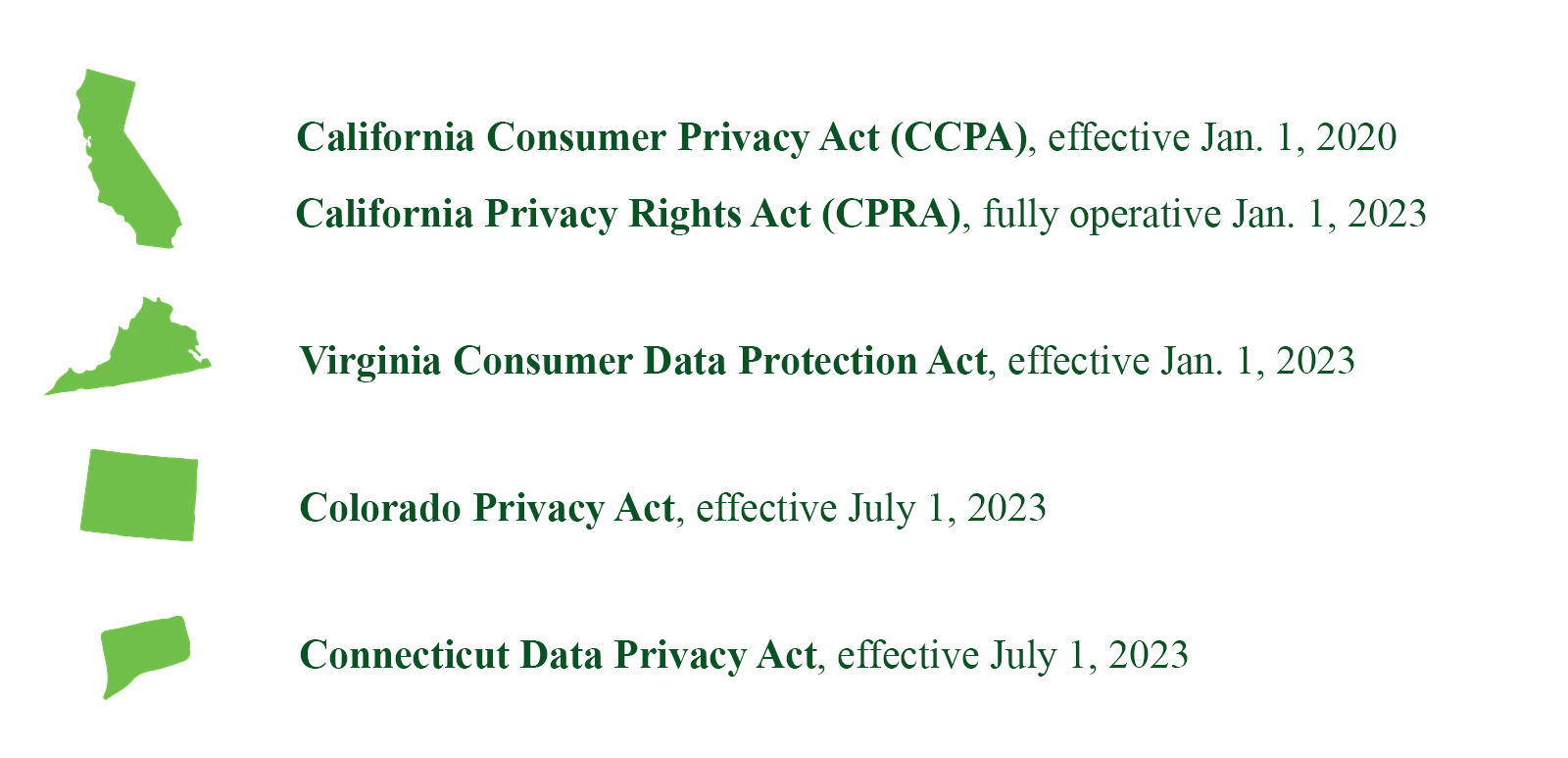
California and Virginia already have operative data privacy laws, and on July 1, laws from two more states—Colorado and Connecticut—came into effect.
CA, VA, CO, CT privacy laws
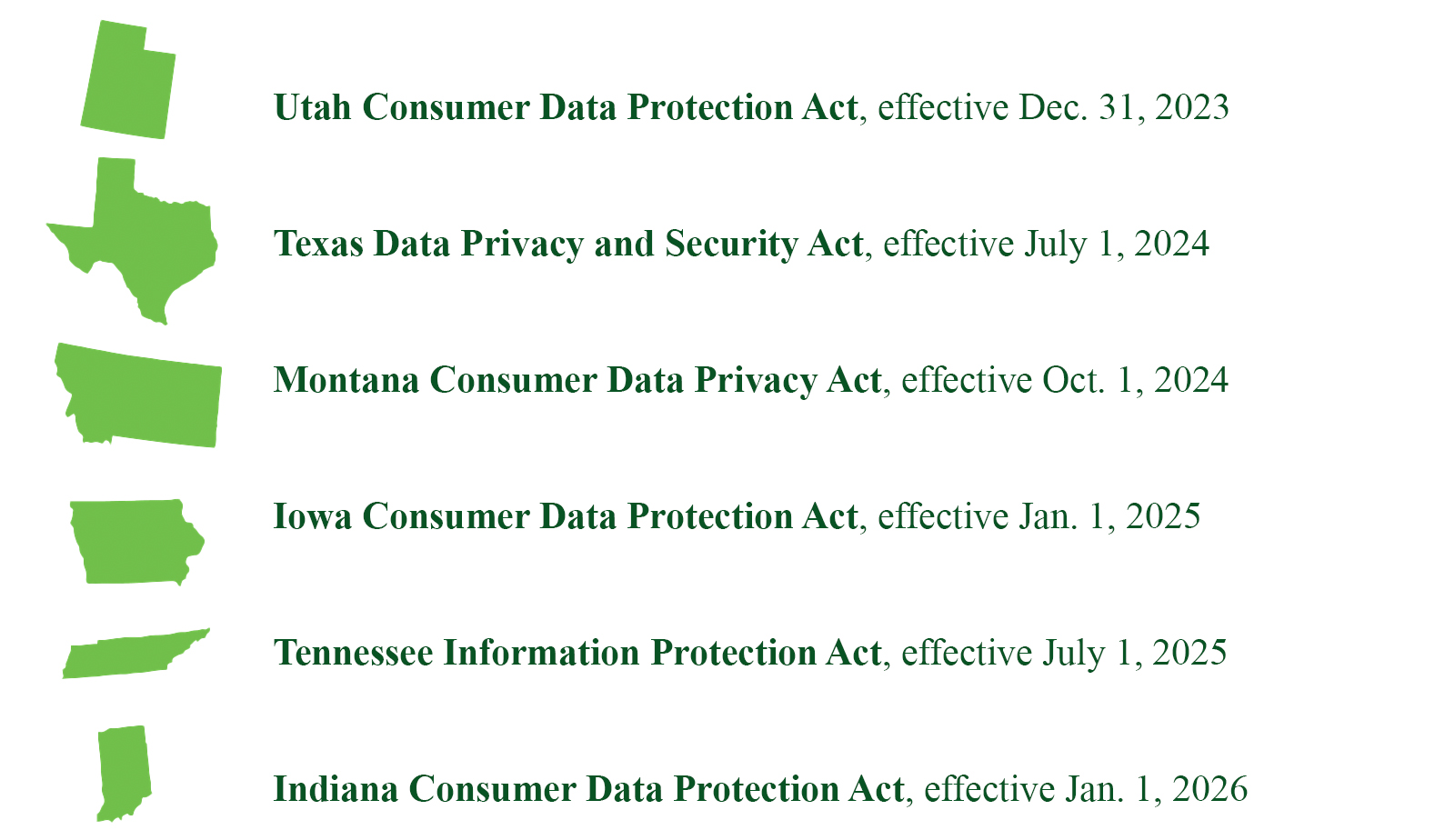
Six other states—Utah, Texas, Montana, Iowa, Tennessee, and Indiana—have passed laws; however, these have yet to take effect. Although these six states are all predominately red, each has different rules related to consumer rights and business obligations. In some cases, the differences are massive.
UT, TX, MT, IA, TN, IN privacy laws
Take Montana, for example. According to recent reporting from Politico, Montana resisted a great deal of Big Tech lobbying. Despite complaints from the State Privacy and Security Coalition, Montana legislators refused to remove “universal opt-out requirements,” which essentially allow Montanans to opt-out of tracking with a single click. Additionally, Montana legislators refused to allow carve-outs for “pseudonymous data,” which would have allowed tech companies to continue to track consumers who have opted out.

Lobbyists advocated for a provision that would have provided companies with time to remedy a violation before accruing a fine; however, it was to no avail, as Republican Gov. Greg Gianforte and bill sponsor Sen. Daniel Zolnikov (R-MT) didn’t take the bait.

Speaking about the lobbyists’ attempts to get him to water down the bill, Zolnikov colorfully said, “I’m not an idiot, and you treating us in Montana like a bunch of rural backwoods folks is quite an insult as well.”

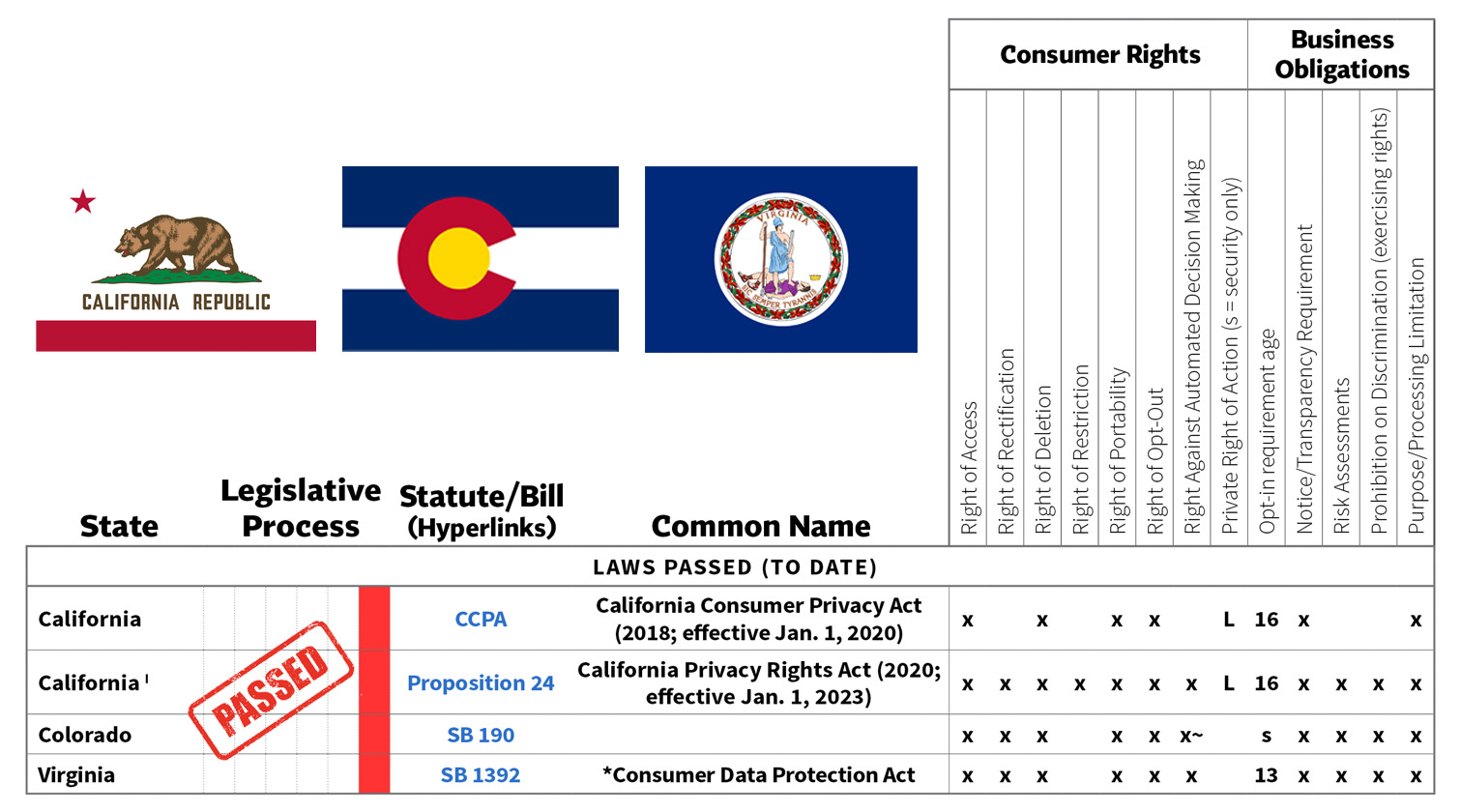
Suffice it to say, it is too simplistic to assume that blue-leaning states offer tougher consumer data privacy legislation than red-leaning states. In an effort to highlight the myriad differences between the states’ data privacy legislation, the International Association of Privacy Professionals (IAPP) provides an excellent chart of all the consumer privacy bills, which they update frequently. It shows the bills’ statuses: Introduced, In Committee, In Cross Chamber, In Cross Committee, Passed, and Signed.

Additionally, the chart highlights the states’ various, and varying, consumer rights—e.g., right to access; right to correct; right to delete; right to opt-out of certain processing; right to portability; right to opt-out of sales to third parties; right to opt-in for sensitive data processing; right against automated decision making, and private right of action, which is essentially the consumers’ right to seek civil damages for a business’ violation of the law.

IAPP’s chart also lists the state laws’ different business obligations—e.g., opt-in defaults, which require businesses to treat a consumer under a certain age with an opt-in default for the sale of his or her personal information; transparency requirements, risk assessments, and processing limitations.

Minimize your data collection, processing, and usage.

I would be remiss if I didn’t point out that the best course of action would be to abstain from collecting, processing, trading, selling, and otherwise handling sensitive consumer data in the first place. If possible, you should comply with the most stringent laws (e.g., CPRA, GDPR) and adhere generally to the principle of data minimization, which states that one should only handle user data that is essential to the task at hand, and only for as long as that task takes.

However, not every company can completely abstain from processing consumer data. For such companies, here are a few ways to navigate the myriad data privacy laws in the states:

Identify which, if any, laws apply to your business.

Each state has a different threshold for companies doing business in its state. There are thresholds that pertain to the number of customers in the state, the percentage of revenue attributable to the sale of personal data, and a minimum number of customers.

For example, the Virginia law—which incidentally was based on a bill drafted by an Amazon lobbyist—only pertains to either (1.) businesses that have at least 100,000 customers in Virginia, or (2.) businesses that have at least 25,000 consumers and make at least 50 percent of its gross revenue from the sale of personal data. Also, if one’s business doesn’t have at least an annual revenue of $25 million, the Virginia law isn’t applicable.

Aside from these basic thresholds, there are many other ways in which a state’s law may not pertain to your business. States have different regulations related to the types of data that an organization is allowed to collect and how that data can be used.

Some states have processing loopholes; for example, laws in Iowa, Utah, and Indiana—some of the weakest in the country—have a rather broad definition of what it means to “sell” user data. If you’re not explicitly charging money for user data in those states, you’re likely in the clear.

Review your service contracts with third-party vendors; frequently update your internal and external privacy policies, and have an incident response plan in case of a cyberattack.

As a best practice, it’s prudent to build data protection clauses directly into the contracts you have with your third-party vendors. Even if it’s not required by law today, it may be down the road. You don’t want to be held liable for data protection mistakes made by your vendors. Also, when in doubt, put things in writing. Auditors—and regulators—need to see written procedures for information collecting practices. Also, have an incident response plan and ensure that your privacy policies are up-to-date and accurate.

Err on the side of caution, and look to California and Europe.

Of the ten state laws in the U.S., California is the most stringent; thus, you’re probably in compliance with the other state-level laws if you comply with the CPRA. However, every business operates differently; these laws are quite granular, and I’m not a lawyer. Thus, in the short term, be sure to have your chief security officer and legal team assess the ten laws.

In the long term, Congress will eventually pass a federal data privacy law. So, if you’re compliant with GDPR in 2023, you’ll most likely be all set by the time the federally mandated bill comes down the pike—whenever that may be.

John Donegan

John Donegan

Enterprise Analyst, ManageEngine

Want to read<br>this article on the go?

Want to read
this article on the go?

Do it on the ManageEngine
Insights app.

Published on September 22, 2022 | 5 min

Unfortunately, we are living in an age in which the mass commodification of consumer data has become commonplace and generally accepted. Companies, and data brokers, can buy and sell the majority of adults’ personal data with impunity.

Aside from the California Consumer Privacy Act (CCPA), which came three years after the E.U.’s General Data Protection Regulation (GDPR), we haven’t seen major U.S. legislation on the personal data front. To be sure, there’s a patchwork of state laws. In addition to the CCPA and California Privacy Rights Act (CPRA), there are the Virginia Consumer Data Protection Act; the Colorado Privacy Act; the Connecticut Data Privacy Act, and the Utah Consumer Privacy Act, to name a few; however, it is time for a strong privacy law at the federal level, and with a few revisions, the American Data Privacy Protection Act (ADPPA) could be this law.

The current state of the ADPPA

On one hand, the ADPPA is far and away the closest the U.S. has ever been to issuing a federal data privacy law; the bill is bipartisan in nature, and it passed the House Energy Commerce Committee with a whopping 53-2 vote. On the other hand, in its current form, this bill does not appear to have much potential. Right now, it can’t get past Speaker of the House Nancy Pelosi, let alone reach the Senate floor.

The main concern held by Pelosi is that the ADPPA would supersede state laws, thus diluting the protections already offered by California’s CPRA and the consumer data protection bills held by other states.

In a September 1 statement, Pelosi writes,

“Governor Newsom, the California Privacy Protection Agency (CPPA), and top state leaders have pointed out the American Data Privacy and Protection Act does not guarantee the same essential consumer protections as California’s privacy laws.”

Likewise, last month the CPPA released a letter opposed to the ADPPA, and in late July, the five-member CPPA board voted unanimously to oppose the ADPPA or any bill that would supersede existing state laws. They write,

“The ADPPA would remove important safeguards that are already available to Californians today and tie the hands of states from improving privacy protections in the future. We urge lawmakers to focus their efforts on ensuring that any privacy legislation follows the model of other federal privacy laws and sets a floor, not a ceiling, on privacy rights.”

A floor, not a ceiling

This exact language was also used by 10 state attorneys general in their open letter to Congress in July. The attorneys general—from California, Connecticut, Illinois, Maine, Massachusetts, Nevada, New Jersey, New Mexico, New York, and Washington — write,

“It is critical that Congress set a federal privacy-protection floor, rather than a ceiling, to continue to allow the states to innovate to regulate data privacy and protect our residents.”

In addition to the preemption issue, these attorneys general believe that states are inherently better suited to respond to technological changes, and there are concerns that the current ADPPA bill compromises the ability of state attorneys general to investigate entities that violate the law.

What exactly is in the current ADPPA bill?

Initially spearheaded by House Energy and Commerce Chair Frank Pallone (D-NJ), Cathy McMorris Rodgers (R-WA), and member of Senate Commerce Committee Sen. Roger Wicker (R-MS), the ADPPA is an attempt to minimize the collection of Americans’ personal data.

Much like the GDPR, this legislation would bolster Americans’ consumer privacy rights, while also holding data collectors accountable for discriminatory data handling practices.

Stronger consumer privacy rights

According to the language in the current bill, the ADPPA provides users with the right to “access, correct, (and) delete” data pertaining to them. Under this bill, most technology companies would be barred from collecting any user data they do not need; only “reasonably necessary” data could be collected. As a caveat, those organizations that are already regulated by existing privacy regulations—such as education, healthcare, and certain financial services companies —would not incur additional compliance burdens from ADPPA.

Additionally, assuming a federal prosecutor isn’t already on the case, individuals would now be able to sue companies for mishandling their data.

More protections for minors

The ADPPA would also provide more protection for minors. Currently, federal privacy laws ban organizations from using personal data to target users under the age of 13; however, the ADPPA would bump this up to 17.

Per Section 205 of the proposed bill, targeted advertising to individuals under 17 is expressly prohibited; entities can’t transfer covered data of individuals to third parties without these individuals’ consent. Put differently, the data of all Americans under 17 would now be defined as “sensitive covered data.”

Public registry of data brokers

Under the ADPPA , which falls under the purview of the FTC, there would be a newly created public registry of data brokers. According to Section 206, data brokers will be required to register with the FTC if they process covered data of more than 5,000 people.

So far, this all sounds well and good. However, in addition to the preemption problem (the potential for the ADPPA to supersede the CPRA and other state laws), there are a number of problematic loopholes in the current bill.

Loopholes

Other than the creation of a registry, the ADPPA continues to let data brokers operate with impunity. Despite this, the proposed bill has instigated a lobbying surge from the data brokerage industry.

Also, the language of the bill provides a few problematic carve-outs. “Covered data” does not include “de-identified data,” “employee data,” or “publicly available information.” The exception for “de-identified data” is particularly problematic because, as we have seen time and again, data can get de-identified and re-identified.

Also, there are loopholes for law enforcement. The bill reads,

“A covered entity may decline to comply with a request to exercise a right described in subsection (a), in whole or part, that would…interfere with law enforcement, judicial proceedings, investigations, or reasonable efforts to guard against, detect, or investigate malicious or unlawful activity, or enforce valid contracts.”

In most cases, law enforcement agencies would still be allowed to collect biometrics, genetic information, and “known nonconsensual intimate images.” Seeing as federal law enforcement agencies are one of the biggest purchasers of Americans’ data, these loopholes should not be taken lightly.

In summary

There is little doubt that the collection of Americans’ personal data needs to be reined in. A federal data privacy law is certainly welcome. That said, it is important that Congress passes legislation that sets a floor, rather than a ceiling, for Americans’ privacy rights. Any federal law needs to encourage and respect existing, protective laws at the state level.

There is an inherent risk that a federal law could be amended and watered down in the future; so, just as the CPRA cannot be amended unless those amendments further protect Californians, any federal data privacy law needs to guarantee the same.

Lastly, the carve-out for de-identified data needs to be addressed, and although a public registry is nice, we would be better served by an actual crackdown on the data brokerage industry. At any rate, we’re moving in the right direction with this bill.

John Donegan

John Donegan

Enterprise Analyst, ManageEngine

Want to read<br>this article on the go?

Want to read
this article on the go?

Do it on the ManageEngine
Insights app.

Published on July 20, 2021 | 4 min

Not to be outdone by California and Virginia, legislators in Colorado recently passed a data privacy law, making Colorado the third state with comprehensive data privacy legislation. Bill SB 21-190 unanimously passed the Colorado state Senate on May 26. Then, with a vote of 57-7, the state legislature passed it on June 8, and it was signed into law by Governor Jared Polis early this month.

Although the Colorado Privacy Act (CPA) closely mirrors Virginia’s Consumer Data Protection Act (CDPA) and California’s CPRA, it is not a direct copy of these laws.
CA, CO, VA¹ — CPRA’s right of restriction/limitation is only applicable to sensitive personal data; * — Continued to 2021 Special Session; ~ — Right to opt out of certain automated decision-making activities

Consumer benefits of the Colorado Privacy Act

Much like the CPRA, the CPA allows consumers to opt out of the processing of certain personal data. Consumers have rights of data access, correction, deletion, and portability. This means that consumers can access their data up to twice per calendar year. They can delete their data, correct any inaccurate information, and move their personal data from one location to another, if they choose to do so. That said, there are a few exemptions to these rules.

Businesses’ obligations under the CPA

The CPA pertains to any company that conducts business in Colorado and meets one of the following two criteria: (1) The company controls or processes personal data of at least 100,000 consumers; or (2) the company receives revenue from the sale of personal data of at least 25,000 consumers.

These companies, or “controllers” as they’re called, must conduct data protection assessments for certain types of data processing. These assessments are mandatory for any processing that presents a heightened risk of harm, including the processing of sensitive data; processing data for targeted advertising, and processing data to sell to a third party. As a caveat, companies can always process their consumers’ sensitive data if the consumers choose to opt-in.

Under the CPA, controllers also have the following obligations:
• A duty of transparency, whereby controllers must provide privacy policy disclosures to their consumers.
• A duty of purpose specification, which mandates that controllers explicitly state their purposes for collecting and processing customer data.
• A duty of data minimization, which requires that controllers only collect the customer data that is reasonably necessary.
• A duty to avoid secondary use, which essentially means that the controllers cannot process the customers’ data for any reason(s) other than the controllers’ specified purposes—unless, of course, consent is obtained.
• A duty of care, whereby controllers must implement reasonable measures to secure their customers’ data.

Exemptions, exclusions, and enforcement

It’s important to note that there are a few exceptions to the aforementioned business obligations. Publicly available information, employee data, and de-identified data are all exempt from the CPA. Also, any data governed by federal laws, such as the Health Insurance Portability and Accountability Act (HIPPA), the Gramm-Leach-Bliley Act (GLBA), the Children’s Online Privacy Protection Act (COPPA), and the Securities Exchange Act of 1934 are not subject to CPA, as these federal privacy laws take precedence.

Colleges, non-profits, and state and local governments are also exempt from CPA. Additionally, certain processing activities are excluded from the CPA, including detecting fraud or illegal activity, and conducting internal research to develop products.

Perhaps the most egregious omission in the CPA lies in its enforcement. Unlike the CPAA, there is no private right of action clause in the CPA, making it difficult for individuals to sue companies. Consumers must rely on the Colorado Attorney General or the District Attorney’s office to handle enforcement.

Lastly, from January 1, 2023, (when the CPA goes into effect) to January 1, 2025, companies will have a 60-day window to address and remedy any infractions before the Colorado AG or DAs are able to hit them with a violation. On January 1, 2025, this 60-day “cure period” will be automatically repealed.

Important takeaways

Although the Colorado law will not be enforced until January 1, 2023, companies should adhere to its statutes as soon as possible. Until the U.S. gets a federal data privacy law, these state-level data privacy laws will continue to come down the pike.

The growing patchwork of US data privacy laws will only get more confusing for businesses that ignore them, or choose to operate differently in various states. The most prudent thing to do is to voluntarily comply with the most rigorous data privacy regulation in the US and then practice that compliance in all 50 states as soon as possible. By doing so, businesses can be sure to avoid expensive fines, interruptions to their business operations, and general aggravation in early 2023.

— Chart via IAPP.org and featured image via Andrew Coop, Unsplash

John Donegan

John Donegan

Enterprise Analyst, ManageEngine

Want to read<br>this article on the go?

Want to read
this article on the go?

Do it on the ManageEngine
Insights app.

Published on February 02, 2021 | 5 min

Passed on November 4, 2020, Proposition 24—now known as the California Privacy Rights Act (CPRA)—amends and bolsters the existing CCPA. The CPRA, which can be thought of as CCPA 2.0, makes data minimization a must for any business that does business in California, collects consumer data, and satisfies one of the following: has over $25m in annual revenue; makes more than half of its revenue from the sale of consumer data; or processes the personal information of more than 100,000 California residents or households.

The CCPA has been enforced since July 1, 2020, and enforcement of the CPRA is set to begin in July of 2023; however, there is a “look back” period that begins on January 1, 2022. Any data collected after this date will be subject to the CPRA, so if business leaders are not doing so already, they should prepare for the new obligations.

California Consumer Privacy Act (CCPA) vs. California Privacy Rights Act (CPRA)
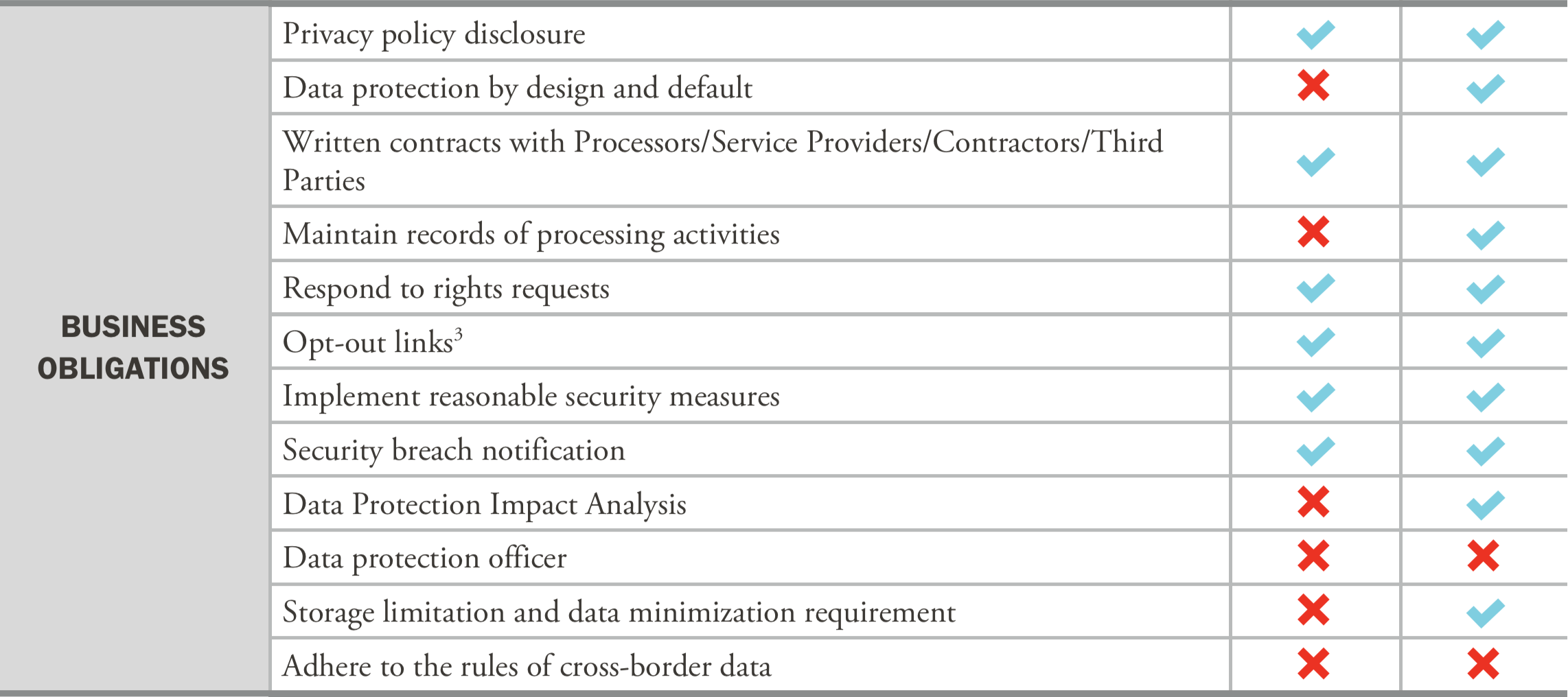
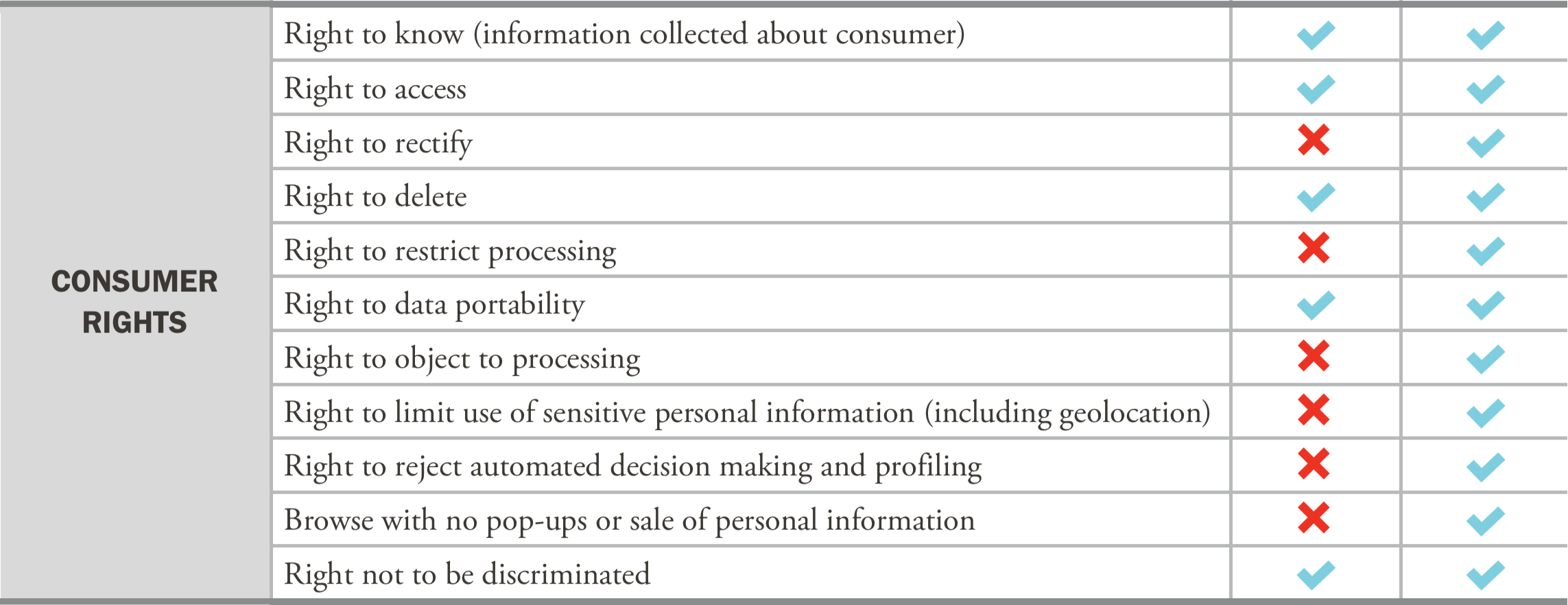
California Consumer Privacy Act (CCPA) v. California Privacy Rights Act (CPRA)
1. B2B and employee information exempted until Jan 1, 2022; 2. B2B and employee information exempted until Jan 1, 2023.

With a new category for “sensitive personal information,” data minimization is vital

Already a core component of the GDPR, data minimization is set to become an important part of the CPRA. According to Section 1798.100(c), the CPRA prevents businesses from collecting more personal information than is “reasonably necessary and proportionate to achieve the purposes for which the personal information was collected or processed.” Likewise, businesses are not to retain such personal information for any longer than is reasonably necessary [Section 1798.100(a)(3)].

The CPRA creates a new category for “sensitive personal information.” This includes social security numbers, driver’s license numbers, precise geolocation data, race, ethnicity, religion, sexual orientation, union membership, philosophical beliefs, genetic data, biometrics, and other health information. This is an extremely broad definition, making corporate data minimization (and data mapping) more important than ever.

The corporate liability for data breaches expands

Under the CPRA, data breaches will be particularly painful for companies that see their customers’ personal information compromised. The CPRA expands the existing law, allowing customers to bring legal cases against a company if their email address, password, or any other personal information is compromised during a breach.

California Consumer Privacy Act (CCPA) v. California Privacy Rights Act (CPRA) 33. The CPRA expands the CCPA’s “Right to Opt-Out” to include not only the sale, but also the sharing of personal information. Businesses that share personal data are “covered businesses,” regardless of whether these businesses make money from this sharing.

The creation of a new watchdog group

Perhaps the most obvious new provision of the CPRA is the creation of a new government agency tasked with handling compliance and enforcing the law. This California Privacy Protection Agency (CPPA) will be comprised of a five-member board, which will be announced later this year. Additionally, there will be a Chief Privacy Auditor who will be responsible for auditing businesses and liaising with European data protection agencies. Working on a three-pronged front, the agency will be tasked with additional rule-making, enforcement of the law, and some education initiatives. In regard to the education component, the agency will periodically allocate some of its annual budget to educating consumers and businesses about CPRA compliance.

We can expect to see more audits under the CPRA

If an organization processes enough personal information to be deemed a significant risk to consumer privacy or security, the aforementioned agency and the Chief Privacy Auditor will conduct an annual cybersecurity audit of the organization. Additionally, all high-risk organizations will be mandated to submit regular risk assessments to the agency as well.

California Consumer Privacy Act (CCPA) v. California Privacy Rights Act (CPRA) 4

With new provisions for automated decision-making technologies, consumer rights are bolstered

Under the CPRA, for the first time, consumers can opt-out of automated decision-making technologies. Consumers can inquire about the nature of the AI-based models your organization is using, as well as how their personal information is being used in such models. If any consumers object to their inclusion in these models, organizations must remove these customers’ data.

Consumers have more ways to restrict corporate data processing

Whereas the CCPA currently requires businesses to include a “Do not sell my information” link, the CPRA takes things a step further, mandating a “Do not sell or share my personal information” link, as well as a “Limit the use of my sensitive personal information” link.

The inclusion of “sharing” is an important modification of the CCPA. Under the CPRA, now covered businesses are responsible for not only the selling of consumer data, but also the sharing of such data. This includes any sharing of consumer data “to a third party for cross-context behavioral advertising, whether or not for monetary or other valuable consideration.” [Section 1798.100(a)(3)]

California Consumer Privacy Act (CCPA) v. California Privacy Rights Act (CPRA) 2*Charts from Frost, Brown, Todd LLC

How best to prepare for the CPRA

If you’re already in compliance with the GDPR, you likely won’t have too much to worry about when the new regulatory agency begins enforcing the CPRA in July 2023. That said, the “look back” period is less than a year away, so it’s important to review your CCPA compliance and, if necessary, revamp your processes to meet the new requirements of the CPRA. Below are some suggested steps to take to ensure that your business will be ready.

1. Cut out all superfluous data collection. Much like the GDPR, the main goal of the CPRA is to ensure that organizations do not collect any more customer data than they need. As a best practice, be sure to only collect information on your customers that you absolutely need; make sure you only collect that data for the purpose in which you need it, and don’t keep any of this data for any longer than necessary.

2. Create a data inventory. Through the creation of a data inventory, you can maintain a handle on your data at all times. With a data inventory, you’ll know exactly what personal information has been collected and, importantly, why it’s been collected.

A data inventory will also help you account for retention periods—how long is the data being collected?—as well as the involvement of any third-party recipients—is the data being shared with any other organizations? To be sure, the creation of a data inventory is a crucial step in CPRA compliance, as it helps with audits and subjects’ access requests. It also helps you know exactly which applications and systems the consumer data is on, as well as whether these apps and systems are internal or external.

3. Track the trajectory of your collected data. Before the CPRA comes into effect, be sure to have your data flows in order. With data maps and data flow diagrams, you can effectively track the trajectory of your data. As mentioned earlier, companies need to ensure they are keeping track of any data that qualifies as “sensitive personal information” under the CPRA’s new definition.

Conclusion

Overall, the CPRA expands upon the CCPA, as it bolsters consumers’ rights; accounts for new algorithmic decision-making technologies, and takes a more comprehensive view of what qualifies as “sensitive personal information.” It also creates a new regulatory agency and expands the corporate liabilities for data breaches. To put it simply, if corporations are not already taking consumer data privacy seriously, they need to start. Although the law passed earlier in the year, it will not be enforced until January 2023. Nevertheless, we’ll keep you up to date on any additional changes as they come along.

John Donegan

John Donegan

Enterprise Analyst, ManageEngine

Want to read<br>this article on the go?

Want to read
this article on the go?

Do it on the ManageEngine
Insights app.

Published on December 08, 2020 | 3 min

If Proposition 24, now known as the California Privacy Rights Act of 2020 (CPRA), is a harbinger of things to come, we’re about to see more AI legislation. Not only does the CPRA establish a new privacy protection regulation agency, expand the definition of personal information, and create new transparency requirements, the law also explicitly addresses algorithmic decision-making. The CPRA, which passed last month, expands the California Consumer Privacy Act (CCPA) and greatly bolsters consumers’ data privacy rights. It doesn’t take effect until January 1, 2023, so businesses have time to make the necessary adjustments.

The CPRA takes aim at AI-based models

Unlike the CCPA, the CPRA explicitly addresses AI-based models’ processes. Consumers have new rights under the CPRA, including the right to access information about companies’ automated decision-making, as well as the right to opt-out of these automated decision-making technologies. This is significant.

Consumers can inquire about the logic involved in the AI’s decision-making, and they can also request that their data not be included in these technologies. Generally speaking, this law is part of a much-needed, noble effort to stop businesses from misusing consumers’ sensitive personal information; to be sure, businesses need to cease tracking consumers across devices, and across unrelated businesses. As it stands, even with this new law, there’s still a woefully inadequate amount of oversight of how businesses handle consumer data—especially data used in algorithmic decision-making. However, it appears this is likely to change.

New AI regulatory initiatives are coming down the pike in Europe

California’s legislators have modeled much of their data privacy laws on the legal work being done on the other side of the pond. After all, the European Commission, which brought us the General Data Protection Regulation (GDPR), first drafted their Ethical Guidelines for Trustworthy AI back in December 2018. Although these guidelines are not legally binding, they served as a first step toward legislation.

Assessment List for Trustworthy AI

In July 2020, the EU’s high-level expert group on AI (AI HLEG) revised and published their final “Assessment List for Trustworthy AI (ALTAI),” which is based on seven key requirements:

  1. Human agency and oversight
  2. Technical robustness and safety
    a. Resilience to attack and security
    b. General safety
    c. Accuracy
    d. Reliability, fall-back plans, and reproducibility
  3. Privacy and data governance
  4. Transparency
    a. Traceability
    b. Explainability
    c. Communication
  5. Diversity, non-discrimination, and fairness
  6. Environmental and societal well-being
  7. Accountability
    a. Auditability
    b. Risk management

Not only does the ALTAI offer a checklist for AI designers, developers, compliance officers, and data scientists to follow, but it also offers insight into the nature of the legislation that is on the horizon. Again, the ALTAI did not arise out of a vacuum; like the CPRA, it too builds upon the privacy laws that were concurrently put forth in the GDPR.

The GDPR and AI regulation

Although the initial GDPR document does not explicitly make reference to algorithmic decision-making or AI systems, it does mandate the regulation of processing of personal data, regardless of which technology is used. As many lawyers and analysts have noted, any processing of personal data through an algorithm undoubtedly falls within the scope of the GDPR; nevertheless, European Commission president Ursula von der Leyen has vowed to push supplementary legislation regarding AI.

To that end, the Center for Information Policy Leadership (CIPL), a Washington, D.C.-based privacy and security policy think tank, cautions against too much legislation. In their March 2020 white paper, “Artificial Intelligence and Data Protection: How the GDPR Regulates AI,” CIPL analysts contend that “the GDPR already extensively regulates AI,” and any regulatory group that intends to govern AI must take the GDPR into consideration to avoid saddling businesses with unnecessary or conflicting obligations. This is a fair point.

Conclusion

As consumers increasingly recognize the importance of data privacy, and AI systems proliferate, we are in for some AI regulatory intervention. In fact, the two phenomena are undoubtedly intertwined. It’s vital that consumers formally agree to provide their data for inclusion in companies’ algorithmic decision-making—and that consumers understand how their data is being used.

Unfortunately, companies do not have a good track record of self-regulation, so formal AI legislation will definitely be necessary. When it comes to emerging technologies, lawmakers are generally playing catch-up, so it will be interesting to see how quickly such laws can come to fruition.

John Donegan

John Donegan

Enterprise Analyst, ManageEngine

Want to read<br>this article on the go?

Want to read
this article on the go?

Do it on the ManageEngine
Insights app.

Published on November 24, 2020 | 4 min

With all the curveballs 2020 has thrown our way, one thing that has become clear is that in order to survive, businesses need to be able to respond to disruptions quickly. While many companies collapsed due to the fallout of the pandemic, the ones that didn’t—the ones that managed to survive or, in fact, thrive—are the ones that were able to think on their feet and connect with their customers. One of the most important elements of building a great customer relationship program is personalization. To remain competitive, organizations need to be responsive and provide a personalized customer experience (CX) that their end users can relate to.

When done right, personalization can yield increased engagement, greater mindshare, and enhanced customer loyalty. The market demands this personalization too, as it makes customers feel like a business understands their needs and values their input. A recent research report published by SmarterHQ found that 72 percent of consumers say that they now only engage with marketing messages tailored to their interests. This goes to show how important it has become for businesses to connect with their customers.

However, it’s important to keep in mind that the success of a personalized CX program depends on how much customers trust the company. To build a truly personalized experience, organizations need access to data that they can use to gather actionable insights. The trust that organizations will need to establish then hinges on their ability to exhibit fair practices, accountability, and transparency when it comes to data processing.

A matter of values

Global markets have become a veritable battlefield, with organizations vying for consumers’ attention. Given the dynamism of consumer behavior patterns and the unpredictability of market conditions, customer relationships are forged on one-on-one engagement. In order to build that reliable connection with consumers, organizations need to tap into customer preferences—how they act, feel, and behave. This intelligence is gathered from user data collected at various stages of the customer journey.

If consent is sought in the appropriate manner, consumers are usually okay with their data being collected and processed as long as they benefit from it. The SmarterHQ report also found that 90 percent of consumers are willing to share behavioral data if it results in a cheaper, easier shopping experience.

Now, what constitutes value will obviously differ slightly from customer to customer. Here’s where the real intelligence comes in. How do organizations leverage user data in a way that allows them to deliver maximum value to consumers? Success in personalization starts with ensuring that the organization has data that matches its business goals. This could be biographical information, data derived from how consumers engage with services or offerings, web cookie data, or survey findings—and it all must come from reliable sources.

So, this is where transparency in consent and communication preference management practices comes in. While consumers understand the trade-off involved in sharing their data with companies in exchange for value, the relationship can quickly turn sour if data is utilized in a manner that the consumer wasn’t explicitly made aware of or did not consent to.

Where data privacy and personalization intersect

Today there is heightened consumer awareness regarding how data is collected, used, and shared. Rather than looking at this shift in awareness as a deterrent, businesses need to realize that this provides a new opportunity to enhance their relationship with their customers. Consumers are more willing to share their data when they implicitly trust that, in addition to the value they’ll receive, their data will also be used only for purposes clearly stated by the company.

“Consent data”, which is information collected through an honest and transparent process, should form the cornerstone of an organization’s personalization strategy. This data needs to be obtained directly from the end user, who’s made fully aware of the intended use and potential benefits of the data. The end user needs to be informed about what data is being collected, why it is being collected, how long it will be stored or utilized, and who it will be shared with. Additionally, the practice of keeping the customer informed is not a one-time activity to be carried out at the time of data collection; this needs to be an iterative process wherein the consumer is consistently kept informed throughout the data life cycle.

When organizations use consent data, they not only improve their CX but also drive product innovation and marketing effectiveness. Brands that incorporate this transparency foster a sense of mutual trust, respect, security, and privacy with their clients. Organizations also need to keep in mind that consumer preferences can change over time, so opt-in and opt-out options should be provided at different checkpoints to give consumers control over their personal data throughout the customer journey. Lastly, businesses should incorporate the principle of privacy by design into all their business practices. This enables organizations to anticipate privacy issues and avoid them.

The bottom line is that privacy and personalization can definitely coexist, provided organizations are willing to be fair and transparent about their practices. Consumers have the power to decide whether the privacy-benefit trade-off is worth it and, if it’s not, take their business elsewhere. With user data privacy regulations such as the GDPR and the CCPA on the rise, businesses will either need to ensure that they are utilizing data judiciously or risk falling behind.

Priyanka Roy

Priyanka Roy

Senior Enterprise Evangelist, ManageEngine

Want to read<br>this article on the go?

Want to read
this article on the go?

Do it on the ManageEngine
Insights app.

Subscribe to CCPA

Thanks for subscribing to ManageEngine Insights. If you do not receive our welcome email, please check your SPAM folder.