
Published on May 14, 2026 | 7 min

The United States needs a federal consumer data privacy law, but not one like the recently proposed SECURE Data Act.

On April 22, Republicans on the House Energy and Commerce Committee introduced the SECURE Data Act (H.R. 8413), making it the first attempt at comprehensive privacy legislation in years; unfortunately, the bill is a disaster, as it would erase too much state-level progress.

The main problem with the SECURE Data Act is the issue of federal preemption. The bill would preempt all state legislation, effectively eviscerating strong state legislation like California’s CCPA (2018) and CPRA (2020).

The preemption problem

Nobody, myself included, wants businesses to have to deal with a patchwork of data privacy laws. We absolutely need a federal data privacy law on the books. That said, any federal law should build on top of state-level laws; it shouldn’t dilute existing laws, rendering them unenforceable, and erasing years of state-level legislative work.

As of May 2026, the U.S. has comprehensive privacy legislation in 21 states: Alabama, California, Colorado, Connecticut, Delaware, Indiana, Iowa, Kentucky, Maryland, Minnesota, Montana, Nebraska, New Hampshire, New Jersey, Oklahoma, Oregon, Rhode Island, Tennessee, Texas, Utah, and Virginia.

Of course, there is a great deal of nuance here, as some states have stronger laws than others. Nevertheless, any proposed federal law should be treated as a floor to build on top of these state-level laws, rather than a ceiling.

I agree with the Electronic Frontier Foundation’s Mario Trujillo, who writes, “Federal privacy laws should allow states to build ever stronger rights on top of the federal floor. Many federal privacy laws allow this, including the Health Insurance Portability and Accountability Act (HIPAA).”

Which businesses are affected

The proposed bill would apply to all businesses subject to the FTC Act, as well as all businesses in the U.S. that process the personal data of 200,000 U.S. consumers or more.

Additionally, there’s another standard that would affect other businesses; any business that processes the data of more than 100,000 U.S. consumers and derives more than 25% of revenue from selling that data would also be subject to the SECURE Data Act.

As it stands, the proposed bill exempts businesses with less than $25m in adjusted gross annual revenue.

Key provisions of the bill

The SECURE Data Act mandates that U.S. consumers be given a clear mechanism to opt out of targeted advertising practices as well as the sale of their personal data.

Were the bill to pass, many businesses that process and control consumer data would be forced to obtain opt-in consent before they processed any sensitive consumer data, including geolocation, financial information, and health data. Also, the bill would require businesses to get parental consent before processing the personal data of kids aged 13-16.

Data broker registry

This is my favorite part of the proposed bill. The SECURE Data Act would create a federally mandated data broker registry. Maintained by the FTC, this registry would require many data brokers to register every year and disclose all of their data collection and sales activities.

All data brokers that make over 50% of their profits by selling our personal data would be forced to register in the FTC’s public database. This is a wonderful development.

Enforcement

Here is where things get problematic for privacy advocates. The SECURE Data Act mandates that all enforcement be handled by the FTC and state attorneys general.

Particularly problematic for most privacy advocates, the proposed bill doesn’t include a private right of action, meaning that consumers cannot file civil suits against law-breaking companies. Only the FTC and state attorneys general can enforce the SECURE Data Act.

Moreover, the proposed bill includes a “45-day notice-and-cure provision,” which basically means that if a company is caught breaking the law, they have 45 days to “cure” any violation with no penalty.

Personally, for me, the lack of a private right of action isn’t a deal-breaker. And I think future iterations of this bill can reach a compromise on this issue.

No private right of action

Although privacy rights activists are up in arms about the lack of a private right of action, Electronic Privacy Information Center (EPIC) Deputy Director and Policy Director Caitriona Fitzgerald suggests that a compromised version of a private right of action could be reached down the line.

As Fitzgerald writes, “Previous bipartisan privacy proposals, such as the American Data Privacy and Protection Act and the American Privacy Rights Act, proposed a compromise version of a private right of action that allowed for injunctive relief so that consumers could force companies to stop violating the law, but did not allow for statutory damages.”

I think such a “compromise version” of a private right of action could get future iterations of this bill across the finish line.

The issue of “notice and choice” and burying fine print in the privacy policy

Another important issue to highlight is “notice and choice”; this is a common model in data privacy that allows companies to collect our data as long as they tell us what they’re doing with it (and they give us an option to opt-out.)

The problem with “notice and choice” is that sometimes exactly how the data is being used is buried in the companies’ privacy policies. And who reads these?

Also, many times, the consumers’ choice to allow data collection is bundled with the service itself, creating a take-it-or-leave-it situation.

Alternatively, companies sometimes combine user consent for necessary data collection (e.g., a navigation app needing our location data in order to provide us with directions) with totally unrelated uses (e.g., selling our location data to third-party advertisers or data brokers).

A far better policy is to mandate that companies adhere to data minimization requirements. For example, some state-level laws prevent companies from collecting consumer data beyond what is necessary to fulfill the requested service. This way, even if the consumer technically gives his or her consent, it is still illegal for companies to surreptitiously over-collect and profit from that user’s data in other ways.

The SECURE Data Act perpetuates the notice-and-choice model, as opposed to requiring that companies adhere to data minimization. This is a shame.

Maryland’s data privacy law has an excellent data minimization standard, as did two other previous bipartisan federal bills: American Data Privacy and Protection Act (ADPPA) and American Privacy Rights Act (APRA). It’s too bad the SECURE Data Act didn’t have such a standard.

Support for the SECURE Data Act

I’d be remiss if I didn’t point out that many folks are happy with the proposed bill. As an example, Adam Thierer, a senior fellow at the R Street Institute, was excited to see the bill not include a private right of action. Thierer writes, “Importantly, the SECURE Data Act wisely does not include a PRA, which would only exacerbate America’s growing over-litigation problem.”

And of course, many lobbyists and lawmakers are rejoicing at the chance to dilute the CPRA and other state laws. For example, advocacy group Americans for Tax Reform and twenty-three other center-right groups are particularly excited by the prospect of the SECURE Data Act passing.

The self-proclaimed center-right groups collectively write, “If all 50 states move forward with their own privacy laws, it could cost the American economy over $1 trillion in the next decade, with $200 billion of that burden falling on small businesses.” These 24 groups want to see “strong preemption, with no private right of action and no open-ended rule-making authority for federal agencies or additional state regulations.”

My take

I agree with the EFF’s contention that “the bill is weaker than congressional proposals in prior years, as well as most of the 21 state consumer privacy laws already on the books.”

The fact that the SECURE Data Act preempts existing state-level laws ultimately makes this a bad bill.

Aside from the federal preemption problem, which is a deal-breaker in and of itself in my mind, there are several other issues with the SECURE Data Act. As it stands, the bill perpetuates the “notice and choice” status quo, allowing organizations to obfuscate how they process consumer data, as they bury the specifics deep in their corporate privacy policies. Given that few consumers bother to read or understand corporate privacy policies, data minimization provisions would be much better than this “notice and choice” approach.

Unlike other privacy advocates, I am less concerned about the bill’s failure to include a private right of action. That’s not a deal-breaker for me. However, I am inclined to agree with EPIC’s Fitzgerald, who writes, “The combination of minimal consumer protections, weak enforcement, and insanely expansive preemption of state laws makes the SECURE Act a disaster for Americans’ privacy.”

That said, there are some great things inside the proposed SECURE Data Act. I particularly like the call for a federal data broker registry. It’s refreshing to see politicians on both sides of the aisle ready to crack down on the data brokerage industry, a particularly pernicious part of the data surveillance apparatus.


Related reading

John Donegan

John Donegan

Enterprise Analyst, ManageEngine

Want to read<br>this article on the go?

Want to read
this article on the go?

Do it on the ManageEngine
Insights app.

Published on November 21, 2025 | 6 min

The government shutdown may be over, but there won’t be much federal data privacy legislation being passed in 2026. Given the current dysfunction in Congress, the onus will continue to fall onto the states.

In fact, 8 states—Delaware, Iowa, Maryland, Minnesota, Nebraska, New Hampshire, New Jersey, and Tennessee—have already enacted new data privacy laws in 2025. According to the IAPP Weston Research Center, there are now 19 states with comprehensive data privacy laws on the books. As a quick caveat, different trackers have different qualifications; some trackers list 20 states and include Florida.

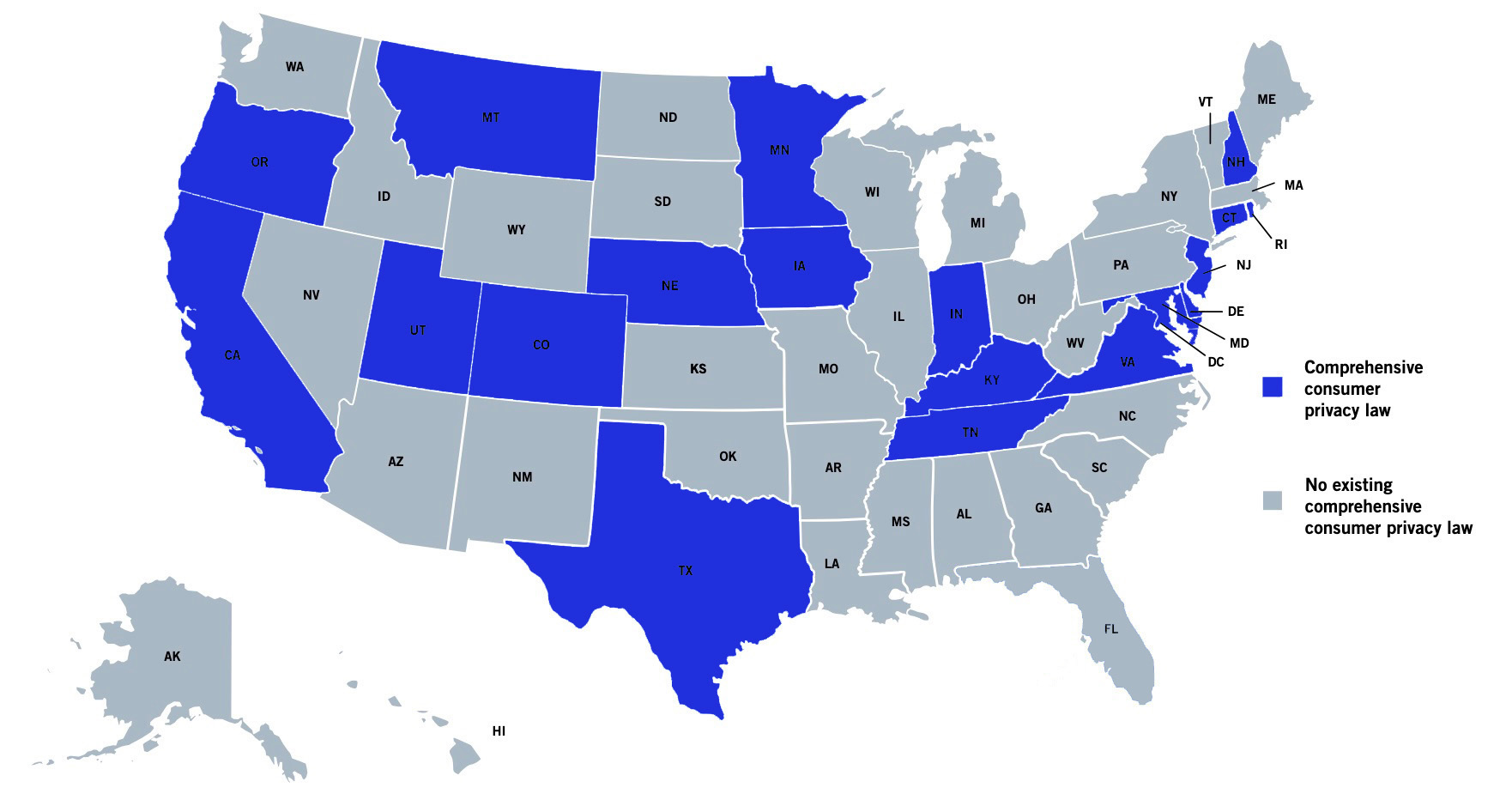
As seen above, the 19 states are California, Colorado, Connecticut, Delaware, Indiana, Iowa, Kentucky, Maryland, Minnesota, Montana, Nebraska, New Hampshire, New Jersey, Oregon, Rhode Island, Tennessee, Texas, Utah, and Virginia.

Although similar bills in Alabama, Georgia, Oklahoma, Maine, and Vermont failed to pass in 2025, other states—Massachusetts, Michigan, North Carolina, Pennsylvania, and Wisconsin—are currently considering data privacy legislation. Moreover, new laws from Indiana, Kentucky, and Rhode Island are expected to arrive in 2026.

Of the 19 states with comprehensive data privacy laws, 9 states (more specifically, 10 regulators across 9 states) have joined the Consortium of Privacy Regulators, a bipartisan initiative formed last April to protect consumers across different jurisdictions.

State-level data privacy bills generally include both protections for consumers and obligations for businesses. On the consumer side, these state laws allow consumers to control how their data is collected, stored, and shared with other parties. These rights—e.g., consumers’ right to delete, correct, and opt-out of data collection—are similar in nature to provisions in the GDPR and CCPA. On the business side, organizations are often obligated to adhere to various data minimization requirements.

Of course, not all states’ data privacy bills are created equal

Big Tech lobbyists have historically been extremely adept at watering down state-level bills. Speaking at the Capitol Forum’s 2025 Tech Conference, the Electronic Privacy Information Center’s Sara Geoghegan opines that Big Tech lobbyist involvement often results in watered-down bills.

Geoghegan describes the current landscape of state-level data legislation as a “mixed bag.” As Geoghegan explains, “Unfortunately, some states’ laws have kind of been written by Amazon and Big Tech; so it really depends a lot on the state. Some states have some really interesting proposals, and then Big Tech gets involved during the process and the final result is watered-down. But some [other] states have passed bans on the sale of geolocation information, special protections for things like abortion care. So, it’s kind of a mixed bag.”

With artificial intelligence progressing at a rapid pace, many state lawmakers are calling for more forms of data privacy regulation, particularly in regard to the data brokerage industry and surveillance pricing.

States are cracking down on the data brokerage industry

Recently, Texas and Oregon joined California and Vermont in requiring data brokers to register in their respective states and disclose their activities. (Data brokers are third-party entities that purchase our personal data, often unbeknownst to us.) All data brokers that process data not collected directly from the data subjects themselves now have to register with these four states. However, as of today, it is not exactly straightforward for data subjects to delete their information from these brokers’ databases.

On the Capitol Forum’s recent “Anticipated Trends for the Data Broker Industry and Enforcement” panel, cybersecurity and data privacy consultant Justin Sherman makes the case that we need a one-stop deletion request tool across the board.

Speaking specifically about states with data broker registries, Sherman says, “It’s not realistic to say to a consumer, here’s this registry in Vermont or Oregon—four states, Vermont, Oregon, Texas, and California, [each] has 500 or 600 entries—to go click on each one individually. No one is doing that, right? […] Having a one-stop shop is essential for actually effectuating those rights.”

He makes a good point. There should be a single button where one can have his or her information removed from all registered brokers in the state. California’s new Delete Act (SB 362) provides such a mechanism for Californians; this law, which is set to take effect in August 2026, is a welcome development—one that other states should follow.

Of course, there are other carve-outs and loopholes that need to be rectified as well. For example, Montana, which has been ahead of the data privacy legislation curve, recently became the first state to close the infamous data broker loophole for law enforcement. In May 2025, Montana signed their bill SB 282 into law.

Essentially, SB 282 prevents law enforcement from purchasing citizens’ data from data brokers when ordinarily they would need a warrant to access such information. This is another welcome step in the right direction.

Efforts are also being made to combat surveillance pricing at the state level

As I’ve written about in the past, surveillance pricing is the practice of surreptitiously collecting behavioral data on individuals and using that information to set prices. On the surface, it seems legitimate; much like dynamic pricing, surveillance pricing is a subset of algorithmic pricing that allows businesses to react quickly to market changes. However, by definition, surveillance pricing also includes surreptitious data collection.

Essentially, surveillance pricing is the use of one’s personal data—collected through geographic locations, credit scores, or browsing patterns—to set different prices for different users for the exact same products or services. As an example, think of a mechanic that charges different prices for the same car service depending on the customers’ location or browsing history.

In another panel at the Capitol Forum Tech Conference, “Personalization or Discrimination: Outlook for Surveillance Pricing Law,” a group of pundits addressed recent state-level developments on surveillance pricing.

Brad Weber, an attorney at Troutman Pepper Locke, points out that “over twenty states now have data privacy laws that somehow implicate surveillance pricing.” Another panel member, Javier Mabrey, a member of the Colorado House of Representatives, suspects that this number will increase.

Mabrey says, “I have very little faith in the institution of the United States Congress to step in and provide any meaningful protections for consumers any time soon […] Of course, we no longer have consumer friendly cops on the beat at the FTC and the CFPB. And, so if we’re going to do anything to protect the people in Colorado, we need to do it at the state level.” Maybrey recently brought a bill to ban surveillance pricing in Colorado; however, it didn’t pass. A similar bill proposed in California also did not pass.

Even without new state laws on the books, Mabrey makes the case that, given the size and scope of many of these companies, surveillance pricing might already be in violation of existing federal antitrust law.

Transparency alone is not an adequate policy solution

Some states have opted for transparency, rather than outright bans on surveillance pricing. As an example, New York’s recent Algorithmic Pricing Disclosure Act requires companies to disclose when they use consumers’ personal data to set a price.

Hannah Garden-Monheit, senior fellow at the American Economic Liberties Project, takes umbrage with this pivot to transparency. Garden-Monheit opines, “Transparency cannot be an end, in itself […] When you see something that is taking advantage of people, and your policy solution is ‘Let me tell you more information about how you’re being taken advantage of,’ but then you don’t actually stop it, that fundamentally undermines citizens’ trust that their institutions are capable of standing up for them.”

From a policy perspective, transparency is not as good as an outright ban on the practice; however, it certainly is yet another step in the right direction.

Breaking down the larger issue at hand, Garden-Monheit hits the nail on the head with her call for an assessment of the current mass collection of our personal data. She says, “I think we need to be thinking too about the mass collection of data in our society. One of my biggest regrets from my time in the last administration is that we didn’t succeed in passing comprehensive data minimization laws in this country; surveillance pricing is the latest pernicious symptom of an economy in which companies are amassing huge amounts of data to understand our innermost thoughts, wishes, and desires—and manipulate us with it.”

To be sure, getting companies to stop surreptitiously amassing large quantities of our personal data will not happen overnight. However, if and when these companies are reined in, one thing is certain: it will be the states leading the charge.

Related reading:

John Donegan

John Donegan

Enterprise Analyst, ManageEngine

Want to read<br>this article on the go?

Want to read
this article on the go?

Do it on the ManageEngine
Insights app.

Subscribe to data broker registry

Thanks for subscribing to ManageEngine Insights. If you do not receive our welcome email, please check your SPAM folder.