
Published on March 19, 2026 | 5 min

As OpenAI pivots to advertising, it is becoming clear that our current AI revolution will rapidly expand the surveillance economy: the mass collection and monetization of our personal behavioral data.

Although many of us saw advertisements in LLMs to be an inevitability, OpenAI CEO Sam Altman had hoped to avoid this outcome. On more than one occasion, Altman went on the record to lambast ads. He said,  “[Advertisements] fundamentally misalign a user’s incentives with the company providing the service,” and “I kind of think of ads as like a last resort for us as a business model.” And yet, here we are. Ads are coming to his LLM.

OpenAI’s financial quandary

Based on leaked shareholder disclosures, OpenAI allegedly had an operating loss of roughly $8 billion (excluding equity charges) in the first half of 2025. What’s more, the company says it will spend at least $600 billion in compute spend over the next five years, as it has agreements in place with Nvidia, AMD, Broadcom, and Oracle to buy data center capacity, chips, and other related infrastructure.

As of late February 2026, OpenAI had 900 million weekly active users; however, only 5.5% (50 million) pay for subscriptions. Venture capitalist and early Facebook investor Roger McNamee describes OpenAI’s pivot to advertising as a “five-alarm fire.”

According to the Financial Times, OpenAI intends to charge advertisers $60 per 1,000 impressions, in an effort to bring in billions in ad revenue in 2026. To be fair, other than ads, there are alternative revenue streams that OpenAI can pursue, including taking commissions on e-commerce transactions powered by ChatGPT; releasing wearables, and of course, raising funds via an IPO. OpenAI hopes to raise as much as $60 billion through a public offering, although it remains to be seen how accommodating the capital markets will be.

In a January New York Times essay, Sebastian Mallaby, a fellow at the Council on Foreign Relations, predicts that OpenAI will run out of money “over the next 18 months.” Mallaby suspects that it will be acquired by a well-heeled entity like Microsoft, which already owns roughly 27% of OpenAI via a cloud services partnership, or Amazon, which recently invested $50 billion in OpenAI.

Further complicating OpenAI’s financial situation, the company’s business model has virtually no moat.

OpenAI’s competitors

For its part, Google hasn’t integrated ads into Gemini yet, though ads are already popping up alongside its AI-generated search results (Google AI mode and the AI overview summaries for traditional Google searches). However, unlike OpenAI, Google can afford to hold off on advertising in Gemini because it already has plenty of revenue from its legacy businesses.

Another competitor, Perplexity, has experimented with ads, but it ultimately decided to pull the plug on them, declaring that ads were “misaligned with what the users want.” Perplexity very well may revisit ads down the line. In fact, I suspect they will.

And as many of us saw during its $8 million, 30-second Super Bowl spot, Anthropic has positioned itself as the ad-free alternative to ChatGPT. That said, even Anthropic CEO Dario Amodei is leaving the door open to ads. In his February 4th blog post, Amodei writes, “Should we need to revisit this approach, we’ll be transparent about our reasons for doing so.” This doesn’t exactly inspire confidence.

I believe that an advertising ecosystem with mass collection of user data is eventually coming to all of these LLMs—and a new wave of digital advertising is on the horizon.

The fourth wave of digital advertising

The first wave of digital advertising was search advertising and banner ads. With the second wave came social media advertising and mobile ads. And the third wave was comprised of large-scale data surveillance fueled by third-party cookies, cross-site tracking, and behavioral profiling—all in an effort to fuel advertising at scale. Within this third wave, it was the data brokers that really allowed behavioral targeting to scale.

Due to new laws (e.g., GDPR, CPRA), AI developments, declining third-party data quality, and sunsetting cookies, we’re now seeing the emergence of a fourth wave of digital advertising. This AI-fueled fourth wave is more reliant on first-party and zero-party data (data that is explicitly provided by the users).

This fourth wave is a shift to walled gardens and AI-native environments; through new chatbots and agentic shopping flows, customers will encounter ads based on their behavioral data. And without a doubt, this AI-fueled fourth wave will supercharge the surveillance economy.

Surveillance capitalism

The surveillance economy is closely related to Harvard Business School professor Shoshana Zuboff’s concept of surveillance capitalism. In her book, The Age of Surveillance Capitalism: The Fight for a Human Future at the New Frontier of Power, Zuboff describes surveillance capitalism as “a new economic order that claims human experience as free raw material for hidden commercial practices of extraction, prediction, and sales.”

Put differently, surveillance capitalism describes how entities acquire our behavioral data (frequently unbeknownst to us) and use it to generate revenue, often by selling it to data brokers and other third parties that use our data to send us targeted ads.

Big Tech’s widespread collection and commoditization of our personal data perfectly encapsulates surveillance capitalism. For years, our data has been tracked, aggregated, and sold in various markets; the largely unregulated data brokerage industry has ballooned to a $315 billion industry. And the current generative AI boom will further expand it.

Gen AI tools will fuel surveillance capitalism

According to a Fall 2025 report from the Harvard Kennedy School, “AI technologies—especially predictive models, automated decision systems, and generative tools feed on the data extraction pipelines that surveillance capitalism built.”

With each passing day, we see a further conflation of AI developments and the broader surveillance economy. As Harvard Kennedy fellow Burcu Kilic writes, “AI provides a new layer of legitimacy framed as progress, innovation, or national competitiveness, even as it deepens asymmetries of power and concentration of market and control. The surveillance capitalist order now markets itself as an AI revolution.”

Of course, hypothetically, this AI-fueled surveillance economy could always be reined in by federal data privacy legislation. But I’m not holding my breath.


John Donegan

John Donegan

Enterprise Analyst, ManageEngine

Want to read<br>this article on the go?

Want to read
this article on the go?

Do it on the ManageEngine
Insights app.

Published on November 21, 2025 | 6 min

The government shutdown may be over, but there won’t be much federal data privacy legislation being passed in 2026. Given the current dysfunction in Congress, the onus will continue to fall onto the states.

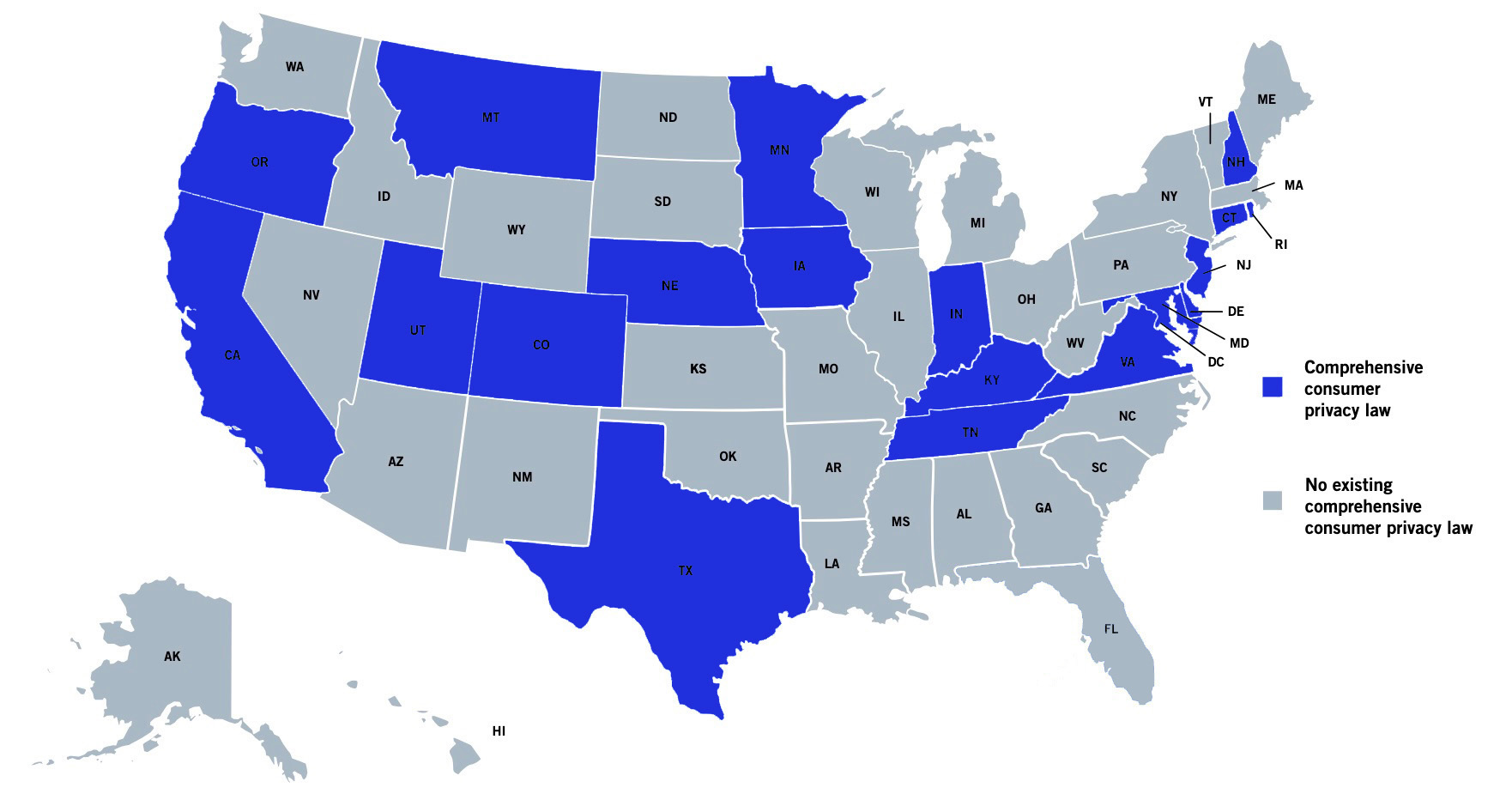
In fact, 8 states—Delaware, Iowa, Maryland, Minnesota, Nebraska, New Hampshire, New Jersey, and Tennessee—have already enacted new data privacy laws in 2025. According to the IAPP Weston Research Center, there are now 19 states with comprehensive data privacy laws on the books. As a quick caveat, different trackers have different qualifications; some trackers list 20 states and include Florida.

As seen above, the 19 states are California, Colorado, Connecticut, Delaware, Indiana, Iowa, Kentucky, Maryland, Minnesota, Montana, Nebraska, New Hampshire, New Jersey, Oregon, Rhode Island, Tennessee, Texas, Utah, and Virginia.

Although similar bills in Alabama, Georgia, Oklahoma, Maine, and Vermont failed to pass in 2025, other states—Massachusetts, Michigan, North Carolina, Pennsylvania, and Wisconsin—are currently considering data privacy legislation. Moreover, new laws from Indiana, Kentucky, and Rhode Island are expected to arrive in 2026.

Of the 19 states with comprehensive data privacy laws, 9 states (more specifically, 10 regulators across 9 states) have joined the Consortium of Privacy Regulators, a bipartisan initiative formed last April to protect consumers across different jurisdictions.

State-level data privacy bills generally include both protections for consumers and obligations for businesses. On the consumer side, these state laws allow consumers to control how their data is collected, stored, and shared with other parties. These rights—e.g., consumers’ right to delete, correct, and opt-out of data collection—are similar in nature to provisions in the GDPR and CCPA. On the business side, organizations are often obligated to adhere to various data minimization requirements.

Of course, not all states’ data privacy bills are created equal

Big Tech lobbyists have historically been extremely adept at watering down state-level bills. Speaking at the Capitol Forum’s 2025 Tech Conference, the Electronic Privacy Information Center’s Sara Geoghegan opines that Big Tech lobbyist involvement often results in watered-down bills.

Geoghegan describes the current landscape of state-level data legislation as a “mixed bag.” As Geoghegan explains, “Unfortunately, some states’ laws have kind of been written by Amazon and Big Tech; so it really depends a lot on the state. Some states have some really interesting proposals, and then Big Tech gets involved during the process and the final result is watered-down. But some [other] states have passed bans on the sale of geolocation information, special protections for things like abortion care. So, it’s kind of a mixed bag.”

With artificial intelligence progressing at a rapid pace, many state lawmakers are calling for more forms of data privacy regulation, particularly in regard to the data brokerage industry and surveillance pricing.

States are cracking down on the data brokerage industry

Recently, Texas and Oregon joined California and Vermont in requiring data brokers to register in their respective states and disclose their activities. (Data brokers are third-party entities that purchase our personal data, often unbeknownst to us.) All data brokers that process data not collected directly from the data subjects themselves now have to register with these four states. However, as of today, it is not exactly straightforward for data subjects to delete their information from these brokers’ databases.

On the Capitol Forum’s recent “Anticipated Trends for the Data Broker Industry and Enforcement” panel, cybersecurity and data privacy consultant Justin Sherman makes the case that we need a one-stop deletion request tool across the board.

Speaking specifically about states with data broker registries, Sherman says, “It’s not realistic to say to a consumer, here’s this registry in Vermont or Oregon—four states, Vermont, Oregon, Texas, and California, [each] has 500 or 600 entries—to go click on each one individually. No one is doing that, right? […] Having a one-stop shop is essential for actually effectuating those rights.”

He makes a good point. There should be a single button where one can have his or her information removed from all registered brokers in the state. California’s new Delete Act (SB 362) provides such a mechanism for Californians; this law, which is set to take effect in August 2026, is a welcome development—one that other states should follow.

Of course, there are other carve-outs and loopholes that need to be rectified as well. For example, Montana, which has been ahead of the data privacy legislation curve, recently became the first state to close the infamous data broker loophole for law enforcement. In May 2025, Montana signed their bill SB 282 into law.

Essentially, SB 282 prevents law enforcement from purchasing citizens’ data from data brokers when ordinarily they would need a warrant to access such information. This is another welcome step in the right direction.

Efforts are also being made to combat surveillance pricing at the state level

As I’ve written about in the past, surveillance pricing is the practice of surreptitiously collecting behavioral data on individuals and using that information to set prices. On the surface, it seems legitimate; much like dynamic pricing, surveillance pricing is a subset of algorithmic pricing that allows businesses to react quickly to market changes. However, by definition, surveillance pricing also includes surreptitious data collection.

Essentially, surveillance pricing is the use of one’s personal data—collected through geographic locations, credit scores, or browsing patterns—to set different prices for different users for the exact same products or services. As an example, think of a mechanic that charges different prices for the same car service depending on the customers’ location or browsing history.

In another panel at the Capitol Forum Tech Conference, “Personalization or Discrimination: Outlook for Surveillance Pricing Law,” a group of pundits addressed recent state-level developments on surveillance pricing.

Brad Weber, an attorney at Troutman Pepper Locke, points out that “over twenty states now have data privacy laws that somehow implicate surveillance pricing.” Another panel member, Javier Mabrey, a member of the Colorado House of Representatives, suspects that this number will increase.

Mabrey says, “I have very little faith in the institution of the United States Congress to step in and provide any meaningful protections for consumers any time soon […] Of course, we no longer have consumer friendly cops on the beat at the FTC and the CFPB. And, so if we’re going to do anything to protect the people in Colorado, we need to do it at the state level.” Maybrey recently brought a bill to ban surveillance pricing in Colorado; however, it didn’t pass. A similar bill proposed in California also did not pass.

Even without new state laws on the books, Mabrey makes the case that, given the size and scope of many of these companies, surveillance pricing might already be in violation of existing federal antitrust law.

Transparency alone is not an adequate policy solution

Some states have opted for transparency, rather than outright bans on surveillance pricing. As an example, New York’s recent Algorithmic Pricing Disclosure Act requires companies to disclose when they use consumers’ personal data to set a price.

Hannah Garden-Monheit, senior fellow at the American Economic Liberties Project, takes umbrage with this pivot to transparency. Garden-Monheit opines, “Transparency cannot be an end, in itself […] When you see something that is taking advantage of people, and your policy solution is ‘Let me tell you more information about how you’re being taken advantage of,’ but then you don’t actually stop it, that fundamentally undermines citizens’ trust that their institutions are capable of standing up for them.”

From a policy perspective, transparency is not as good as an outright ban on the practice; however, it certainly is yet another step in the right direction.

Breaking down the larger issue at hand, Garden-Monheit hits the nail on the head with her call for an assessment of the current mass collection of our personal data. She says, “I think we need to be thinking too about the mass collection of data in our society. One of my biggest regrets from my time in the last administration is that we didn’t succeed in passing comprehensive data minimization laws in this country; surveillance pricing is the latest pernicious symptom of an economy in which companies are amassing huge amounts of data to understand our innermost thoughts, wishes, and desires—and manipulate us with it.”

To be sure, getting companies to stop surreptitiously amassing large quantities of our personal data will not happen overnight. However, if and when these companies are reined in, one thing is certain: it will be the states leading the charge.

Related reading:

John Donegan

John Donegan

Enterprise Analyst, ManageEngine

Want to read<br>this article on the go?

Want to read
this article on the go?

Do it on the ManageEngine
Insights app.

Published on June 07, 2024 | 5 min

Mind tracking, hacking, and data aggregation of consumer brain activity is no longer science fiction. In fact, consumer brain wearables have been on the market for years.

Consumer-focused EEG devices, such as brainwave headsets, are available to aid with gaming, sleeping, and the prediction of epileptic seizures and other health concerns. In addition to various well-known brain-computer interface companies (Blackrock Neurotech, Neurable, Neuralink, and Synrchron among them), there are many lesser known entities in the space, such as Myndplay in the U.K. and Hangzhou-based Entertech.

Entertech made headlines a few years ago after partnering with SingularityNET to bring AI-powered neurotechologies to the consumer and enterprise markets. According to reporting from The South China Morning Post, Enertech provided the China State Grid with thousands of EEG helmets to measure worker fatigue.

For a variety of reasons, some more altruistic than others, many companies want to tap into this multibillion-dollar market. The consumer (and eventually, enterprise) neurotechnology space is already filled with patents from the usual Big Tech names. Snap, Meta, Microsoft, and Apple are all working hard to bring neurotechnology devices to the masses.

The neurotech timetable

According to Nina Farahany, an AI ethicist and professor at Duke Law School, these technologies will scale up and become a part of our everyday lives over the next 2-5 years. In fact, since she gave her estimate in a September 2023 interview, the timetable is likely closer to 1-4 years.

Big Tech as “the new Big Tobacco”

Earlier this week, on June 3, Farahany spoke on a popular podcast to discuss the dangers of the forthcoming technologies. One segment in particular jumped out at me, and it’s worth quoting in full; Farahany says we’re living in an interesting time, much like the days when the public first learned that the tobacco industry was hiding health facts. Farahany says,

“For awhile, tobacco companies were sitting on a whole bunch of information about the addictiveness of the products, about the effects on lung cancer. They had a whole lot of asymmetrical information. And people smoked.

And then it turned out they also had information that showed if a kid before the age of 15 smoked their first cigarette, they were more likely to be addicts for life, and they’d have a much harder time trying to break free of it.

Most of the tech companies are sitting on data like this. About the effect of technology on our brain and mental experiences.”

In many ways, Big Tech has far more power than Big Tobacco because the technology products’ negative effects are more insidious and harder to pin down. Equally importantly, these Big Tech companies aren’t just sitting on the pernicious data they’ve acquired. They’re leveraging it. Farahany continues,

“And they’re not only sitting on it. They’re like, ‘Oh, it turns out if we do intermittent rewards in this game, it will addict people more.’ Or, ‘If we have the notifications bunched, it will distract them and bring them back to the platform and lead to greater engagement.’

Or, ‘If we use this algorithm with short-form videos, it puts people into system 1 thinking instead of system 2 thinking; so, their brains are hijacked; their self-control is eviscerated. And they stay on the platform for longer.’ Or, ‘if we give them only information that is of this particular political leaning, it puts them in a silo and makes them stay on platform.’ They’re sitting on all this data.”

Their goal is to harvest the consumer data they’ve accumulated to strengthen their designs and algorithms in order to keep users on their platforms for as long as possible.

Today, due to corporate whistleblowers and congressional interest (from both sides of the aisle), we’re slowly learning more and more about the data Big Tech weaponizes.

Neurotechnologies offer both medical benefits and ethical risks

Nuerotechnologies have already brought medical benefits. We’ve seen Empatica release an FDA-cleared epilepsy watch; using an EEG-based algorithm, their wearable can detect the onset of a seizure. Also, researchers are working on wearable tech devices to help ALS patients’ movement and speech. Any technology that can help measure brain function, identify neurological diseases, and help combat the effects of those neurological diseases is a technology worth pursuing.

That said, we all have a right to mental privacy. And if neurotechnologies become the norm on consumer devices, it very well may be hard to get that horse back in the stable.

Even historically privacy-centric companies are invested in normalizing such tech; for example, Apple’s recent patent has EEG technologies attached to AirPods.

Now, many of us may or may not care. After all, sharing data isn’t new. Google has access to our emails. Apple has our iPhone locations. Moreover, the propensity to share personal data is even more acceptable among younger generations. Gen-Zers frequently share their locations with their friends.

The point is, we slowly become indifferent to giving our data away via emerging technologies, and it’s a slippery slope.

Solutions for consumers and enterprises

Ideally, we would try to course correct from the ad-driven ecosystem that is so rampant in search and social media companies, especially as these companies strive to become heavyweights in the ML, AI, and neurotech spaces.

As Farahany suggests, we should choose companies that don’t intentionally put addictive constructs (algorithms and designs) into their products. We should seek out companies that don’t commodify and misuse our data.

Apple, Snap, Meta, and Microsoft will likely be among the many winners in the forthcoming neurotech device space. Some of these companies are more privacy-centric than others. All other things being equal, we should support companies that are less reliant on ad revenue and the data surveillance economy at large.

After neurotech devices do permeate the consumer space, it won’t be long until they’re also in the enterprise space. And then, it will be up to the organizations to make ethical software and hardware procurement decisions.

We’re living in a unique time. Consumers, regulators, and society eventually did make Big Tobacco change some of its ways; perhaps, we’ll do the same with Big Tech.

John Donegan

John Donegan

Enterprise Analyst, ManageEngine

Want to read<br>this article on the go?

Want to read
this article on the go?

Do it on the ManageEngine
Insights app.

Subscribe to surveillance economy

Thanks for subscribing to ManageEngine Insights. If you do not receive our welcome email, please check your SPAM folder.