
Published on November 21, 2025 | 6 min

The government shutdown may be over, but there won’t be much federal data privacy legislation being passed in 2026. Given the current dysfunction in Congress, the onus will continue to fall onto the states.

In fact, 8 states—Delaware, Iowa, Maryland, Minnesota, Nebraska, New Hampshire, New Jersey, and Tennessee—have already enacted new data privacy laws in 2025. According to the IAPP Weston Research Center, there are now 19 states with comprehensive data privacy laws on the books. As a quick caveat, different trackers have different qualifications; some trackers list 20 states and include Florida.
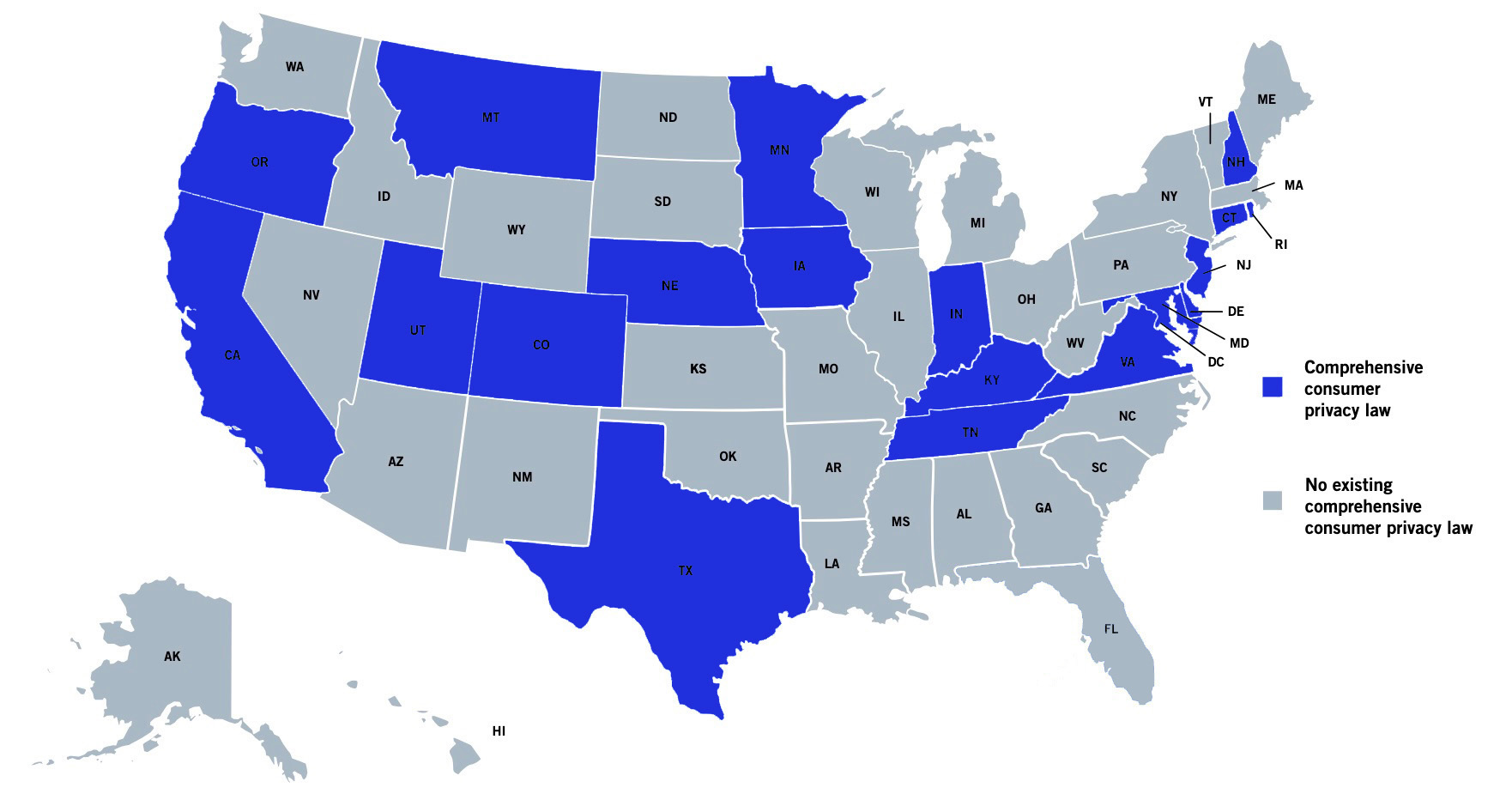
As seen above, the 19 states are California, Colorado, Connecticut, Delaware, Indiana, Iowa, Kentucky, Maryland, Minnesota, Montana, Nebraska, New Hampshire, New Jersey, Oregon, Rhode Island, Tennessee, Texas, Utah, and Virginia.

Although similar bills in Alabama, Georgia, Oklahoma, Maine, and Vermont failed to pass in 2025, other states—Massachusetts, Michigan, North Carolina, Pennsylvania, and Wisconsin—are currently considering data privacy legislation. Moreover, new laws from Indiana, Kentucky, and Rhode Island are expected to arrive in 2026.

Of the 19 states with comprehensive data privacy laws, 9 states (more specifically, 10 regulators across 9 states) have joined the Consortium of Privacy Regulators, a bipartisan initiative formed last April to protect consumers across different jurisdictions.

State-level data privacy bills generally include both protections for consumers and obligations for businesses. On the consumer side, these state laws allow consumers to control how their data is collected, stored, and shared with other parties. These rights—e.g., consumers’ right to delete, correct, and opt-out of data collection—are similar in nature to provisions in the GDPR and CCPA. On the business side, organizations are often obligated to adhere to various data minimization requirements.

Of course, not all states’ data privacy bills are created equal

Big Tech lobbyists have historically been extremely adept at watering down state-level bills. Speaking at the Capitol Forum’s 2025 Tech Conference, the Electronic Privacy Information Center’s Sara Geoghegan opines that Big Tech lobbyist involvement often results in watered-down bills.

Geoghegan describes the current landscape of state-level data legislation as a “mixed bag.” As Geoghegan explains, “Unfortunately, some states’ laws have kind of been written by Amazon and Big Tech; so it really depends a lot on the state. Some states have some really interesting proposals, and then Big Tech gets involved during the process and the final result is watered-down. But some [other] states have passed bans on the sale of geolocation information, special protections for things like abortion care. So, it’s kind of a mixed bag.”

With artificial intelligence progressing at a rapid pace, many state lawmakers are calling for more forms of data privacy regulation, particularly in regard to the data brokerage industry and surveillance pricing.

States are cracking down on the data brokerage industry

Recently, Texas and Oregon joined California and Vermont in requiring data brokers to register in their respective states and disclose their activities. (Data brokers are third-party entities that purchase our personal data, often unbeknownst to us.) All data brokers that process data not collected directly from the data subjects themselves now have to register with these four states. However, as of today, it is not exactly straightforward for data subjects to delete their information from these brokers’ databases.

On the Capitol Forum’s recent “Anticipated Trends for the Data Broker Industry and Enforcement” panel, cybersecurity and data privacy consultant Justin Sherman makes the case that we need a one-stop deletion request tool across the board.

Speaking specifically about states with data broker registries, Sherman says, “It’s not realistic to say to a consumer, here’s this registry in Vermont or Oregon—four states, Vermont, Oregon, Texas, and California, [each] has 500 or 600 entries—to go click on each one individually. No one is doing that, right? […] Having a one-stop shop is essential for actually effectuating those rights.”

He makes a good point. There should be a single button where one can have his or her information removed from all registered brokers in the state. California’s new Delete Act (SB 362) provides such a mechanism for Californians; this law, which is set to take effect in August 2026, is a welcome development—one that other states should follow.

Of course, there are other carve-outs and loopholes that need to be rectified as well. For example, Montana, which has been ahead of the data privacy legislation curve, recently became the first state to close the infamous data broker loophole for law enforcement. In May 2025, Montana signed their bill SB 282 into law.

Essentially, SB 282 prevents law enforcement from purchasing citizens’ data from data brokers when ordinarily they would need a warrant to access such information. This is another welcome step in the right direction.

Efforts are also being made to combat surveillance pricing at the state level

As I’ve written about in the past, surveillance pricing is the practice of surreptitiously collecting behavioral data on individuals and using that information to set prices. On the surface, it seems legitimate; much like dynamic pricing, surveillance pricing is a subset of algorithmic pricing that allows businesses to react quickly to market changes. However, by definition, surveillance pricing also includes surreptitious data collection.

Essentially, surveillance pricing is the use of one’s personal data—collected through geographic locations, credit scores, or browsing patterns—to set different prices for different users for the exact same products or services. As an example, think of a mechanic that charges different prices for the same car service depending on the customers’ location or browsing history.

In another panel at the Capitol Forum Tech Conference, “Personalization or Discrimination: Outlook for Surveillance Pricing Law,” a group of pundits addressed recent state-level developments on surveillance pricing.

Brad Weber, an attorney at Troutman Pepper Locke, points out that “over twenty states now have data privacy laws that somehow implicate surveillance pricing.” Another panel member, Javier Mabrey, a member of the Colorado House of Representatives, suspects that this number will increase.

Mabrey says, “I have very little faith in the institution of the United States Congress to step in and provide any meaningful protections for consumers any time soon […] Of course, we no longer have consumer friendly cops on the beat at the FTC and the CFPB. And, so if we’re going to do anything to protect the people in Colorado, we need to do it at the state level.” Maybrey recently brought a bill to ban surveillance pricing in Colorado; however, it didn’t pass. A similar bill proposed in California also did not pass.

Even without new state laws on the books, Mabrey makes the case that, given the size and scope of many of these companies, surveillance pricing might already be in violation of existing federal antitrust law.

Transparency alone is not an adequate policy solution

Some states have opted for transparency, rather than outright bans on surveillance pricing. As an example, New York’s recent Algorithmic Pricing Disclosure Act requires companies to disclose when they use consumers’ personal data to set a price.

Hannah Garden-Monheit, senior fellow at the American Economic Liberties Project, takes umbrage with this pivot to transparency. Garden-Monheit opines, “Transparency cannot be an end, in itself […] When you see something that is taking advantage of people, and your policy solution is ‘Let me tell you more information about how you’re being taken advantage of,’ but then you don’t actually stop it, that fundamentally undermines citizens’ trust that their institutions are capable of standing up for them.”

From a policy perspective, transparency is not as good as an outright ban on the practice; however, it certainly is yet another step in the right direction.

Breaking down the larger issue at hand, Garden-Monheit hits the nail on the head with her call for an assessment of the current mass collection of our personal data. She says, “I think we need to be thinking too about the mass collection of data in our society. One of my biggest regrets from my time in the last administration is that we didn’t succeed in passing comprehensive data minimization laws in this country; surveillance pricing is the latest pernicious symptom of an economy in which companies are amassing huge amounts of data to understand our innermost thoughts, wishes, and desires—and manipulate us with it.”

To be sure, getting companies to stop surreptitiously amassing large quantities of our personal data will not happen overnight. However, if and when these companies are reined in, one thing is certain: it will be the states leading the charge.


Related reading:

John Donegan

John Donegan

Enterprise Analyst, ManageEngine

Want to read<br>this article on the go?

Want to read
this article on the go?

Do it on the ManageEngine
Insights app.

Published on October 10, 2025 | 5 min

Given Texas’ pro-business proclivity, it’s a bit of a surprise to see the Lone Star State emerge as one of the top data privacy regulators in the country. Under Attorney General Ken Paxton, Texas has cracked down on unfair data surveillance practices from the data brokerage industry and Silicon Valley heavyweights. Over the past two years, the state has reached landmark settlements with Google ($1.375 billion) and Meta ($1.4 billion), the latter of which is the largest settlement ever obtained by a single state.

Paxton’s multipronged battle with Google

In addition to a 2020 antitrust lawsuit related to Google online ad sales, Paxton brought several other suits against the search giant, alleging deceptive trade practices and rampant user data privacy violations.

A January 2022 lawsuit alleged that Google had violated Texas’ “Deceptive Trade Practices-Consumer Protection Act” by running misleading advertisements on iHeartMedia networks in the Houston area. In this suit, Paxton contended that Google forced disk jockeys to record first-hand testimonials for Google products that the DJs had never used.

An additional suit, also brought in January 2022, claimed Google was again in violation of the Deceptive Trade Practices Act for surreptitiously tracking Texas users’ geolocation data against their will. According to the filing, Google continued to track Texas users’ locations even after users had disabled the “Location History” setting.

Paxton also accused Google of violating Texas’ “Capture or Use of Biometric Identifier” (CUBI) Act. Allegedly, the search giant used biometric data, specifically facial and voice recognition technologies from Google Photos, Nest Hub Max, and Google Assistant—all without asking Texans for permission. Lastly, Paxton filed an additional complaint to his geolocation data tracking suit, this time accusing Google’s “Incognito” browser mode of being anything but incognito.

In May 2025, Google reached a $1.375 billion settlement with Paxton’s office to end the myriad litigation. This is the largest amount Google has ever paid to settle an individual state’s claims. A previous 40-state antitrust settlement against Google netted $391 million, which pales in comparison to Texas’ recent recovery.

Meta caught in Paxton’s crosshairs

Google isn’t the only Silicon Valley titan forced to empty its coffers to Texas. In February 2022, Paxton sued Meta for violating CUBI and capturing Texans’ biometrics without obtaining consent.

In the largest privacy settlement ever captured by a state AG, Meta settled the suit in June 2024; Zuckerberg’s company is now scheduled to pay Texas $1.4 billion over the next five years.

In that suit, Paxton alleged that Meta had been illegally capturing Texans’ biometric data for over a decade. Back in 2011, Meta rolled out a facial recognition feature called “Tag Suggestions,” which ostensibly would make it easier for users to tag friends in photos. However, without providing informed consent to users, Meta allegedly deployed this feature onto users’ accounts and surreptitiously captured records of Texans’ faces for ten years.

Texas’ Data Privacy and Security Act (TDPSA) used to sue data broker

With no federal comprehensive data privacy act on the books, Texas is one of nineteen states to pass its own state legislation. And Texas, much like California, is actively enforcing it.

In January of this year, Paxton sued Allstate and its data broker subsidiary Arity for collecting and selling consumer geolocation and driving data, which was surreptitiously collected from an app on Texans’ phones. Given that there was no proper notice or consent given, Allstate has allegedly violated the Texas Data Privacy and Security Act (TDPSA), as well as the Texas Data Broker Law. Allstate and Arity also allegedly failed to disclose the sale of personal data, and they neglected to provide a way for users to opt out of the data collection.

This case hasn’t been settled yet; however, it sends a strong message to other businesses that the TDPSA will be enforced, and surreptitious collection of Texans’ user data will not be tolerated.

Texas’ other attempts to rein in Big Tech and the data brokerage industry

In June 2024, Paxton launched a data privacy and security initiative. Housed within the consumer protection division of the AG’s office, this initiative creates the largest legal team in the U.S. to focus on privacy law enforcement. In addition to federal laws like HIPAA and COPPA, the legal team will aggressively enforce Texas’ state-level data privacy laws, including TDPSA, CUBI, and its Data Broker Act.

To his credit, Paxton has taken meaningful steps to address the shadowy data brokerage industry. In fact, Texas is one of only a handful of states with a data broker registry. According to the state’s Data Broker Act, brokers are required to register annually with the Texas Secretary of State; pay the requisite fees, and post conspicuous notices on all their apps and websites informing users that they are a data broker. Also, brokers are required to take certain information security measures to protect any personal data that is collected.

Paxton’s political future and Texas’ data privacy enforcement moving forward

Under Paxton’s tenure, Texas has become a leader in consumer data privacy enforcement. In fact, after California, Texas is the most aggressive enforcer of privacy laws in the nation. However, whether this continues in the years to come remains to be seen.

Paxton will likely leave the AG office in the not-too-distant future, as he intends to challenge John Cornyn for his senate seat in March 2026. Despite being indicted for securities fraud in 2015, and more recently being accused of bribery, obstruction, and abuse of office charges (which 70% of Republicans supported in the TX house), Paxton has emerged as a powerful political force. In fact, recent polls have him and Cornyn neck and neck.

If his impressive crackdown on Big Tech consumer data privacy violations is a harbinger of things to come, Paxton’s future looks bright. And if he does leave the AG’s office, one can only hope his successor picks up right where he left off on the data privacy front.

Related reading:

John Donegan

John Donegan

Enterprise Analyst, ManageEngine

Want to read<br>this article on the go?

Want to read
this article on the go?

Do it on the ManageEngine
Insights app.

Published on October 07, 2023 | 7 min

Introduced by Senator Josh Becker (D-CA), Senate Bill 362, now referred to as the Delete Act, was created to close loopholes in the California Consumer Privacy Act (CCPA).

Under the CCPA, Californians are able to ask individual data brokers to delete any personal information that these brokers have obtained directly from them; however, neither the CCPA—nor the CPRA—requires brokers to delete personal information that has been acquired from third-party sources. Clearly, this is a loophole that does, indeed, need to be remedied.

Becker’s bill cleared the California legislature on September 14. Now, Governor Gavin Newsom has until next week (Oct. 14) to sign the bill, and there’s every indication he will do so.

What will the Delete Act entail?

Assuming Newsom signs the bill, the Delete Act will provide California residents with a one-stop system for data deletion. With a single request, Californians will be able to ensure that ALL their personal data is erased by ALL data brokers operating in the state.

Also, under the Delete Act, the regulation of data brokers will be transferred from the California Attorney General to the California Privacy Protection Agency (CPPA).

Creating this system is a tall task; however, the CPPA has some time. In fact, they have until January 1, 2026, to create the website or mechanism that allows residents to place their deletion requests. Tasked with administrating the Delete Act, the CPPA will enforce data broker registration and ensure that all brokers are deleting Californians’ personal information every 45 days after receiving a valid request.

New obligations for the data brokerage industry

Although it certainly provides new affordances for Californians, the Delete Act also brings a host of new obligations to businesses operating within the surveillance economy. The hundreds, if not thousands, of data brokerages operating in California will see additional workflows and costs.

Essentially, the Delete Act layers on top of the CPRA and strengthens existing data broker legislation. Importantly, the definition of “data broker” will not change under the new law. A data broker is a “business that knowingly collects and sells to third parties the personal information of a consumer with whom the business does not have a direct relationship.” Thus, if a broker has a direct relationship with the consumer, they will most likely not have new obligations under the Delete Act.

As a quick caveat, brokers covered by the Fair Credit Reporting Act, Gramm-Leech-Bliley Act, or the Insurance Information and Privacy Protection Act are exempt.

On an annual basis, all non-exempt data brokerages will now have to disclose metrics, including the number of deletion requests and rejected requests. Every three years—starting in 2028—brokerages will have to undergo an independent audit, proving they have been in compliance with the new law.

Then, most taxing of all, is the brokers’ ongoing deletion obligation. Every 45 days, the brokerage will have to ensure that they have complied with all valid deletion requests. Needless to say, there has been a great deal of pushback from a host of entities in the surveillance realm.

Does the Delete Act go too far?

In my estimation, the short answer is no. However, I would be remiss if I didn’t give the law’s detractors their chance to weigh in. The Consumer Data Industry Association (CDIA), which is a lobbyist group for data brokerage companies, credit bureaus, and background check companies, has been particularly vocal in their opposition to the Delete Act. The CDIA’s website, “No to SB 362,” argues that the new law will harm Californian businesses—and supposedly, Californians as well.

The CDIA claims that small and mid-sized businesses in California will be unable to reach new customers, which will likely be true for some companies, including some digital advertising businesses. The CDIA’s website lists some other potential effects of the Delete Act, such as “blocking law enforcement agencies from using data to investigate crimes,” “erasing the data sets needed by academics to conduct research,” and “preventing government agencies from using data to evaluate and improve public services.” Of course, the CDIA isn’t the only entity claiming that there will be unintended downstream effects of the Delete Act.

Potential unintended consequences of the Delete Act

On September 21, the International Association of Privacy Processionals (IAPP) hosted a LinkedIn Live event with Jessica Lee, a partner at Loeb & Loeb, LLP and Jason Sarfati, chief privacy officer at Gravy Analytics—an enterprise location technology company that provides businesses with data about peoples’ physical movements, among other things.

Despite his clear alliance with the data brokerage industry, Sarfati makes some persuasive arguments during this event. He laments, “It’s regrettable that the benefits to consumers that data brokers provide is so frequently lost in this conversation, and if someone later in time submits a mass opt out request, I regret to say that I don’t think they’re going to be fully aware of the downstream consequences of that.”

Sarfati claims that some data brokerage companies do positive work in the anti-fraud and identity verification spaces. “By number, most data brokers are not part of the advertising or mar-tech ecosystem. There are a host of other data brokers that do great work in the anti-fraud or identity verification world.”

Sarfati continues,

“I truly believe that if an individual submits a mass opt-out request, they are going to be at greater risk at credit card fraud down the line, or they’re going to encounter frequently issues around job applications and verifying their identity because there’s a lot of other companies that just do a lot of work in the background on behalf of others.”

There’s no way to know if those risks are real. It will depend on how the law is written, the nature of the exemptions, and how it is enforced by the CPPA.

One thing is certain—the data brokerage industry is in for a colossal shake-up

Firstly, not all data brokers and companies that rely on their services will be able to remain in business. This isn’t the worst thing, although Sarfati tries to frame it as such. Sarfati opines, “Reducing the availability of third-party data is going to have a chilling effect on competition, and in particular, smaller and medium-sized companies that don’t have access to that rich amount of first-party data.” In response to that, I’d merely shrug.

Personally, I don’t have much empathy for companies with business models that rely on third-party user data. The surveillance economy needs to be disrupted. If some of the smaller players go out of business because they are unable to operate without surreptitiously accessing our third-party personal information, then so be it.

Secondly, we will begin to see a tidal wave of copycat laws at the state level. Just as other states followed California’s lead on earlier data privacy legislation (CCPA and CPRA), other states will follow California’s lead in the data brokerage space.

As dozens of states pass data brokerage legislation, big brokers and lobbyist groups like the Consumer Data Industry Association will begin to clamor for a federal data broker registry and a federal law. In fact, it’s already happening. Sarfati complains, “There needs to be a federal data broker registry. It just doesn’t make sense for us to have piece meal registrations.” I very much agree with him on this front.

Thirdly, given that access to third-party consumer data will dry up, businesses will have to change their business models to garner first-party consumer data. Put differently, brands will start to engage more directly with consumers. As Jessica Lee explains,

“We’re seeing third-party cookies getting sunset. So all these avenues to get additional information about someone to enhance your advertising, marketing, or other personalization efforts, they’re shrinking. And I think it’s also pushing a lot of power to the walled gardens who are not data brokers, who do have a direct relationship with the consumer and have the large volumes of data, and it will push brands to engage there.”

Lee suspects that businesses’ loyalty programs will evolve; not only will they grow larger in scope, but they’ll also focus more on enhancing the first-party consumer data that they’re already collecting. This makes sense.

Key takeaways

Although Sarfati has convinced me that there will be some unforeseen consequences, I ultimately believe the Delete Act is a much-needed crackdown on a largely unregulated industry that operates in the shadows. As Senator Becker succinctly put in his September press release,

“The time of uncontrolled gambling with our personal information is almost over. Data brokers currently have the ability to use data on reproductive healthcare, geolocation, and purchasing data to sell it to the highest bidder, and the Delete Act would protect our most sensitive information.”

If this bill becomes law, then we are moving in the right direction. Moreover, a federal law that quickly follows in the footsteps of the California Delete Act would be even better—both for consumers and the brokerage industry. That said, it’s still early days; we’ll have to wait and see how it plays out.

John Donegan

John Donegan

Enterprise Analyst, ManageEngine

Want to read<br>this article on the go?

Want to read
this article on the go?

Do it on the ManageEngine
Insights app.

Published on September 22, 2022 | 5 min

Unfortunately, we are living in an age in which the mass commodification of consumer data has become commonplace and generally accepted. Companies, and data brokers, can buy and sell the majority of adults’ personal data with impunity.

Aside from the California Consumer Privacy Act (CCPA), which came three years after the E.U.’s General Data Protection Regulation (GDPR), we haven’t seen major U.S. legislation on the personal data front. To be sure, there’s a patchwork of state laws. In addition to the CCPA and California Privacy Rights Act (CPRA), there are the Virginia Consumer Data Protection Act; the Colorado Privacy Act; the Connecticut Data Privacy Act, and the Utah Consumer Privacy Act, to name a few; however, it is time for a strong privacy law at the federal level, and with a few revisions, the American Data Privacy Protection Act (ADPPA) could be this law.

The current state of the ADPPA

On one hand, the ADPPA is far and away the closest the U.S. has ever been to issuing a federal data privacy law; the bill is bipartisan in nature, and it passed the House Energy Commerce Committee with a whopping 53-2 vote. On the other hand, in its current form, this bill does not appear to have much potential. Right now, it can’t get past Speaker of the House Nancy Pelosi, let alone reach the Senate floor.

The main concern held by Pelosi is that the ADPPA would supersede state laws, thus diluting the protections already offered by California’s CPRA and the consumer data protection bills held by other states.

In a September 1 statement, Pelosi writes,

“Governor Newsom, the California Privacy Protection Agency (CPPA), and top state leaders have pointed out the American Data Privacy and Protection Act does not guarantee the same essential consumer protections as California’s privacy laws.”

Likewise, last month the CPPA released a letter opposed to the ADPPA, and in late July, the five-member CPPA board voted unanimously to oppose the ADPPA or any bill that would supersede existing state laws. They write,

“The ADPPA would remove important safeguards that are already available to Californians today and tie the hands of states from improving privacy protections in the future. We urge lawmakers to focus their efforts on ensuring that any privacy legislation follows the model of other federal privacy laws and sets a floor, not a ceiling, on privacy rights.”

A floor, not a ceiling

This exact language was also used by 10 state attorneys general in their open letter to Congress in July. The attorneys general—from California, Connecticut, Illinois, Maine, Massachusetts, Nevada, New Jersey, New Mexico, New York, and Washington — write,

“It is critical that Congress set a federal privacy-protection floor, rather than a ceiling, to continue to allow the states to innovate to regulate data privacy and protect our residents.”

In addition to the preemption issue, these attorneys general believe that states are inherently better suited to respond to technological changes, and there are concerns that the current ADPPA bill compromises the ability of state attorneys general to investigate entities that violate the law.

What exactly is in the current ADPPA bill?

Initially spearheaded by House Energy and Commerce Chair Frank Pallone (D-NJ), Cathy McMorris Rodgers (R-WA), and member of Senate Commerce Committee Sen. Roger Wicker (R-MS), the ADPPA is an attempt to minimize the collection of Americans’ personal data.

Much like the GDPR, this legislation would bolster Americans’ consumer privacy rights, while also holding data collectors accountable for discriminatory data handling practices.

Stronger consumer privacy rights

According to the language in the current bill, the ADPPA provides users with the right to “access, correct, (and) delete” data pertaining to them. Under this bill, most technology companies would be barred from collecting any user data they do not need; only “reasonably necessary” data could be collected. As a caveat, those organizations that are already regulated by existing privacy regulations—such as education, healthcare, and certain financial services companies —would not incur additional compliance burdens from ADPPA.

Additionally, assuming a federal prosecutor isn’t already on the case, individuals would now be able to sue companies for mishandling their data.

More protections for minors

The ADPPA would also provide more protection for minors. Currently, federal privacy laws ban organizations from using personal data to target users under the age of 13; however, the ADPPA would bump this up to 17.

Per Section 205 of the proposed bill, targeted advertising to individuals under 17 is expressly prohibited; entities can’t transfer covered data of individuals to third parties without these individuals’ consent. Put differently, the data of all Americans under 17 would now be defined as “sensitive covered data.”

Public registry of data brokers

Under the ADPPA , which falls under the purview of the FTC, there would be a newly created public registry of data brokers. According to Section 206, data brokers will be required to register with the FTC if they process covered data of more than 5,000 people.

So far, this all sounds well and good. However, in addition to the preemption problem (the potential for the ADPPA to supersede the CPRA and other state laws), there are a number of problematic loopholes in the current bill.

Loopholes

Other than the creation of a registry, the ADPPA continues to let data brokers operate with impunity. Despite this, the proposed bill has instigated a lobbying surge from the data brokerage industry.

Also, the language of the bill provides a few problematic carve-outs. “Covered data” does not include “de-identified data,” “employee data,” or “publicly available information.” The exception for “de-identified data” is particularly problematic because, as we have seen time and again, data can get de-identified and re-identified.

Also, there are loopholes for law enforcement. The bill reads,

“A covered entity may decline to comply with a request to exercise a right described in subsection (a), in whole or part, that would…interfere with law enforcement, judicial proceedings, investigations, or reasonable efforts to guard against, detect, or investigate malicious or unlawful activity, or enforce valid contracts.”

In most cases, law enforcement agencies would still be allowed to collect biometrics, genetic information, and “known nonconsensual intimate images.” Seeing as federal law enforcement agencies are one of the biggest purchasers of Americans’ data, these loopholes should not be taken lightly.

In summary

There is little doubt that the collection of Americans’ personal data needs to be reined in. A federal data privacy law is certainly welcome. That said, it is important that Congress passes legislation that sets a floor, rather than a ceiling, for Americans’ privacy rights. Any federal law needs to encourage and respect existing, protective laws at the state level.

There is an inherent risk that a federal law could be amended and watered down in the future; so, just as the CPRA cannot be amended unless those amendments further protect Californians, any federal data privacy law needs to guarantee the same.

Lastly, the carve-out for de-identified data needs to be addressed, and although a public registry is nice, we would be better served by an actual crackdown on the data brokerage industry. At any rate, we’re moving in the right direction with this bill.

John Donegan

John Donegan

Enterprise Analyst, ManageEngine

Want to read<br>this article on the go?

Want to read
this article on the go?

Do it on the ManageEngine
Insights app.

IT Security

Assessing the cybersecurity and emerging tech landscape with Graham Cluley

Published on January 12, 2022

Enterprise analyst John Donegan speaks with cybersecurity veteran Graham Cluley, whose award-winning podcast “Smashing Security” has over 7 million downloads. Cluley discusses security threats, emerging technologies, Big Tech overreach, and contemporary media effects.

Agenda

    • Cybersecurity threats
    • Ransomware and cyber insurance
    • Synthetic media
    • The data brokerage industry
    • Regulation and algorithmic decision-making
    • Media effects
    • IoT devices and data collection
    • Deepfake technology and new threats
    • The migration to remote work
LISTEN NOW
John Donegan

John Donegan

Enterprise Analyst, ManageEngine

Listen without limits—<br>stream this podcast on <br>the ManageEngine Insights app.

Listen without limits—
stream this podcast on
the ManageEngine Insights app.

Published on October 07, 2021 | 8 min

Widespread surveillance has been normalized. To access our sensitive data, companies routinely scrape the internet, tap IoT devices, and monitor our phones around the clock. Unfortunately, we have virtually zero visibility into the shadowy ecosystem that is the data brokerage industry.

However, every so often, a data breach occurs, showcasing the disreputability of so many of these businesses. For example, a data breach from last summer revealed that a now-defunct broker, DeepSocial, had been aggregating and packaging data from 235 million social media profiles. Although such activity is against the terms and services of Facebook and Instagram, it is not technically illegal, assuming it’s publicly-facing information and none of the data belong to minors, which would likely be a COPPA violation.

DeepSocial may be gone, but the data brokerage ecosystem is thriving. As individuals, we neither have insight into the transactional process of these brokers, nor do we have any federal rights to change any of our personal information that is incorrect. Perhaps more importantly, as it currently stands, the FTC doesn’t have a strong federal data privacy law that would enable the agency to investigate unscrupulous data brokers.

Put simply, the data brokerage industry is in dire need of regulation. As Duke University cyber policy fellow Justin Sherman notes in his recent report,

“The data brokerage ecosystem represents the unrestrained aggregation of surveillance power as a service.”

The data brokerage world: “surveillance power as a service”

Seeing as all outsourced services seem to eventually morph into an “-aaS” acronym, let’s run with Sherman’s “surveillance power as a service” (SPaaS) designation; after all, it is certainly an apt description of the data brokers’ business model.

Data brokers gather information on individuals via many different methods. They crawl government records, use applications to pull data, and purchase or license data from a bevy of third parties. After successfully tracking and aggregating users’ locations, life events, purchases, financial data, political affiliations, and lifestyle interests, these brokers turn around and sell it to the highest bidders—be it insurance companies, super PACs, corporations, asset management firms, or intelligence agencies.

Moreover, as it currently stands, there is virtually nothing in U.S. federal law that limits the selling of this data. In fact, there is not even a shared definition of a “data broker” in federal law. At the state level, Vermont and California do require brokers to register with their respective state; however, the states’ narrow legal definition of “broker” allows most companies who buy and sell data to operate without any need to disclose their actions.

For the most part, data brokers are operating with impunity, and the industry is unregulated.

The major brokers’ unsavory activity

Sherman’s report, entitled “Data brokers and sensitive data on U.S. individuals: Threats to American civil rights, national security, and democracy”, looks at the public-facing advertising from nine behemoths in the data brokerage world: Experian, Equifax, CoreLogic, Verisk, Oracle, Epsilon, Acxiom, LexisNexis, and Nielsen. He also examines the advertising of people-search (“white pages”) websites.

What quickly becomes apparent is that much of the data collection is quite unsettling. To cite a few examples, Equifax, and others, buy payroll data from thousands of U.S. organizations; LexisNexis offers to identify relatives, neighbors, and associates who appear in social media posts and online photographs; and Verisk’s ISO ClaimSearch, the world’s largest database of property and casualty claims, pulls data from IoT devices from inside the home.

To substantiate his claim that data brokers undermine national security, Sherman notes that Axciom, LexisNexis, and Nielsen all openly offer to provide data on U.S. military personnel. Acxiom, through their partner NinthDecimal, sells individuals’ geo-locations, and it should be noted that many of these entities work with dozens of other data brokers as well; for example, Oracle owns and works with over 80 data brokers.

Threats to civil liberties

Whether data brokers’ activities undermine national security is up for debate; however, it certainly does appear that the rampant surveillance by these players is a threat to basic civil liberties. Sherman argues that the aggregation of data from across the web exacerbates existing algorithmic biases that disproportionately affect marginalized groups. Additionally, data brokers arguably help facilitate doxing efforts; they put victims of domestic violence in danger by exposing victims’ locations, and they allegedly place some politically active people in harm’s way by exposing their political affiliations. This last point—data brokers’ propensity to expose individuals’ political preferences—has not gone unnoticed.

As an example, allegedly, data broker Mobilewalla surreptitiously collected information on Black Lives Matter protesters via their mobile devices. The information included location data, home addresses, and other sensitive information, which prompted four U.S. senators to issue a press release, as well as a letter to the Mobilewalla CEO.

An excerpt from the letter reads,

“We are deeply concerned that Mobilewalla’s report advertises that the company can target thousands of Americans on the basis of their exercise of First Amendment rights. This use could include political targeting based on personal or religious beliefs, which Mobilewalla has previously facilitated. More concerning, once profiled on the basis of their location data or other information collected about them, people can be targeted not only for marketing or political purposes, but for law or immigration enforcement.”

In addition to Mobilewalla, Senators Elizabeth Warren (D-MA) and Ron Wyden (D-OR) have also looked into Dulles, VA-based Venntel, Inc. (Gravy Analytics), a broker that sells sensitive data to U.S. government agencies. Rather than enduring the hassle of getting warrants and dealing with cell phone companies, government agencies can get individuals’ sensitive information directly from data brokers. So, in essence, these data brokers allow agencies to “buy their way around the Fourth Amendment.”

Another important issue: individuals are unable to revise incorrect data

Data brokers compile profiles on us by scraping data from mobile applications, social media, government websites, and the internet at large; then, they turn around and sell, share, or license these datasets to other brokers, who in turn, pass the data along to others. In this dystopian version of the game of “Telephone,” the information is not always going to be accurate by the time it reaches its final destination. That being the case, it is definitely worth highlighting the fact that individuals usually lack the ability to correct missing or erroneous information about themselves and their families. Such incorrect data can lead to a home loan refusal, job loss, or worse. As a caveat, we do have the right to correct some data, including rights related to credit reporting, clinical health data, and children’s data.

Sherman suggests that individuals should have the right to revise any incorrect data that brokers are selling and licensing. This seems appropriate. In a similar vein, the FTC should be empowered to investigate unfair broker practices.

Additionally, Sherman suggests that brokers should not be able to sell, license, or share sensitive data on U.S. citizens to non-state actors, foreign governments, or international security agencies, as this could jeopardize national security.

Counterargument: data brokers aren’t doing anything wrong

Jim Harper, a senior fellow at the right-leaning think tank, American Enterprise Institute for Public Policy Research, takes umbrage with much of Sherman’s assessment on the data brokerage landscape. In a recent blog post entitled, “What if data brokers aren’t doing anything wrong?“, Harper refutes much of Sherman’s report.

Harper does acknowledge that data brokerage is a “shadowy” industry; however, he compares it to credit reporting, which was disreputable decades ago, but has since gained legitimacy. Recognizing that apps collect information on us and sell it to the highest bidder, Harper contends that this is merely a form of efficiency. He posits, quite correctly, that data brokerage activities allow companies to reach customers more efficiently. With detailed dossiers on individuals’ personal preferences, companies can spend less money on marketing costs—which in turn, Harper argues, ultimately lowers costs for consumers and returns value to shareholders. This is true, but at what cost? At no point, does Harper try to make the case that data brokers are not violating civil liberties.

That said, he does make a persuasive case that Sherman’s fears about national security implications may be overblown. Harper writes,

“It is doubtful that generic information about present or past military service is terribly useful to foreign enemies. If information about particular dimensions of military service is both useful and routinely brokered, one wonders why it is available to the data brokers in the first place. And if data brokering allows foreign governments to microtarget election disinformation, our fragile democracy might need shoring up irrespective of the role data brokerage may have in disseminating information more efficiently.”

Harper believes that the data brokerage industry can gain legitimacy, and he fears that empowering the FTC, passing a federal data privacy law, and giving individuals more rights may come at the expense of business efficiency.

Harper suggests that Sherman’s argument is flawed, as he highlights the fact that Sherman’s report states that data brokers are “open and explicit” about what they are selling. Harper goes so far as to point out that Sherman uses this “open and explicit” phrase eight times in 16 pages. Harper asks, if this industry is so sketchy, then how are they open and explicit about what they’re selling? This is a false equivalency, and Harper is missing the point. Data brokers may, indeed, be open and explicit about what information they’re selling; however, they are most certainly not transparent about where it came from and how it got there. The bulk of the broker ecosystem is in the shadows, and there is currently no federal law to provide insight into this process.

As Sherman points out—and Harper willfully ignores—it is the limited visibility into the mechanisms within the data brokerage process that is the issue at hand.

It’s time for regulation

As it stands, the FTC lacks a strong federal data privacy law that could embolden the agency to go after unscrupulous brokers; additionally, there is virtually no federal law preventing brokers from selling most individuals’ personal data to foreign actors, insurance firms, law enforcement, or government agencies. That said, there has been some recent regulation in the world of finance.

Last week, the SEC issued a $10 million fine on private analytics firm App Annie, Inc., signaling that the SEC is taking a harder look at data brokers. According to the SEC, App Annie sold nonpublic, confidential user data through its “Intelligence” product, which was marketed to and purchased by trading firms. The user data was neither anonymized, nor was it aggregated, making it more valuable to asset managers—and also in violation of security laws. This SEC enforcement is the first of its kind against a third-party data broker, and many see it as a harbinger of things to come. It’s a step in the right direction, but whether this type of enforcement becomes more commonplace remains to be seen.

Nevertheless, a few things are certain: there is limited visibility into the shadowy ecosystem of data brokering, and we need more insights into the inner workings of this world. Additionally, individuals should have the right to change their information if its incorrect, and the FTC needs more power to go after brokers. Whether this should come under the umbrella of a strong, federal data privacy law is up for debate; however, data brokers’ unfettered surveillance absolutely needs to be addressed, even if Harper is right and such regulation makes businesses’ targeted advertising initiatives slightly less efficient.

John Donegan

John Donegan

Enterprise Analyst, ManageEngine

Want to read<br>this article on the go?

Want to read
this article on the go?

Do it on the ManageEngine
Insights app.

Subscribe to data brokerage

Thanks for subscribing to ManageEngine Insights. If you do not receive our welcome email, please check your SPAM folder.