
Published on October 10, 2025 | 5 min

Given Texas’ pro-business proclivity, it’s a bit of a surprise to see the Lone Star State emerge as one of the top data privacy regulators in the country. Under Attorney General Ken Paxton, Texas has cracked down on unfair data surveillance practices from the data brokerage industry and Silicon Valley heavyweights. Over the past two years, the state has reached landmark settlements with Google ($1.375 billion) and Meta ($1.4 billion), the latter of which is the largest settlement ever obtained by a single state.

Paxton’s multipronged battle with Google

In addition to a 2020 antitrust lawsuit related to Google online ad sales, Paxton brought several other suits against the search giant, alleging deceptive trade practices and rampant user data privacy violations.

A January 2022 lawsuit alleged that Google had violated Texas’ “Deceptive Trade Practices-Consumer Protection Act” by running misleading advertisements on iHeartMedia networks in the Houston area. In this suit, Paxton contended that Google forced disk jockeys to record first-hand testimonials for Google products that the DJs had never used.

An additional suit, also brought in January 2022, claimed Google was again in violation of the Deceptive Trade Practices Act for surreptitiously tracking Texas users’ geolocation data against their will. According to the filing, Google continued to track Texas users’ locations even after users had disabled the “Location History” setting.

Paxton also accused Google of violating Texas’ “Capture or Use of Biometric Identifier” (CUBI) Act. Allegedly, the search giant used biometric data, specifically facial and voice recognition technologies from Google Photos, Nest Hub Max, and Google Assistant—all without asking Texans for permission. Lastly, Paxton filed an additional complaint to his geolocation data tracking suit, this time accusing Google’s “Incognito” browser mode of being anything but incognito.

In May 2025, Google reached a $1.375 billion settlement with Paxton’s office to end the myriad litigation. This is the largest amount Google has ever paid to settle an individual state’s claims. A previous 40-state antitrust settlement against Google netted $391 million, which pales in comparison to Texas’ recent recovery.

Meta caught in Paxton’s crosshairs

Google isn’t the only Silicon Valley titan forced to empty its coffers to Texas. In February 2022, Paxton sued Meta for violating CUBI and capturing Texans’ biometrics without obtaining consent.

In the largest privacy settlement ever captured by a state AG, Meta settled the suit in June 2024; Zuckerberg’s company is now scheduled to pay Texas $1.4 billion over the next five years.

In that suit, Paxton alleged that Meta had been illegally capturing Texans’ biometric data for over a decade. Back in 2011, Meta rolled out a facial recognition feature called “Tag Suggestions,” which ostensibly would make it easier for users to tag friends in photos. However, without providing informed consent to users, Meta allegedly deployed this feature onto users’ accounts and surreptitiously captured records of Texans’ faces for ten years.

Texas’ Data Privacy and Security Act (TDPSA) used to sue data broker

With no federal comprehensive data privacy act on the books, Texas is one of nineteen states to pass its own state legislation. And Texas, much like California, is actively enforcing it.

In January of this year, Paxton sued Allstate and its data broker subsidiary Arity for collecting and selling consumer geolocation and driving data, which was surreptitiously collected from an app on Texans’ phones. Given that there was no proper notice or consent given, Allstate has allegedly violated the Texas Data Privacy and Security Act (TDPSA), as well as the Texas Data Broker Law. Allstate and Arity also allegedly failed to disclose the sale of personal data, and they neglected to provide a way for users to opt out of the data collection.

This case hasn’t been settled yet; however, it sends a strong message to other businesses that the TDPSA will be enforced, and surreptitious collection of Texans’ user data will not be tolerated.

Texas’ other attempts to rein in Big Tech and the data brokerage industry

In June 2024, Paxton launched a data privacy and security initiative. Housed within the consumer protection division of the AG’s office, this initiative creates the largest legal team in the U.S. to focus on privacy law enforcement. In addition to federal laws like HIPAA and COPPA, the legal team will aggressively enforce Texas’ state-level data privacy laws, including TDPSA, CUBI, and its Data Broker Act.

To his credit, Paxton has taken meaningful steps to address the shadowy data brokerage industry. In fact, Texas is one of only a handful of states with a data broker registry. According to the state’s Data Broker Act, brokers are required to register annually with the Texas Secretary of State; pay the requisite fees, and post conspicuous notices on all their apps and websites informing users that they are a data broker. Also, brokers are required to take certain information security measures to protect any personal data that is collected.

Paxton’s political future and Texas’ data privacy enforcement moving forward

Under Paxton’s tenure, Texas has become a leader in consumer data privacy enforcement. In fact, after California, Texas is the most aggressive enforcer of privacy laws in the nation. However, whether this continues in the years to come remains to be seen.

Paxton will likely leave the AG office in the not-too-distant future, as he intends to challenge John Cornyn for his senate seat in March 2026. Despite being indicted for securities fraud in 2015, and more recently being accused of bribery, obstruction, and abuse of office charges (which 70% of Republicans supported in the TX house), Paxton has emerged as a powerful political force. In fact, recent polls have him and Cornyn neck and neck.

If his impressive crackdown on Big Tech consumer data privacy violations is a harbinger of things to come, Paxton’s future looks bright. And if he does leave the AG’s office, one can only hope his successor picks up right where he left off on the data privacy front.


Related reading:

John Donegan

John Donegan

Enterprise Analyst, ManageEngine

Want to read<br>this article on the go?

Want to read
this article on the go?

Do it on the ManageEngine
Insights app.

Published on June 27, 2024 | 5 min

Everything’s bigger in Texas—even the state’s recent initiative to protect consumer data.

On Monday, July 1, 2024, the Texas Data Privacy and Security Act (TDPSA) goes into effect. Signed into law by Gov. Abbott back in June 2023, the TDPSA is one of the most comprehensive data privacy laws in the country.

Under the TDPSA, nearly all consumer-facing companies doing business in Texas will soon face data collection, processing, and disclosure requirements similar to those in California’s CCPA and CPRA. Although Texas and California are usually on different ends of the political spectrum, the states are apparently quite like-minded when it comes to data privacy.

The fact that Texas has decided to join California in passing one of the most stringent data privacy laws in the country suggests a few things: (1) consumer data privacy has become a bipartisan, hot-button issue; (2) consumers are paying more attention than ever to how companies are collecting, using, and selling their personal data, and (3) many state legislators don’t have much confidence in our dysfunctional Congress passing an effective federal data privacy law.

One of the TDPSA’s authors, Giovanni Capriglione (R-TX), certainly didn’t have faith in federal lawmakers taking the initiative back in 2019. While advocating for an earlier iteration of the TDPSA, Texas House Bill 4390, Capriglione bluntly told his colleagues, “I disagree that this is the duty of the federal government, mostly because I don’t have much faith that they will do it.”

Businesses affected by the Texas Data Privacy and Security Act

Most large organizations doing business in Texas will be affected. Unlike nearly all the other states with comprehensive data privacy laws in place, the TDPSA doesn’t exclude organizations that don’t meet volume thresholds (such as processing data of at least 100,000 residents). In Texas, there’s no minimum volume threshold.

According to the language in the TDPSA, the new law applies to any entity that (1) conducts business in Texas or produces a product or service consumed by residents of Texas; (2) processes or engages in the the sale of personal data, and (3) is not a small business as defined by the U.S. Small Business Administration.

As a quick aside, whether a business qualifies as “small” varies by industry; it’s usually based on annual revenue, number of employees, or both of these variables. Also, under the TDPSA, even “small” businesses are required to obtain consent before selling sensitive personal data.

Exceptions

In addition to the small business exception, the TDPSA doesn’t apply to (1) state agencies or political subdivisions; (2) financial institutions subject to the Gramm-Leach-Bliley Act (which already requires covered entities to safeguard sensitive data and explain their data sharing practices to customers); (3) covered entities or business associates already governed by the Health Insurance Portability and Accountability Act (HIPAA), and any other applicable federal and state healthcare laws; (4) non-profit organizations; (5) institutions of higher education; or (6) electric utility, power generation companies, or retail electric providers. 

Compliance obligations

Under the letter of the law, data controllers now must: (1) only process information that is completely necessary to deliver the product or service; (2) notify consumers of their privacy rights, including the type of personal information collected, consumers’ rights to opt out, and the purposes of the collecting and processing consumer data; (3) not discriminate against consumers for exercising their privacy rights; (4) not process any personal data that violates existing state and federal discrimination laws; (5) gain consent before collecting sensitive data; (6) ensure security of personal data through reasonable data security practices; (6) conduct data protection assessments; (7) respond to consumer data requests within 45 days; (8) maintain contracts with third-party data processors and ensure that these third parties are compliant with the TDPSA as well; and (9) disclose any data breach within 60 days.

TDPSA compliance will be enforced by the Texas Attorney General. Texas residents can’t initiate a private right of action (file a civil case); however, they can inform the Texas AG about the alleged violations. Businesses face fines of up to $7500 per violation.

How businesses should prepare

If you’re already in compliance with the CCPA and CPRA, you should be well on your way toward TDPSA compliance. However, in some respects, the TDPSA goes beyond the scope of the CCPA. As a quick example, the TDPSA includes provisions for privacy policy disclosures related to the sale of biometric data, and there’s also a mechanism in place for consumers to appeal a denial of a request.

To prepare for TDPSA enforcement, businesses should organize and assess all of the data they’re collecting. It is vital that all consumer consent requirements are compliant with TDPSA. Adjustments may need to be made to corporate policies and procedures;  moreover, all vendor agreements and privacy policies should be reviewed.

The growing patchwork of state laws

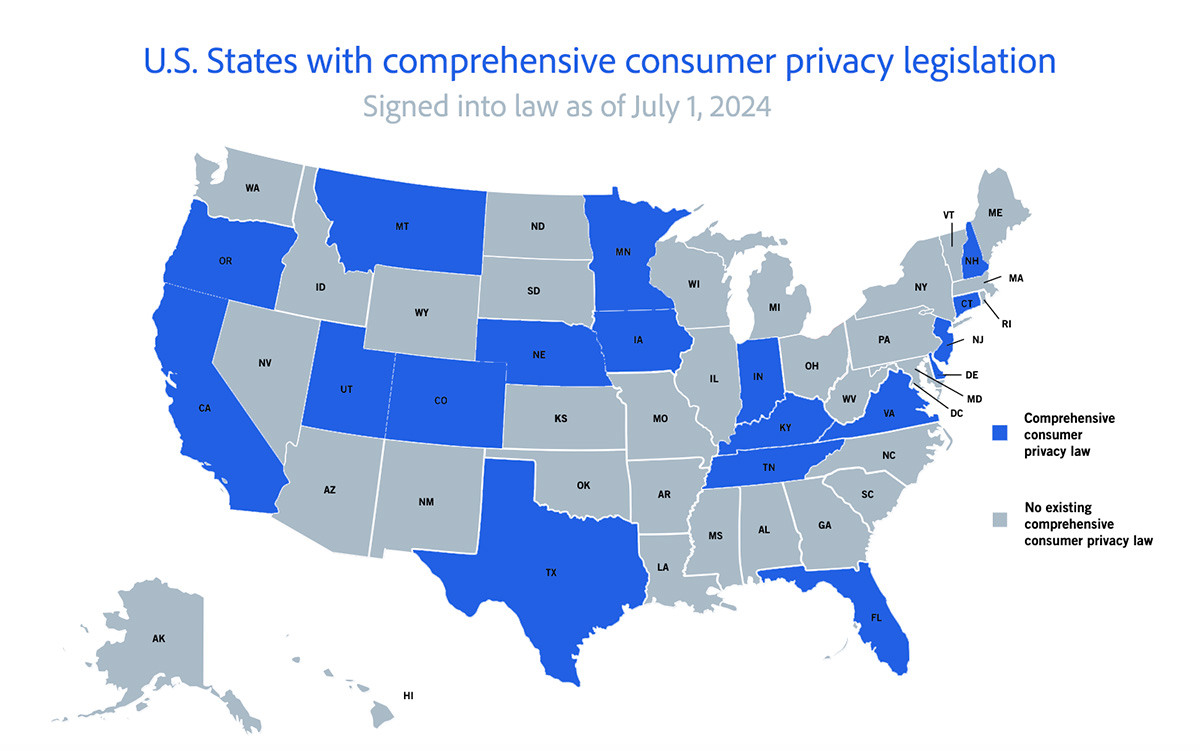
According to the International Association of Privacy Professional’s privacy legislation tracker, eighteen states currently have signed comprehensive consumer privacy bills into law: California, Colorado, Connecticut, Delaware, Indiana, Iowa, Kentucky, Maryland, Minnesota, Montana, Nebraska, New Hampshire, New Jersey, Oregon, Tennessee, and now, Texas.

Texas Data Privacy Act

Rhode Island appears to be next up, as its Data Transparency and Privacy Protection Act passed on June 24, 2024. And Illinois, Louisiana, Massachusetts, Michigan, North Carolina, Ohio, and Pennsylvania all have data privacy bills in either committee, cross chamber, or cross committee.

Interestingly, Vermont’s Data Privacy Act, which passed 139-3 in the House, appears to be dead on arrival after a recent veto by Republican Gov. Phil Scott. Nevertheless, with so many bills coming down the pike, the pressure is certainly on Capitol Hill to enact privacy legislation at the federal level.

Key takeaways

Texas just passed one of the strongest privacy laws in the country, signaling to the folks on Capitol Hill that the state is serious about consumer data privacy.

If legislators in Washington don’t enact a federal data privacy law soon, the headache of complying with a patchwork of state laws will continue for many businesses.  The Texas law is particularly stringent; in fact, as of July 1, it won’t be uncommon for companies to be subject to California and Texas’ data privacy laws, and not many others.

In the wake of the TDPSA, hopefully folks in D.C. are realizing it’s past time for a federal law.  After all, when California and Texas—two state legislatures that don’t often see eye-to-eye—agree that consumer data privacy protections are sorely needed, odds are, they’re onto something.

John Donegan

John Donegan

Enterprise Analyst, ManageEngine

Want to read<br>this article on the go?

Want to read
this article on the go?

Do it on the ManageEngine
Insights app.

Subscribe to TDPSA

Thanks for subscribing to ManageEngine Insights. If you do not receive our welcome email, please check your SPAM folder.