
Published on May 14, 2026 | 7 min

The United States needs a federal consumer data privacy law, but not one like the recently proposed SECURE Data Act.

On April 22, Republicans on the House Energy and Commerce Committee introduced the SECURE Data Act (H.R. 8413), making it the first attempt at comprehensive privacy legislation in years; unfortunately, the bill is a disaster, as it would erase too much state-level progress.

The main problem with the SECURE Data Act is the issue of federal preemption. The bill would preempt all state legislation, effectively eviscerating strong state legislation like California’s CCPA (2018) and CPRA (2020).

The preemption problem

Nobody, myself included, wants businesses to have to deal with a patchwork of data privacy laws. We absolutely need a federal data privacy law on the books. That said, any federal law should build on top of state-level laws; it shouldn’t dilute existing laws, rendering them unenforceable, and erasing years of state-level legislative work.

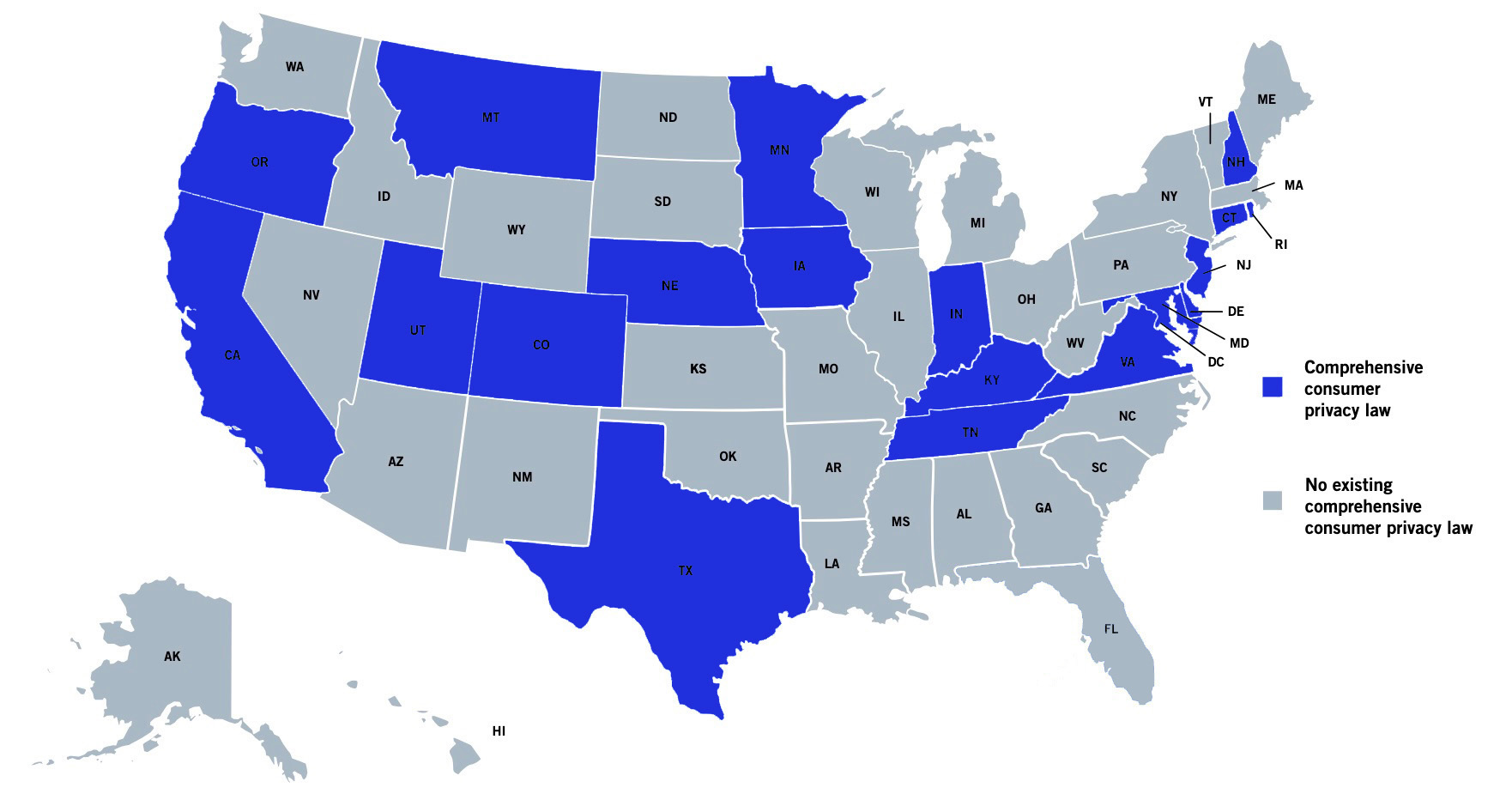
As of May 2026, the U.S. has comprehensive privacy legislation in 21 states: Alabama, California, Colorado, Connecticut, Delaware, Indiana, Iowa, Kentucky, Maryland, Minnesota, Montana, Nebraska, New Hampshire, New Jersey, Oklahoma, Oregon, Rhode Island, Tennessee, Texas, Utah, and Virginia.

Of course, there is a great deal of nuance here, as some states have stronger laws than others. Nevertheless, any proposed federal law should be treated as a floor to build on top of these state-level laws, rather than a ceiling.

I agree with the Electronic Frontier Foundation’s Mario Trujillo, who writes, “Federal privacy laws should allow states to build ever stronger rights on top of the federal floor. Many federal privacy laws allow this, including the Health Insurance Portability and Accountability Act (HIPAA).”

Which businesses are affected

The proposed bill would apply to all businesses subject to the FTC Act, as well as all businesses in the U.S. that process the personal data of 200,000 U.S. consumers or more.

Additionally, there’s another standard that would affect other businesses; any business that processes the data of more than 100,000 U.S. consumers and derives more than 25% of revenue from selling that data would also be subject to the SECURE Data Act.

As it stands, the proposed bill exempts businesses with less than $25m in adjusted gross annual revenue.

Key provisions of the bill

The SECURE Data Act mandates that U.S. consumers be given a clear mechanism to opt out of targeted advertising practices as well as the sale of their personal data.

Were the bill to pass, many businesses that process and control consumer data would be forced to obtain opt-in consent before they processed any sensitive consumer data, including geolocation, financial information, and health data. Also, the bill would require businesses to get parental consent before processing the personal data of kids aged 13-16.

Data broker registry

This is my favorite part of the proposed bill. The SECURE Data Act would create a federally mandated data broker registry. Maintained by the FTC, this registry would require many data brokers to register every year and disclose all of their data collection and sales activities.

All data brokers that make over 50% of their profits by selling our personal data would be forced to register in the FTC’s public database. This is a wonderful development.

Enforcement

Here is where things get problematic for privacy advocates. The SECURE Data Act mandates that all enforcement be handled by the FTC and state attorneys general.

Particularly problematic for most privacy advocates, the proposed bill doesn’t include a private right of action, meaning that consumers cannot file civil suits against law-breaking companies. Only the FTC and state attorneys general can enforce the SECURE Data Act.

Moreover, the proposed bill includes a “45-day notice-and-cure provision,” which basically means that if a company is caught breaking the law, they have 45 days to “cure” any violation with no penalty.

Personally, for me, the lack of a private right of action isn’t a deal-breaker. And I think future iterations of this bill can reach a compromise on this issue.

No private right of action

Although privacy rights activists are up in arms about the lack of a private right of action, Electronic Privacy Information Center (EPIC) Deputy Director and Policy Director Caitriona Fitzgerald suggests that a compromised version of a private right of action could be reached down the line.

As Fitzgerald writes, “Previous bipartisan privacy proposals, such as the American Data Privacy and Protection Act and the American Privacy Rights Act, proposed a compromise version of a private right of action that allowed for injunctive relief so that consumers could force companies to stop violating the law, but did not allow for statutory damages.”

I think such a “compromise version” of a private right of action could get future iterations of this bill across the finish line.

The issue of “notice and choice” and burying fine print in the privacy policy

Another important issue to highlight is “notice and choice”; this is a common model in data privacy that allows companies to collect our data as long as they tell us what they’re doing with it (and they give us an option to opt-out.)

The problem with “notice and choice” is that sometimes exactly how the data is being used is buried in the companies’ privacy policies. And who reads these?

Also, many times, the consumers’ choice to allow data collection is bundled with the service itself, creating a take-it-or-leave-it situation.

Alternatively, companies sometimes combine user consent for necessary data collection (e.g., a navigation app needing our location data in order to provide us with directions) with totally unrelated uses (e.g., selling our location data to third-party advertisers or data brokers).

A far better policy is to mandate that companies adhere to data minimization requirements. For example, some state-level laws prevent companies from collecting consumer data beyond what is necessary to fulfill the requested service. This way, even if the consumer technically gives his or her consent, it is still illegal for companies to surreptitiously over-collect and profit from that user’s data in other ways.

The SECURE Data Act perpetuates the notice-and-choice model, as opposed to requiring that companies adhere to data minimization. This is a shame.

Maryland’s data privacy law has an excellent data minimization standard, as did two other previous bipartisan federal bills: American Data Privacy and Protection Act (ADPPA) and American Privacy Rights Act (APRA). It’s too bad the SECURE Data Act didn’t have such a standard.

Support for the SECURE Data Act

I’d be remiss if I didn’t point out that many folks are happy with the proposed bill. As an example, Adam Thierer, a senior fellow at the R Street Institute, was excited to see the bill not include a private right of action. Thierer writes, “Importantly, the SECURE Data Act wisely does not include a PRA, which would only exacerbate America’s growing over-litigation problem.”

And of course, many lobbyists and lawmakers are rejoicing at the chance to dilute the CPRA and other state laws. For example, advocacy group Americans for Tax Reform and twenty-three other center-right groups are particularly excited by the prospect of the SECURE Data Act passing.

The self-proclaimed center-right groups collectively write, “If all 50 states move forward with their own privacy laws, it could cost the American economy over $1 trillion in the next decade, with $200 billion of that burden falling on small businesses.” These 24 groups want to see “strong preemption, with no private right of action and no open-ended rule-making authority for federal agencies or additional state regulations.”

My take

I agree with the EFF’s contention that “the bill is weaker than congressional proposals in prior years, as well as most of the 21 state consumer privacy laws already on the books.”

The fact that the SECURE Data Act preempts existing state-level laws ultimately makes this a bad bill.

Aside from the federal preemption problem, which is a deal-breaker in and of itself in my mind, there are several other issues with the SECURE Data Act. As it stands, the bill perpetuates the “notice and choice” status quo, allowing organizations to obfuscate how they process consumer data, as they bury the specifics deep in their corporate privacy policies. Given that few consumers bother to read or understand corporate privacy policies, data minimization provisions would be much better than this “notice and choice” approach.

Unlike other privacy advocates, I am less concerned about the bill’s failure to include a private right of action. That’s not a deal-breaker for me. However, I am inclined to agree with EPIC’s Fitzgerald, who writes, “The combination of minimal consumer protections, weak enforcement, and insanely expansive preemption of state laws makes the SECURE Act a disaster for Americans’ privacy.”

That said, there are some great things inside the proposed SECURE Data Act. I particularly like the call for a federal data broker registry. It’s refreshing to see politicians on both sides of the aisle ready to crack down on the data brokerage industry, a particularly pernicious part of the data surveillance apparatus.


Related reading

John Donegan

John Donegan

Enterprise Analyst, ManageEngine

Want to read<br>this article on the go?

Want to read
this article on the go?

Do it on the ManageEngine
Insights app.

Published on November 21, 2025 | 6 min

The government shutdown may be over, but there won’t be much federal data privacy legislation being passed in 2026. Given the current dysfunction in Congress, the onus will continue to fall onto the states.

In fact, 8 states—Delaware, Iowa, Maryland, Minnesota, Nebraska, New Hampshire, New Jersey, and Tennessee—have already enacted new data privacy laws in 2025. According to the IAPP Weston Research Center, there are now 19 states with comprehensive data privacy laws on the books. As a quick caveat, different trackers have different qualifications; some trackers list 20 states and include Florida.

As seen above, the 19 states are California, Colorado, Connecticut, Delaware, Indiana, Iowa, Kentucky, Maryland, Minnesota, Montana, Nebraska, New Hampshire, New Jersey, Oregon, Rhode Island, Tennessee, Texas, Utah, and Virginia.

Although similar bills in Alabama, Georgia, Oklahoma, Maine, and Vermont failed to pass in 2025, other states—Massachusetts, Michigan, North Carolina, Pennsylvania, and Wisconsin—are currently considering data privacy legislation. Moreover, new laws from Indiana, Kentucky, and Rhode Island are expected to arrive in 2026.

Of the 19 states with comprehensive data privacy laws, 9 states (more specifically, 10 regulators across 9 states) have joined the Consortium of Privacy Regulators, a bipartisan initiative formed last April to protect consumers across different jurisdictions.

State-level data privacy bills generally include both protections for consumers and obligations for businesses. On the consumer side, these state laws allow consumers to control how their data is collected, stored, and shared with other parties. These rights—e.g., consumers’ right to delete, correct, and opt-out of data collection—are similar in nature to provisions in the GDPR and CCPA. On the business side, organizations are often obligated to adhere to various data minimization requirements.

Of course, not all states’ data privacy bills are created equal

Big Tech lobbyists have historically been extremely adept at watering down state-level bills. Speaking at the Capitol Forum’s 2025 Tech Conference, the Electronic Privacy Information Center’s Sara Geoghegan opines that Big Tech lobbyist involvement often results in watered-down bills.

Geoghegan describes the current landscape of state-level data legislation as a “mixed bag.” As Geoghegan explains, “Unfortunately, some states’ laws have kind of been written by Amazon and Big Tech; so it really depends a lot on the state. Some states have some really interesting proposals, and then Big Tech gets involved during the process and the final result is watered-down. But some [other] states have passed bans on the sale of geolocation information, special protections for things like abortion care. So, it’s kind of a mixed bag.”

With artificial intelligence progressing at a rapid pace, many state lawmakers are calling for more forms of data privacy regulation, particularly in regard to the data brokerage industry and surveillance pricing.

States are cracking down on the data brokerage industry

Recently, Texas and Oregon joined California and Vermont in requiring data brokers to register in their respective states and disclose their activities. (Data brokers are third-party entities that purchase our personal data, often unbeknownst to us.) All data brokers that process data not collected directly from the data subjects themselves now have to register with these four states. However, as of today, it is not exactly straightforward for data subjects to delete their information from these brokers’ databases.

On the Capitol Forum’s recent “Anticipated Trends for the Data Broker Industry and Enforcement” panel, cybersecurity and data privacy consultant Justin Sherman makes the case that we need a one-stop deletion request tool across the board.

Speaking specifically about states with data broker registries, Sherman says, “It’s not realistic to say to a consumer, here’s this registry in Vermont or Oregon—four states, Vermont, Oregon, Texas, and California, [each] has 500 or 600 entries—to go click on each one individually. No one is doing that, right? […] Having a one-stop shop is essential for actually effectuating those rights.”

He makes a good point. There should be a single button where one can have his or her information removed from all registered brokers in the state. California’s new Delete Act (SB 362) provides such a mechanism for Californians; this law, which is set to take effect in August 2026, is a welcome development—one that other states should follow.

Of course, there are other carve-outs and loopholes that need to be rectified as well. For example, Montana, which has been ahead of the data privacy legislation curve, recently became the first state to close the infamous data broker loophole for law enforcement. In May 2025, Montana signed their bill SB 282 into law.

Essentially, SB 282 prevents law enforcement from purchasing citizens’ data from data brokers when ordinarily they would need a warrant to access such information. This is another welcome step in the right direction.

Efforts are also being made to combat surveillance pricing at the state level

As I’ve written about in the past, surveillance pricing is the practice of surreptitiously collecting behavioral data on individuals and using that information to set prices. On the surface, it seems legitimate; much like dynamic pricing, surveillance pricing is a subset of algorithmic pricing that allows businesses to react quickly to market changes. However, by definition, surveillance pricing also includes surreptitious data collection.

Essentially, surveillance pricing is the use of one’s personal data—collected through geographic locations, credit scores, or browsing patterns—to set different prices for different users for the exact same products or services. As an example, think of a mechanic that charges different prices for the same car service depending on the customers’ location or browsing history.

In another panel at the Capitol Forum Tech Conference, “Personalization or Discrimination: Outlook for Surveillance Pricing Law,” a group of pundits addressed recent state-level developments on surveillance pricing.

Brad Weber, an attorney at Troutman Pepper Locke, points out that “over twenty states now have data privacy laws that somehow implicate surveillance pricing.” Another panel member, Javier Mabrey, a member of the Colorado House of Representatives, suspects that this number will increase.

Mabrey says, “I have very little faith in the institution of the United States Congress to step in and provide any meaningful protections for consumers any time soon […] Of course, we no longer have consumer friendly cops on the beat at the FTC and the CFPB. And, so if we’re going to do anything to protect the people in Colorado, we need to do it at the state level.” Maybrey recently brought a bill to ban surveillance pricing in Colorado; however, it didn’t pass. A similar bill proposed in California also did not pass.

Even without new state laws on the books, Mabrey makes the case that, given the size and scope of many of these companies, surveillance pricing might already be in violation of existing federal antitrust law.

Transparency alone is not an adequate policy solution

Some states have opted for transparency, rather than outright bans on surveillance pricing. As an example, New York’s recent Algorithmic Pricing Disclosure Act requires companies to disclose when they use consumers’ personal data to set a price.

Hannah Garden-Monheit, senior fellow at the American Economic Liberties Project, takes umbrage with this pivot to transparency. Garden-Monheit opines, “Transparency cannot be an end, in itself […] When you see something that is taking advantage of people, and your policy solution is ‘Let me tell you more information about how you’re being taken advantage of,’ but then you don’t actually stop it, that fundamentally undermines citizens’ trust that their institutions are capable of standing up for them.”

From a policy perspective, transparency is not as good as an outright ban on the practice; however, it certainly is yet another step in the right direction.

Breaking down the larger issue at hand, Garden-Monheit hits the nail on the head with her call for an assessment of the current mass collection of our personal data. She says, “I think we need to be thinking too about the mass collection of data in our society. One of my biggest regrets from my time in the last administration is that we didn’t succeed in passing comprehensive data minimization laws in this country; surveillance pricing is the latest pernicious symptom of an economy in which companies are amassing huge amounts of data to understand our innermost thoughts, wishes, and desires—and manipulate us with it.”

To be sure, getting companies to stop surreptitiously amassing large quantities of our personal data will not happen overnight. However, if and when these companies are reined in, one thing is certain: it will be the states leading the charge.

Related reading:

John Donegan

John Donegan

Enterprise Analyst, ManageEngine

Want to read<br>this article on the go?

Want to read
this article on the go?

Do it on the ManageEngine
Insights app.

Published on October 23, 2024 | 6 min

In order to foster innovation and win the proverbial AI arms race, American regulators are often reluctant to regulate Big Tech. However, legislation is definitely needed, as social media companies, video streaming services, and search giants have taken their data surveillance practices too far.

Big Tech’s data surveillance is relentless and intrusive. As an example, security researchers from CyberNews recently issued a scathing report on Android devices’ data collection practices. Using a man-in-the-middle approach, the researchers intercepted traffic between a new Android phone and Google servers. Researchers found that, even with GPS services disabled on the device, location data and a host of personally identifiable information (PII) were being transmitted to Google servers roughly four times every hour.

Researcher Aras Nazarovas explains, “Every fifteen minutes, Google Pixel 9 Pro XL sends a data packet to Google. The device shares location, email address, phone number, network status, and other telemetry. Even more concerning, the phone periodically attempts to download and run new code, potentially opening up security risks.”

Thus, unbeknownst to many owners of these devices, users are constantly sharing their PII with Google, while also potentially putting their sensitive data in harm’s way. That said, data surveillance overreach is not merely a Google issue.

FTC describes Big Tech self-regulation as a “failure” and calls for Congress to act

According to a recent FTC staff report, social media, search, and streaming companies’ data minimization, collection, and retention practices are “woefully inadequate.”

This report is the culmination of four years of investigating the data collection and retention practices of nine different social media and video streaming services (SMVSSs): Amazon’s Twitch; Meta’s Facebook and WhatsApp; Google’s YouTube; ByteDance’s TikTok; X, Snap, Discord, and Reddit. After four years, the FTC came to the conclusion that Congress should pass federal data privacy legislation.

Additionally, FTC researchers found that these SMVSSs frequently neglected to delete user data when requested to do so; they also fed user data into AI training models without informing the users, and often used “privacy-intrusive” pixel tags to send sensitive information to advertising services.

In addition to encouraging Congress to get a federal data privacy law on the books, the FTC staff report issued other, admittedly vague, recommendations. Although one of the report’s authors likened the recommendations to “bureaucratic bullying,” some of the recommendations are nevertheless as follows: (1.) SMVSSs should practice data minimization and only collect as much user data as necessary to provide their services. (Of course, in the European Union, this is already mandated by Article 5(1)(c) of GDPR.) In a similar vein, SMVSSs should only retain user data for the absolute minimum amount of time.

(2.) Users should be informed when companies use their personal data to train AI models, and users should be able to opt out of such training. (3.) New policies need to be put in place to protect children. And (4.) in order to keep sensitive PII from reaching advertisers, companies should use caution when using tracking pixels.

Two FTC commissioners issued dissenting opinions

Although all five FTC commissioners signed off on the report, the two Republicans—Andrew Ferguson and Melissa Holyoak—issued separate concurring and dissenting statements.

In several respects, Ferguson makes a persuasive argument. Ferguson acknowledges that we’re in an “online privacy crisis”; however, he takes umbrage with the report’s sections on AI and targeted advertising. Ferguson believes there is a “protocompetitive justification” for targeted advertisements, as such ads help smaller companies efficiently reach customers at a lower cost, which helps them compete with their larger competitors.

Ferguson doesn’t understand how targeted ads function as a form of “unlawful discrimination,” “reputation harm,” or “invasion of privacy.” He concedes that regulation is needed, but he believes it should come earlier in the supply chain.

Ferguson writes, “The correct regulatory focus is one step earlier in the supply chain—the largely unregulated collection, aggregation, sale, and retention of consumers’ data that makes the targeted advertising possible.” Reading between the lines, such a focus would put the data brokerage industry in regulatory crosshairs. And rightfully so.

Also, I very much appreciate Ferguson’s take on SMVSSs’ shadowy privacy policies. On that front, he writes, “To be sure, most firms technically disclose their data practices to consumers through privacy policies. But every American knows that these policies are long, vague, and unhelpful—probably intentionally so.” I think we all can agree that intentionally vague privacy policies need to become a thing of the past.

In his dissenting statement, Ferguson concludes, “I do not share the report’s apparent view that the display of targeted advertising to adults is, on balance, harmful. (Targeted advertising to children and teenagers is another matter entirely.)”

Thus, despite the lack of productivity on Capitol Hill, there’s a demographic that may finally get lawmakers and regulators to act on the data surveillance front—children and teenagers.

The surveillance of children’s data may provoke lawmakers to act

Like her FTC colleagues, commissioner Melissa Holyoak is particularly worried about SMVSSs’ collection, usage, and retention of children’s data.

Throughout her statement, Holyoak laments that most companies don’t implement safeguards around the sharing of data collected from children. In fact, SMVSSs frequently neglect to differentiate between adults and children in the first place. Teens can often create accounts without restrictions, and many companies collect teens’ data in the same ways in which they collect adults’ data.

Even when companies are formally asked to delete children’s data, they decide to de-identify the data and retain it. This is a problematic practice, as this de-identified data risks re-identification.

Of course, such concerns around targeted advertising and the collection of children’s data aren’t limited to FTC commissioners. For example, Texas Attorney General Ken Paxton recently filed a lawsuit against TikTok, arguing that the ByteDance company is in violation of Texas’ SCOPE Act because TikTok allegedly collects and shares minors’ PII without obtaining parental permission.

Further complicating all of these matters is the fact that SMVSSs’ age verification processes are easily circumvented. Again, possibly by design.

There are steps consumers can take to stifle Big Tech surveillance

Rather than wait for slow-moving legislative wheels to turn, technologically-literate consumers can throw a wrench in Big Tech’s surveillance ecosystem themselves. Although it can be a time-consuming process, opting-out of data brokers’ data collection is definitely worth doing.

Additionally, given that some apps on our smartphones are likely listening to our conversations, it is worth changing the settings to block this. On an iPhone, you can go to Settings > Privacy & Security > Microphone, and then disable microphone access for any applications that you believe are actively listening. For what it’s worth, Meta, Google, and Amazon deny listening to our conversations via smart phone apps.

That said, many applications actively listen; for example, ChatGPT’s application recently used to do so, although OpenAI says it has subsequently changed its settings. Of course, our phones also listen via Siri (iPhone) and Google Assistant (Android), so if you’d like, you could disable those services as well.

Additionally, there are privacy-centric browsers (e.g., Brave, Ulaa) and browser extensions (e.g., Privacy Badger) that block pixel tags. Also, there are business email tools (e.g., Zoho Mail) that automatically disable external image loading in emails, which prevents pixel tracking.

Key Takeaways

The FTC staff report is not going to have an impact until after the presidential election; moreover, it remains to be seen whether FTC Chair Lina Khan will still be in charge regardless of which party wins.

Given the dysfunction on Capitol Hill, privacy legislation seems unlikely; thus, if you’re worried about Big Tech data surveillance, you can take matters into your own hands by disabling microphone access to applications, using privacy-centric browsers, and opting out of data brokers’ collection activities.

John Donegan

John Donegan

Enterprise Analyst, ManageEngine

Want to read<br>this article on the go?

Want to read
this article on the go?

Do it on the ManageEngine
Insights app.

Published on December 01, 2022 | 6 min

It is more important than ever to ensure that all employees are cognizant of privacy and security issues.

With employees increasingly working remotely and using non-sanctioned devices, it is vital to establish a zero trust framework. At the core of this framework is the “principle of least privilege,” whereby users are granted access to the fewest amount of resources for the shortest amount of time necessary to complete a task. Until shown otherwise, IT personnel should assume that every access request has been compromised. Additionally, IT personnel should authenticate users based on their identity, location, and device health, while also looking out for any uncharacteristic, anomalous behavior.

All employees should embrace a zero trust mindset
In addition to a zero trust framework, all employees should have a zero trust mindset. Employees should be wary of emails from unknown sources; all strange phone calls should be treated as potential social engineering efforts, and any shadow IT—devices, software, applications, and services not officially sanctioned by IT personnel—should be reported to IT personnel. This zero trust mindset applies to all employees in an organization, including those in the upper echelons of the org chart. After all, C-level employees and other privileged users are often the most valuable targets for bad actors.

Many high profile attacks are the result of privilege abuse, often due to bad actors gaining access to users’ privileges. It’s particularly important to instill a zero trust mindset in these privileged users. If a privileged user has directly or indirectly facilitated breaches in the past, IT personnel should consider privileged session recordings. By overseeing privileged users’ activities on databases, remote servers, and other critical systems, one can support audits and instantly terminate a user session that looks suspicious. All that said, the key to global data privacy and security has less to due with monitoring employees’ activities and more to do with building a zero trust mindset in all employees.

Assign data privacy scores to hold employees accountable
When it comes to instilling a zero trust mindset in every employee, there are certain tried-and-true methods. At least initially, it does comes down to education. Most companies hold mandatory courses about privacy and security, followed by quizzes, often with questions based on real-world incidents that have happened inside and outside of the company. However, this is the bare minimum.

At ManageEngine, we use “data privacy scores” to hold employees accountable. After holding training courses and periodic quizzes, every team is given a data privacy score, which is posted on an internal forum. These data privacy scores are not so different from the public posting of students’ scores in law school. However, given that these data privacy scores are awarded at the team level, no single employee is singled out. We’ve found that these scores have helped to hold employees accountable.

Although we may have courses and quiz questions related to GDPR or CPRA, we encourage our employees to think more about underlying principles, as opposed to laws.

Focus on principles, rather than laws
New laws are always coming down the pike. By focusing on the principles behind these laws, employees will generally be prepared when the laws do arrive. For example, we stress the principle of data minimization. Across the board, employees should only collect customer data that is necessary, and that data should only be kept for the minimum amount of time necessary. Another example, which pertains primarily to designers and developers in the organization, is the principle of privacy by design. Employees should think proactively about the privacy and security repercussions that their products may facilitate in the future.

Embed contextual hooks in software tools
Placing contextual hooks in applications has proven to be quite an effective way to remind employees about privacy and security issues. For example, if a ManageEngine employee posts another employee’s name, email, or phone number in an internal communications channel, a chatbot pops up with a message stating, “Sharing personal information is not a good practice.” If necessary, this chatbot could be programmed to block the data sharing entirely. Nevertheless, this contextual learning teaches employees about privacy and security in real time, in a real work environment, which allows them to gain a strong grasp of these issues over time.

Also, it is important to stress that security and privacy awareness is ongoing. Much like the team-level data privacy scores, contextual hooks within applications need to be frequently updated.

Conclusion
Even companies that hold a lot of mandatory info-sec education sessions fall victim to preventable cyberattacks. Education alone isn’t enough. Not only do we encourage our employees to embrace a zero trust mindset, but we periodically assign teams data privacy scores and place contextual hooks within software tools. It is vital that all employees make data privacy and security a priority in their lives—in and outside of the 9-5 workday. Thankfully, by using the strategies above, we’ve found that data privacy and security concerns eventually become second nature.

You see the following because WP_DEBUG and WP_DEBUG_DISPLAY are enabled on this site.

  •  
  •  
  •  
  •  
  •  
  •  
  •  
  •  
  •  
  •  
  •  
  •  
  •  
  •  
  •  
  • true
  • Post type is.
  • Post type is.
  • Post type is.
  • Post type is.
  • Post type is.
  • Post type is.
  • Post type is.
  • Post type is.
  • post
  • Is supported post type?
  • Is supported post type?
  • Is supported post type?
  • Is supported post type?
  • Is supported post type?
  • Is supported post type?
  • Is supported post type?
  • Is supported post type?
  • true
  • Is auto insert for post types?
  • Is auto insert for post types?
  • Is auto insert for post types?
  • Is auto insert for post types?
  • Is auto insert for post types?
  • Is auto insert for post types?
  • Is auto insert for post types?
  • Is auto insert for post types?
  • false
  • Not supported post type or insert TOC is disabled.
  • Not supported post type or insert TOC is disabled.
  • Not supported post type or insert TOC is disabled.
  • Not supported post type or insert TOC is disabled.
  • Not supported post type or insert TOC is disabled.
  • Not supported post type or insert TOC is disabled.
  • Not supported post type or insert TOC is disabled.
  • Not supported post type or insert TOC is disabled.
  • false
  • Post eligible.
  • Post eligible.
  • Post eligible.
  • Post eligible.
  • Post eligible.
  • Post eligible.
  • Post eligible.
  • Post eligible.
  • false
  • Found headings:
  • Found headings:
  • Found headings:
  • Found headings:
  • Found headings:
  • Found headings:
  • Found headings:
  • Replace found headings with:
  • Replace found headings with:
  • Replace found headings with:
  • Replace found headings with:
  • Replace found headings with:
  • Replace found headings with:
  • Replace found headings with:
  • Shortcode found, add links to content.
  • Shortcode found, add links to content.
  • Shortcode found, add links to content.
  • Shortcode found, add links to content.
  • Shortcode found, add links to content.
  • Shortcode found, add links to content.
  • Shortcode found, add links to content.
  • true
Rajesh Ganesan

Rajesh Ganesan

CEO at ManageEngine (Zoho), ManageEngine

Want to read<br>this article on the go?

Want to read
this article on the go?

Do it on the ManageEngine
Insights app.

Published on February 02, 2021 | 5 min

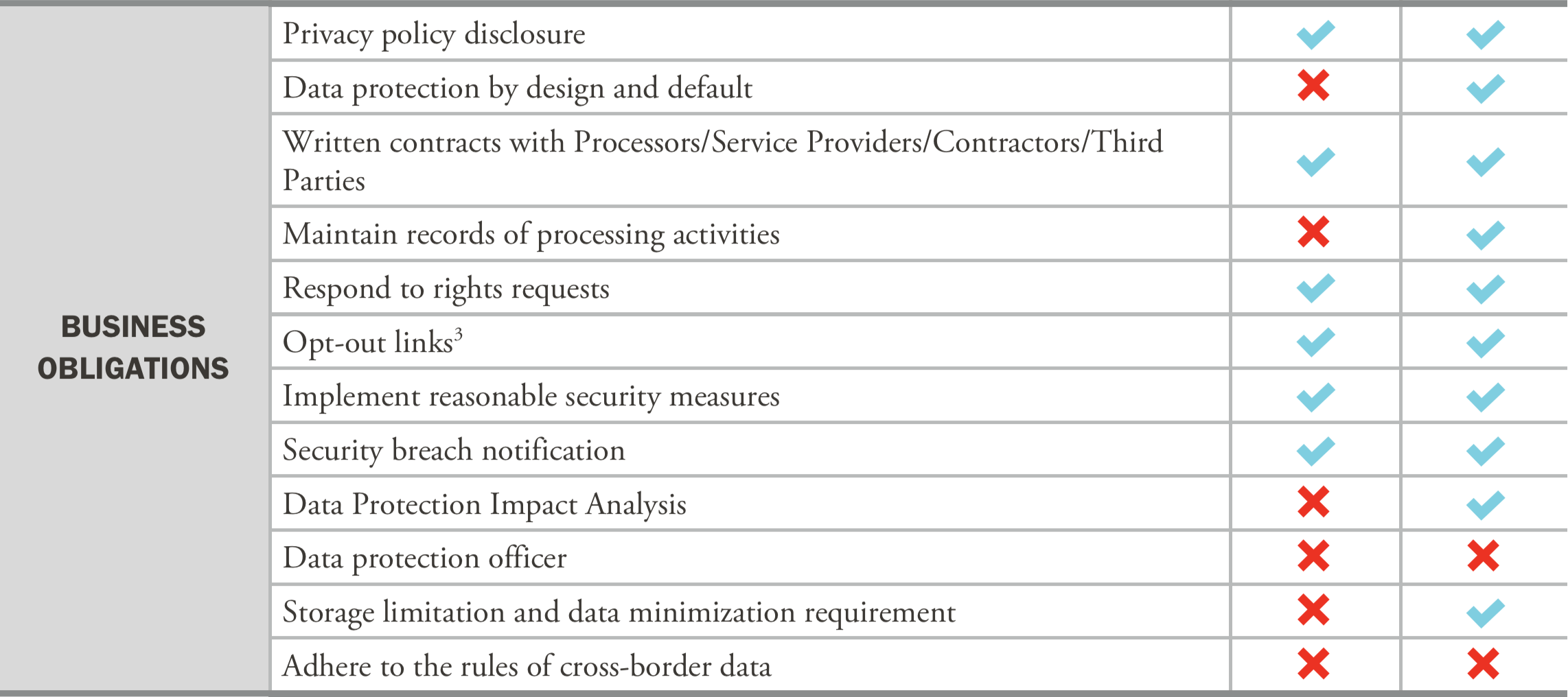
Passed on November 4, 2020, Proposition 24—now known as the California Privacy Rights Act (CPRA)—amends and bolsters the existing CCPA. The CPRA, which can be thought of as CCPA 2.0, makes data minimization a must for any business that does business in California, collects consumer data, and satisfies one of the following: has over $25m in annual revenue; makes more than half of its revenue from the sale of consumer data; or processes the personal information of more than 100,000 California residents or households.

The CCPA has been enforced since July 1, 2020, and enforcement of the CPRA is set to begin in July of 2023; however, there is a “look back” period that begins on January 1, 2022. Any data collected after this date will be subject to the CPRA, so if business leaders are not doing so already, they should prepare for the new obligations.

California Consumer Privacy Act (CCPA) vs. California Privacy Rights Act (CPRA)
California Consumer Privacy Act (CCPA) v. California Privacy Rights Act (CPRA)
1. B2B and employee information exempted until Jan 1, 2022; 2. B2B and employee information exempted until Jan 1, 2023.

With a new category for “sensitive personal information,” data minimization is vital

Already a core component of the GDPR, data minimization is set to become an important part of the CPRA. According to Section 1798.100(c), the CPRA prevents businesses from collecting more personal information than is “reasonably necessary and proportionate to achieve the purposes for which the personal information was collected or processed.” Likewise, businesses are not to retain such personal information for any longer than is reasonably necessary [Section 1798.100(a)(3)].

The CPRA creates a new category for “sensitive personal information.” This includes social security numbers, driver’s license numbers, precise geolocation data, race, ethnicity, religion, sexual orientation, union membership, philosophical beliefs, genetic data, biometrics, and other health information. This is an extremely broad definition, making corporate data minimization (and data mapping) more important than ever.

The corporate liability for data breaches expands

Under the CPRA, data breaches will be particularly painful for companies that see their customers’ personal information compromised. The CPRA expands the existing law, allowing customers to bring legal cases against a company if their email address, password, or any other personal information is compromised during a breach.

California Consumer Privacy Act (CCPA) v. California Privacy Rights Act (CPRA) 33. The CPRA expands the CCPA’s “Right to Opt-Out” to include not only the sale, but also the sharing of personal information. Businesses that share personal data are “covered businesses,” regardless of whether these businesses make money from this sharing.

The creation of a new watchdog group

Perhaps the most obvious new provision of the CPRA is the creation of a new government agency tasked with handling compliance and enforcing the law. This California Privacy Protection Agency (CPPA) will be comprised of a five-member board, which will be announced later this year. Additionally, there will be a Chief Privacy Auditor who will be responsible for auditing businesses and liaising with European data protection agencies. Working on a three-pronged front, the agency will be tasked with additional rule-making, enforcement of the law, and some education initiatives. In regard to the education component, the agency will periodically allocate some of its annual budget to educating consumers and businesses about CPRA compliance.

We can expect to see more audits under the CPRA

If an organization processes enough personal information to be deemed a significant risk to consumer privacy or security, the aforementioned agency and the Chief Privacy Auditor will conduct an annual cybersecurity audit of the organization. Additionally, all high-risk organizations will be mandated to submit regular risk assessments to the agency as well.

California Consumer Privacy Act (CCPA) v. California Privacy Rights Act (CPRA) 4

With new provisions for automated decision-making technologies, consumer rights are bolstered

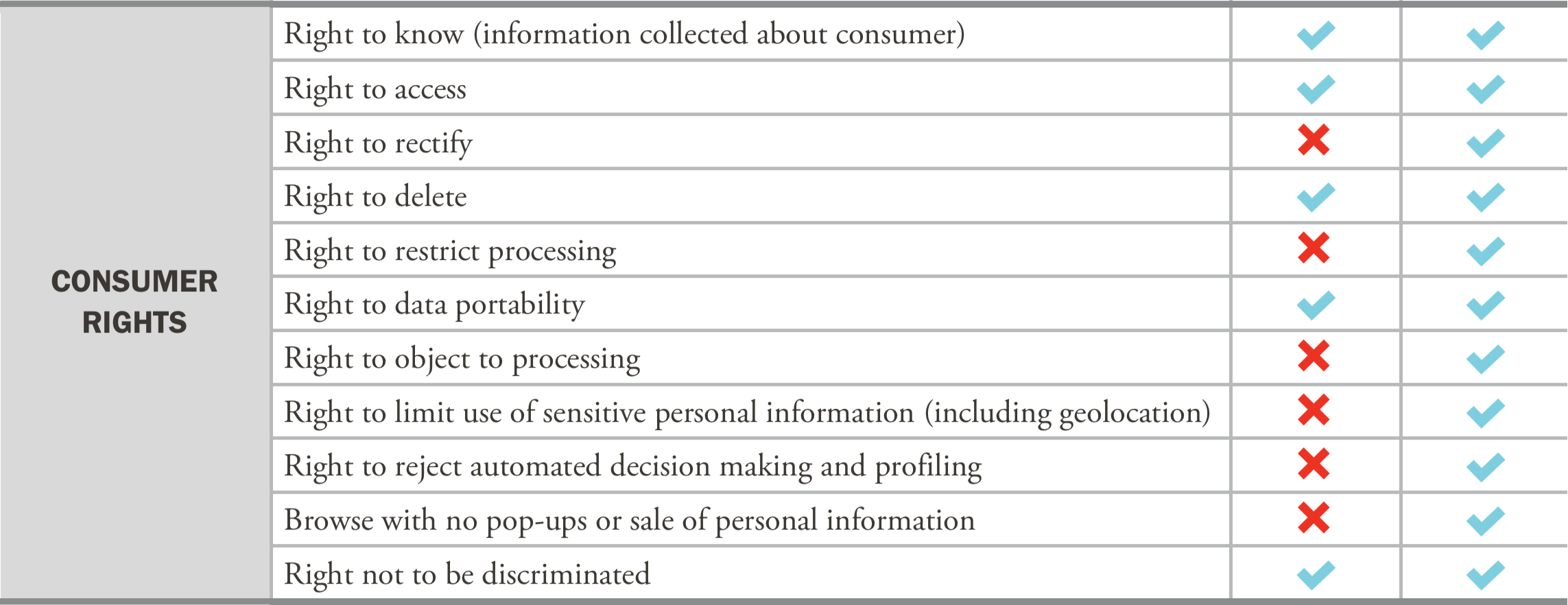
Under the CPRA, for the first time, consumers can opt-out of automated decision-making technologies. Consumers can inquire about the nature of the AI-based models your organization is using, as well as how their personal information is being used in such models. If any consumers object to their inclusion in these models, organizations must remove these customers’ data.

Consumers have more ways to restrict corporate data processing

Whereas the CCPA currently requires businesses to include a “Do not sell my information” link, the CPRA takes things a step further, mandating a “Do not sell or share my personal information” link, as well as a “Limit the use of my sensitive personal information” link.

The inclusion of “sharing” is an important modification of the CCPA. Under the CPRA, now covered businesses are responsible for not only the selling of consumer data, but also the sharing of such data. This includes any sharing of consumer data “to a third party for cross-context behavioral advertising, whether or not for monetary or other valuable consideration.” [Section 1798.100(a)(3)]

California Consumer Privacy Act (CCPA) v. California Privacy Rights Act (CPRA) 2*Charts from Frost, Brown, Todd LLC

How best to prepare for the CPRA

If you’re already in compliance with the GDPR, you likely won’t have too much to worry about when the new regulatory agency begins enforcing the CPRA in July 2023. That said, the “look back” period is less than a year away, so it’s important to review your CCPA compliance and, if necessary, revamp your processes to meet the new requirements of the CPRA. Below are some suggested steps to take to ensure that your business will be ready.

1. Cut out all superfluous data collection. Much like the GDPR, the main goal of the CPRA is to ensure that organizations do not collect any more customer data than they need. As a best practice, be sure to only collect information on your customers that you absolutely need; make sure you only collect that data for the purpose in which you need it, and don’t keep any of this data for any longer than necessary.

2. Create a data inventory. Through the creation of a data inventory, you can maintain a handle on your data at all times. With a data inventory, you’ll know exactly what personal information has been collected and, importantly, why it’s been collected.

A data inventory will also help you account for retention periods—how long is the data being collected?—as well as the involvement of any third-party recipients—is the data being shared with any other organizations? To be sure, the creation of a data inventory is a crucial step in CPRA compliance, as it helps with audits and subjects’ access requests. It also helps you know exactly which applications and systems the consumer data is on, as well as whether these apps and systems are internal or external.

3. Track the trajectory of your collected data. Before the CPRA comes into effect, be sure to have your data flows in order. With data maps and data flow diagrams, you can effectively track the trajectory of your data. As mentioned earlier, companies need to ensure they are keeping track of any data that qualifies as “sensitive personal information” under the CPRA’s new definition.

Conclusion

Overall, the CPRA expands upon the CCPA, as it bolsters consumers’ rights; accounts for new algorithmic decision-making technologies, and takes a more comprehensive view of what qualifies as “sensitive personal information.” It also creates a new regulatory agency and expands the corporate liabilities for data breaches. To put it simply, if corporations are not already taking consumer data privacy seriously, they need to start. Although the law passed earlier in the year, it will not be enforced until January 2023. Nevertheless, we’ll keep you up to date on any additional changes as they come along.

John Donegan

John Donegan

Enterprise Analyst, ManageEngine

Want to read<br>this article on the go?

Want to read
this article on the go?

Do it on the ManageEngine
Insights app.

Published on April 14, 2020 | 4 min

With strict data protection laws in place around the world (including GDPR and CCPA), it’s vital that the data protection officer (DPO) and CISO work closely together. Although part of the DPO’s job is to audit the CISO’s security policies, it is essential that the DPO and CISO have a good rapport. Essentially, CISOs are concerned with security and confidential data, and DPOs are focused on privacy and personal data.

The CISO examines security issues from a business and operations’ standpoint. While bolstering an organization’s cybersecurity posture, the CISO strives to ensure that all company information is securely processed. The DPO is primarily concerned with how the organization handles personal data. This can include data minimization, communication with data subjects, rights management, storage minimization, data collection, and data processing.

Data Minimization


One of the DPO’s main goals is to ensure that no unnecessary customer data is processed. If any personal data is processed, it should not be kept beyond a certain date (as per the commitment mentioned in the privacy policy), and customers must be informed about the nature of the data processing.

Data minimization involves storing less personal data, which shrinks the overall attack surface. This is important when it comes to the collaboration between the DPO and CISO. With the DPO helping to minimize the amount of collected data, the CISO is able to maintain a higher level of security.

For example, perhaps your organization issues a sign-up form that asks for an email address, phone number, and Social Security number. The CISO will mostly be concerned with how the data is protected. Conversely, the DPO will likely ask questions such as, “Why are we even collecting this information?” and “Do we need to process (store, use, or transfer) this data?” By asking questions like these, the DPO helps the CISO’s security team effectively — and proactively — protect data.

Create an Activity Register


In modern digital organizations, there are many data flows coming from a variety of different sources. By creating a register, the DPO can help the CISO monitor the various data flows. An effective activity register will answer questions such as “Where exactly is this information being used?,” “Who is using it?,” and “To whom is this data being transferred?” Again, the CISO is interested in this information from a security standpoint, and the DPO has privacy concerns.

During the creation of an activity register, assess whether the data is personal in nature. Sometimes, whether the data is personal depends on the context. For example, perhaps a customer only provides a company with her home address. If this home address can be traced back to the individual, then it’s personal data. Due to nuances like these, it’s helpful to have a DPO with a legal background.

Data Protection by Design


Another way that the DPO and CISO can effectively work together is during product inception. By working closely with an organization’s developers, the DPO and CISO can proactively build data protection into the company’s products.

For example, during the creation of essential and nonessential cookies, the CISO will have concerns related to security vulnerabilities, and the DPO will have privacy concerns. From a security perspective, the CISO wants to ensure that the essential cookies — those used for tracking logged-in sessions and providing user-related functionality — are protected. This way, no impersonation can occur.

And from a privacy perspective, the DPO will be concerned about nonessential cookies, such as advertising cookies used to display ads. The DPO must ensure that the list of cookies is displayed to the website users, and that users can opt out of some cookies without significantly degrading website performance.

Thus, close collaboration between the CISO and the DPO during the cookie creation process can be effective from both a privacy and a security standpoint.

Handling Breaches and Privacy Violations


Another instance in which DPOs and CISOs should work closely together is in the event of a data breach or privacy violation. Incidentally, these are often disparate events. For example, perhaps a customer is given a contact form, and the phone number is used later to sell him or her a product. If there was not a link to the privacy policy on the contact form, this would be a privacy violation, but not a breach. Alternatively, perhaps there was a data breach; however, only source code was stolen. This would be a data breach but not a privacy violation.

Nevertheless, to assess the situation, the DPO and the CISO should closely collaborate. This is especially important during a breach, as fines can incur if the company doesn’t alert authorities about an incident in time.

Impact Assessments


After a breach, organizations should conduct a risk assessment during which the DPO functions in an advisory role. In addition to auditing the CISO’s existing security infrastructure, the DPO should offer advice for the future. With the help of the CISO, the DPO can answer questions such as “Can an incident like this happen elsewhere?,” “How can we protect against this moving forward?,” and most importantly, “Should we be collecting this personal data at all?”

Conclusion


By working closely, the DPO can help the CISO secure data more efficiently by collecting only the most necessary data and keeping customers well-informed about the transfer and usage of data. With the DPO and CISO working together, the transfer of data from one place to another can be transmitted securely and legally, greatly reducing the chance of a security breach occurring and ultimately helping the organization save time and money.

Disclosure: This article was originally published in Dark Reading. 

Rajesh Ganesan

Rajesh Ganesan

CEO at ManageEngine (Zoho), ManageEngine

Want to read<br>this article on the go?

Want to read
this article on the go?

Do it on the ManageEngine
Insights app.

Subscribe to data minimization

Thanks for subscribing to ManageEngine Insights. If you do not receive our welcome email, please check your SPAM folder.