
Published on June 19, 2025 | 5 min

The average healthcare data breach now costs $9.8 million, but for reproductive health data, the stakes extend far beyond financial penalties. Healthcare providers now face potential criminal liability and staff reluctance to document care—not to mention the operational nightmare of maintaining different data practices across U.S. state lines.

As HIPAA faces mounting criticism from across the political spectrum and Americans’ trust in healthcare plummets to 40%, healthcare leaders face an urgent question: how can organizations protect sensitive data when the regulatory ground continues to shift? This article helps CIOs and CPOs build comprehensive reproductive health data governance frameworks that anticipate policy changes and prioritize patient trust, no matter the type of care.

How Dobbs created data chaos across state lines

The Supreme Court’s 2022 Dobbs v. Jackson Women’s Health Organization decision did more than just overturn Roe v. Wade—it exposed gaps, uncertainties, and challenges in HIPAA’s ability to protect reproductive health data. This has never been more apparent than in 2025, when the same data is treated differently depending on geography:

Abortion reporting requirements: Texas mandates extensive abortion reporting including patient demographics, payment methods, complications, reasons for the procedure, and compliance with state counseling requirements. New York, on the other hand, only reports if a patient specifically requests certain information.

Digital health app protections: Virginia prohibits search warrants or subpoenas for menstrual and fertility data from third-party apps. Conversely, states like Texas and Louisiana offer no such protections, leaving period trackers and fertility apps open to law enforcement requests during abortion investigations.

Interstate data sharing restrictions: Washington’s My Health, My Data act blocks sharing reproductive health data with out-of-state law enforcement if the data could be used to investigate or penalize care. Meanwhile, 17 states are suing to invalidate HIPAA protections, potentially exposing patients and providers to criminal liability across state lines.

If your healthcare system operates in multiple states, you already know how this regulatory patchwork leads to a volatile data governance situation. These conflicting requirements create serious business risks for organizations, with documented cases showing the increasing costs of inadequate preparation.

The business case for proactive data governance

As mentioned earlier, the financial and reputational stakes for protecting reproductive health data continue to escalate as existing frameworks fall short. Here are a few examples of actual liability cases involving healthcare organizations and breaches of reproductive health data:

Impermissible disclosure: In Pennsylvania, a patient authorized Holy Redeemer Family Medicine to release a single test result unrelated to reproductive health to a prospective employer. Instead, the provider disclosed the patient’s full medical record, including reproductive health information. The Office for Civil Rights (OCR) fined the organization $35,581 for impermissible disclosure under HIPAA.

Unauthorized access: Gulf Coast Pain Consultants in Florida allowed a former contractor to access 34,310 patient records, including reproductive health information. OCR found failures in risk analysis, access control, and monitoring, resulting in $1,190,000 in fines for multiple HIPAA Security Rule violations.

Network security breach: ORM Fertility in Oregon recently experienced a security breach involving unauthorized network access. While electronic medical records were reportedly not accessed, some patient data—including fertility-related lab data—was exposed. ORM reported the breach to HHS, and review is ongoing.

These incidents illustrate how reproductive health data governance failures create cascading risks that go far beyond initial breach costs. Healthcare leaders who implement technical safeguards can help their companies address vulnerabilities proactively rather than face penalties and investigations after incidents occur.

Technical safeguards for reproductive health data protection

CIOs looking to guide their companies through policy changes regarding reproductive health data should implement the following safeguards. These measures protect organizations from penalties and investigations while preserving patient trust:

Encryption standards and compliance: Conduct an immediate audit of all systems handling reproductive health data to identify encryption gaps, then implement current industry-standard encryption for data at rest and in transit with established guidelines.

De-identification framework development: Use research-based de-identification methods to scrub data of both obvious (e.g. name, contact information) and indirect identifiers (device IDs, usage patterns, location data) that could compromise patient anonymity. Train data teams on the heightened sensitivity of reproductive health information with clear approval workflows for data access.

Cloud storage jurisdiction management: Map current cloud storage locations and assess jurisdictional risks for reproductive health data across regions with different laws. Establish clear data residency requirements and create migration plans to move sensitive data to compliant regions, supported by monitoring systems that track data location and movement with real-time compliance alerts.

Third-party app integration security controls: Develop comprehensive vendor risk assessments specifically tailored to reproductive health app integrations, including period trackers and fertility apps. Select vendors that have adopted strong privacy safeguards, such as implementing data minimization practices or offering anonymous modes.

CIOs should recognize, however, that varying state regulations may limit vendors’ ability to maintain their commitments universally and should verify that stated policies align with actual technical implementations through regular audits and compliance reviews.

Implementation strategies from leading health systems

Effective reproductive health data governance requires more than just technical safeguards: CIOs and CPOs in the U.S. should look to leading health systems and professional associations that have integrated professional guidelines, staff training, and policy frameworks into their implementation strategies. The examples below prove comprehensive governance is achievable, even in complex regulatory environments:

Cleveland Clinic: Cleveland Clinic co-founded the MOBY.US consortium for male infertility data, demonstrating how to standardize high-quality reproductive health data sharing under strict use agreements and IRB oversight.

AccessMatters: Philadelphia-based public health non-profit AccessMatters partners with health organizations to deliver evidence-based training focused on trauma-informed, equity-centered reproductive health care.

American College of Obstetricians and Gynecologists (ACOG): ACOG develops national clinical guidelines and provides implementation toolkits including staff training modules, patient education materials, and policy templates.

CDC’s Division of Reproductive Health (DRH): Before its elimination by federal budget cuts, the DRH enabled public health researchers and practitioners to track maternal and infant health, evaluate interventions, and inform their own policies and clinical practice.

The dismantling of proven frameworks like the DRH makes coordinated governance even more critical, as organizations must now fill gaps left by reduced federal oversight. As it stands, healthcare leaders must take matters into their own hands to develop comprehensive frameworks for reproductive health data governance.

Key takeaways

As regulations continue to morph across state lines and the current administration axes critical federal resources, the window for action is narrowing. CIOs and CPOs must take the following critical steps to protect reproductive health data:

  1. Address vulnerabilities proactively to reduce financial exposure and maintain patient trust.
  2. Implement core technical safeguards: encryption, de-identification, cloud jurisdiction management, and secure third-party integrations.
  3. Build on the frameworks established by leading health systems and professional associations.

Organizations that act now will be positioned to navigate future regulatory changes while maintaining patient trust. Those that wait risk facing the escalating penalties and operational chaos that come with reactive compliance.


Lauren Spiller

Lauren Spiller

Enterprise Analyst, ManageEngine

Want to read<br>this article on the go?

Want to read
this article on the go?

Do it on the ManageEngine
Insights app.

Published on September 08, 2023 | 6 min

The world is drowning in spam calls, and India is no exception.

With spam calls from fake bank employees and insurance agents, we wonder, “How did they get my data?” But, we often just move on, mainly for two reasons: no awareness about individual rights among consumers and lack of accountability among businesses who collect and share personal data. So, it’s pretty safe to say that India’s new data protection law couldn’t have come at a better time.

India’s most recent stride in personal data protection comes in the form of the Digital Personal Data Protection (DPDP) Act, 2023, which received approval from the Rajya Sabha (the upper house of the Parliament) on August 4, 2023.

This development follows numerous iterations, a response to the growing demand for better data oversight and privacy safeguards. This legislative milestone sets the stage for how personal data is collected, used, and stored, giving individuals authority over their own data, so they can dictate how it will be used.

Even though the DPDP Act arrived at a time of exponential digital growth in India, it’s not flawless and criticisms run rampant. It’s far from being as strong as the data protection laws of other countries, such as Europe’s General Data Protection Regulation (GDPR), which is considered one of the best laws for data privacy.

Let’s dissect the hype and simplify some of the important parts of the act. We’ll also discuss what India could have done better—a few points for the next iteration, if you will.

What is personal data under the new law?

First things first, what exactly does personal data mean now?

The new law defines personal data as “personal data in digital form,” including name, address, phone number, email address, gender, date of birth, physical characteristics (such as height, weight, and eye color), location data, IP address, social media handles, employment status, and criminal history.

A key feature of the DPDP Act recognizes certain data as highly sensitive data, such as an individual’s sexual orientation, genetic data, biometric data, and health information, requiring stricter protection.

Under the new law, any entity collecting such data should provide a detailed invoice to the user. This invoice should include a description of the personal data they intend to collect and how it will be processed.

What new regulations will businesses need to comply with?

The DPDP sets out a number of rules for how businesses can process personal data. These rules are:

  • Businesses must obtain explicit consent from individuals to process their personal data.

  • Businesses must adopt appropriate measures against unauthorized access, misuse, alteration, and deletion of personal data.

  • Businesses must comply with the rights of individuals to restrict, object to, and withdraw consent of the processing of their personal data.

The new law establishes the Data Protection Board (DPB) to oversee compliance. The DPB is granted the power to investigate complaints, issue compliance notices, and impose penalties for violations of the law.

Whether it’s a big corporation or a startup, the DPDP Act applies to every business and every individual who handles personal data within Indian borders. When a business is compliant, it offers them numerous benefits such as:

Data-driven innovation

Indian companies that comply with the DPDP Act can attract more customers and drive increased sales, resulting in the accumulation of additional data in their hands. This can then be harnessed to uncover fresh avenues for customer insights, personalized marketing, and product development—all while upholding stringent privacy and security standards. This innovative approach can potentially spark the creation of entirely novel products or services based on customer needs.

Fostering cybersecurity initiatives

The DPDP Act serves as a catalyst for strengthening India’s cybersecurity infrastructure. It creates a secure digital environment for businesses and individuals alike while paving the way for India to become a leader in cybersecurity. This can lead to the development of homegrown cybersecurity solutions, fostering a dynamic and competitive cybersecurity industry within India.

Better reputation, investment, and innovation

As India aligns its data protection standards with global best practices, companies can more readily compete in international markets. Businesses that can demonstrate a strong commitment to data privacy and security are likely to be more attractive to global partners and customers.

What criticism has the act received?

Some believe that the law is too complex or burdensome to comply with for small or medium businesses. Others argue that the law places a lot of power in the hands of the government, which opens new avenues for its misuse.

The law is too complex and burdensome for businesses to comply with

The DPDP Act is a complex law, making it difficult to understand and comply with for small businesses. Organizations might be fined heavily due the ambiguity around some clauses (discussed further down).

The law does not go far enough in protecting the privacy of individuals 

The act allows businesses to process personal data in certain limited circumstances if it is covered in the contract of the business and if it is necessary to provide the promised features of the business. Critics argue that this could lead to businesses overstepping their bounds and processing personal data without adequate justification.

The law gives too much power to the government

The act places the power to appoint the members of the DPB in the hands of the Central Government. Furthermore, the law gives the government the power to access personal data without a warrant in certain circumstances. This has raised concerns that the DPB could be misused by the government to track certain individuals of personal or political interests.

The law might stifle innovation in the digital economy

While the new law will welcome new investments in products and solutions, the other side of the spectrum argues that the DPDP Act will stifle innovation in the digital economy. The new law’s requirements for consent and data protection could make it more difficult for businesses to market their products on a scale that they are used to.

How does the DPDP Act stack up to other regulations like the GDPR?

Despite drawing from the GDPR, there are a lot of places where the Indian data protection law falls short. For example, the GDPR covers everyone who resides in the EU, businesses operating in the EU, and any business operating inside or outside the region that keeps track of the data of EU individuals. The DPDP Act only applies to organizations working in India with the data of Indian residents and contains a few weak clauses around cross-border transfers of Indian data.

Unlike the GDPR, which requires clear permission from individuals for the use of their data, the DPDP Act lets companies use personal data without permission in a wider range of circumstances. This makes the rights of Indian residents weaker compared to those who are covered under the GDPR. Lastly, the GDPR can fine rule-breaking groups up to €20 million or 4% of their yearly global income, whichever is more. In contrast, the DPDP limits fines to ₹5 crore (about $670,000), which might not be significant for big corporations, reducing their fear of consequences.

A missed opportunity

Some of the terms used in the act are ambiguous and confusing, which could lead to different interpretations and levels of protection for individuals’ personal data.

One such term is “certain legitimate uses.” This term is not defined in the act, and it is unclear what constitutes a “legitimate use” of personal data. This could result in data fiduciaries adopting different levels of protection for specific use cases.

The act also requires data fiduciaries to take “appropriate” technical and organizational measures to protect personal data from unauthorized access, use, disclosure, alteration, or destruction. However, it does not specify what constitutes appropriate security measures.

Finally, the act requires data fiduciaries to be “accountable” for their compliance with the new laws. However, it does not specify how data fiduciaries should demonstrate their accountability, which could make it difficult for individuals to hold data fiduciaries accountable for data breaches or other violations.

Ending on a brighter note

The DPDP Act is a complex law with the potential to offer a number of benefits to individuals and businesses. Organizations rooted in IT management, artificial intelligence, IoT, robotic process automation, and Web 3.0 deal with a ton of personal data, and this act will promote innovation and ensure ethical handling of data.

Businesses should start preparing for compliance by investing in security and asset management software, hiring data protection experts, and developing a compliance plan. The easiest way to start with compliance is using or partnering with software providers who comply with the law as soon as possible.

The DPDP Act is a major step forward for data protection in India and is a welcome move by Indian residents, especially in the age of rampant cybersecurity attacks and data misuse.

Samudhra Sendhil

Samudhra Sendhil

Enterprise Analyst, ManageEngine

Want to read<br>this article on the go?

Want to read
this article on the go?

Do it on the ManageEngine
Insights app.

Published on July 07, 2023 | 5 min

With a policy vacuum on Capitol Hill, there has been a flurry of state-level activity over the past year. Five more states passed laws in 2023, bringing the total number of state-level data privacy laws to ten.

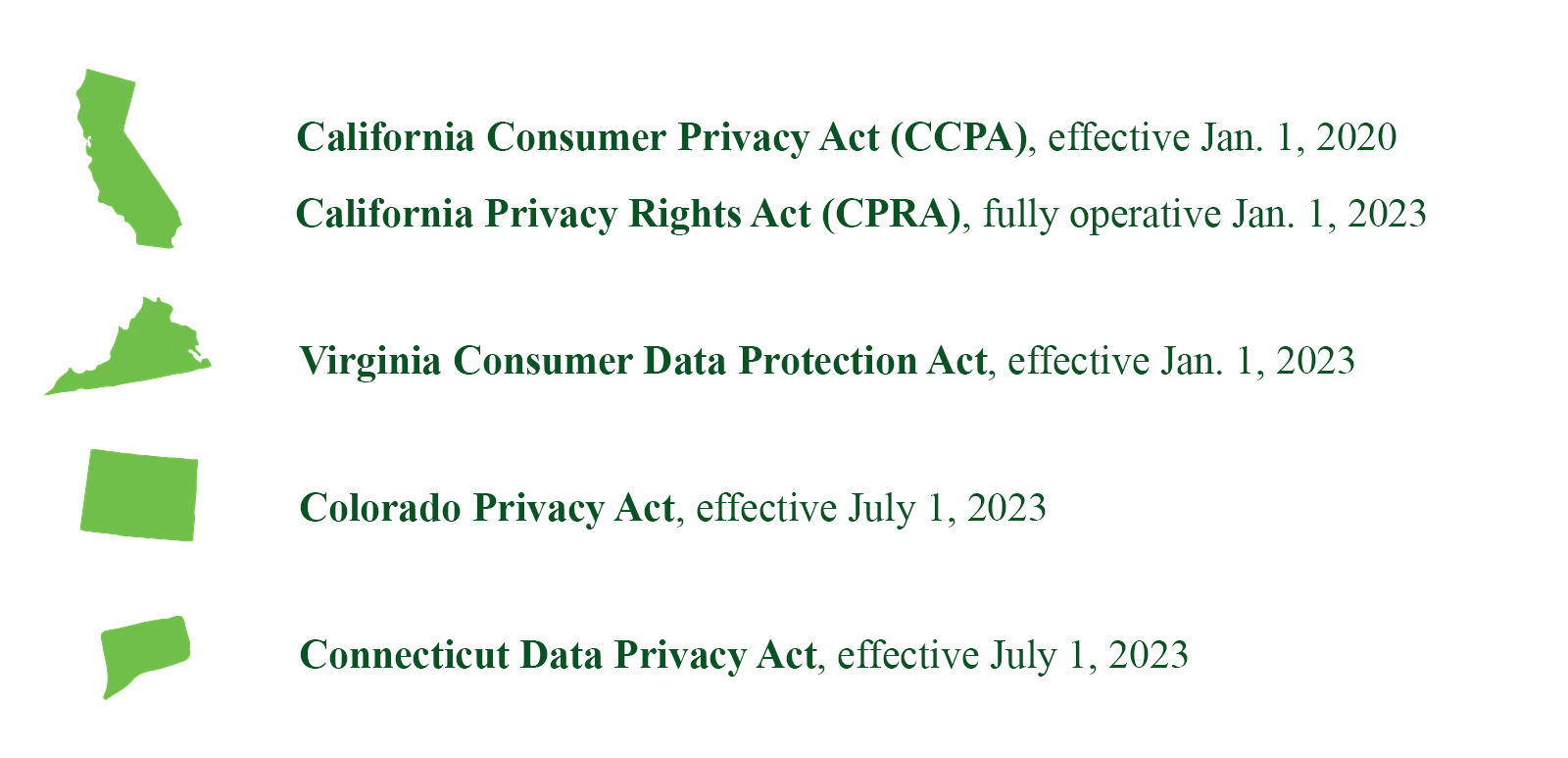
California and Virginia already have operative data privacy laws, and on July 1, laws from two more states—Colorado and Connecticut—came into effect.
CA, VA, CO, CT privacy laws
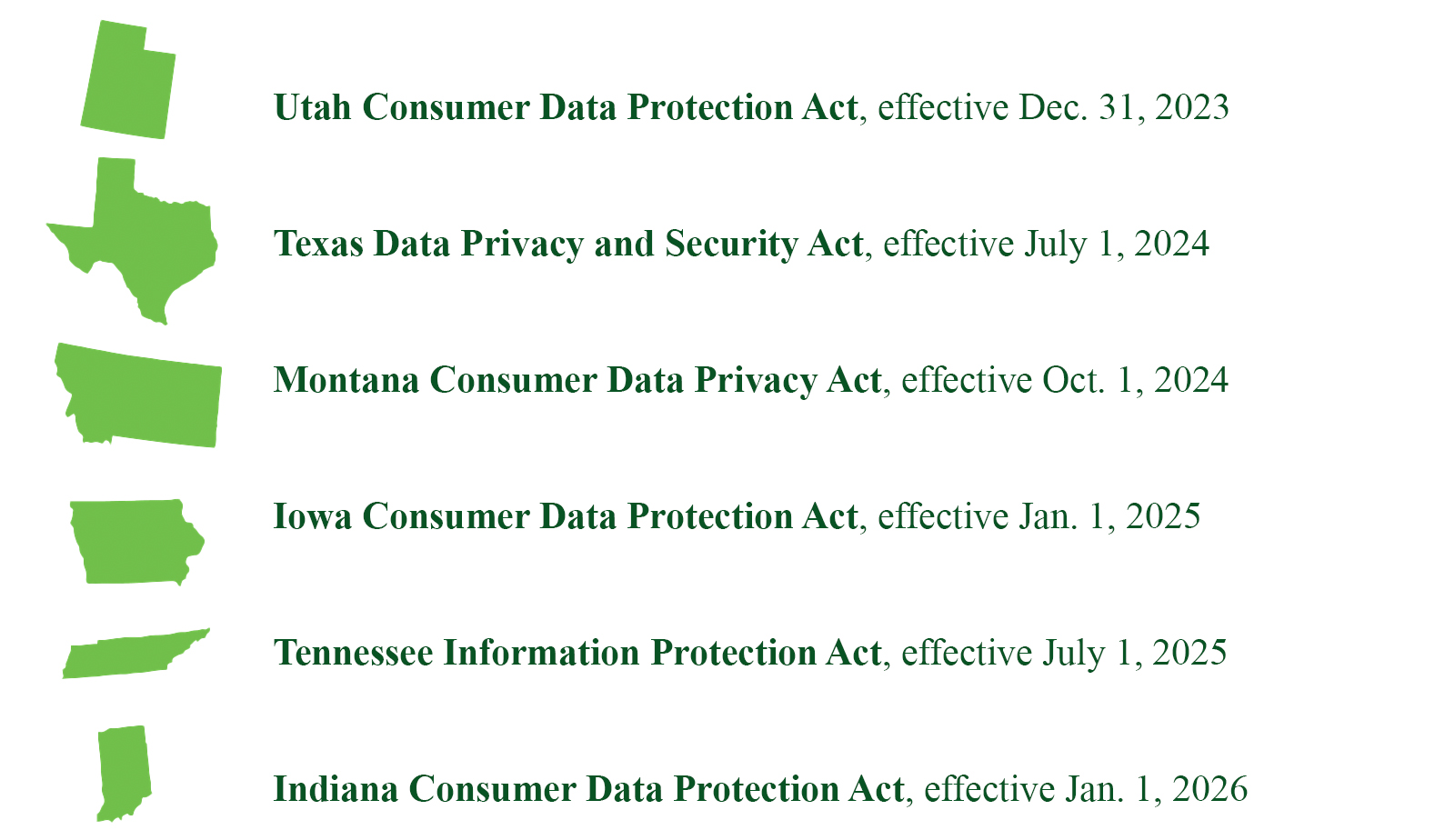
Six other states—Utah, Texas, Montana, Iowa, Tennessee, and Indiana—have passed laws; however, these have yet to take effect. Although these six states are all predominately red, each has different rules related to consumer rights and business obligations. In some cases, the differences are massive.
UT, TX, MT, IA, TN, IN privacy laws
Take Montana, for example. According to recent reporting from Politico, Montana resisted a great deal of Big Tech lobbying. Despite complaints from the State Privacy and Security Coalition, Montana legislators refused to remove “universal opt-out requirements,” which essentially allow Montanans to opt-out of tracking with a single click. Additionally, Montana legislators refused to allow carve-outs for “pseudonymous data,” which would have allowed tech companies to continue to track consumers who have opted out.

Lobbyists advocated for a provision that would have provided companies with time to remedy a violation before accruing a fine; however, it was to no avail, as Republican Gov. Greg Gianforte and bill sponsor Sen. Daniel Zolnikov (R-MT) didn’t take the bait.

Speaking about the lobbyists’ attempts to get him to water down the bill, Zolnikov colorfully said, “I’m not an idiot, and you treating us in Montana like a bunch of rural backwoods folks is quite an insult as well.”

Suffice it to say, it is too simplistic to assume that blue-leaning states offer tougher consumer data privacy legislation than red-leaning states. In an effort to highlight the myriad differences between the states’ data privacy legislation, the International Association of Privacy Professionals (IAPP) provides an excellent chart of all the consumer privacy bills, which they update frequently. It shows the bills’ statuses: Introduced, In Committee, In Cross Chamber, In Cross Committee, Passed, and Signed.

Additionally, the chart highlights the states’ various, and varying, consumer rights—e.g., right to access; right to correct; right to delete; right to opt-out of certain processing; right to portability; right to opt-out of sales to third parties; right to opt-in for sensitive data processing; right against automated decision making, and private right of action, which is essentially the consumers’ right to seek civil damages for a business’ violation of the law.

IAPP’s chart also lists the state laws’ different business obligations—e.g., opt-in defaults, which require businesses to treat a consumer under a certain age with an opt-in default for the sale of his or her personal information; transparency requirements, risk assessments, and processing limitations.

Minimize your data collection, processing, and usage.

I would be remiss if I didn’t point out that the best course of action would be to abstain from collecting, processing, trading, selling, and otherwise handling sensitive consumer data in the first place. If possible, you should comply with the most stringent laws (e.g., CPRA, GDPR) and adhere generally to the principle of data minimization, which states that one should only handle user data that is essential to the task at hand, and only for as long as that task takes.

However, not every company can completely abstain from processing consumer data. For such companies, here are a few ways to navigate the myriad data privacy laws in the states:

Identify which, if any, laws apply to your business.

Each state has a different threshold for companies doing business in its state. There are thresholds that pertain to the number of customers in the state, the percentage of revenue attributable to the sale of personal data, and a minimum number of customers.

For example, the Virginia law—which incidentally was based on a bill drafted by an Amazon lobbyist—only pertains to either (1.) businesses that have at least 100,000 customers in Virginia, or (2.) businesses that have at least 25,000 consumers and make at least 50 percent of its gross revenue from the sale of personal data. Also, if one’s business doesn’t have at least an annual revenue of $25 million, the Virginia law isn’t applicable.

Aside from these basic thresholds, there are many other ways in which a state’s law may not pertain to your business. States have different regulations related to the types of data that an organization is allowed to collect and how that data can be used.

Some states have processing loopholes; for example, laws in Iowa, Utah, and Indiana—some of the weakest in the country—have a rather broad definition of what it means to “sell” user data. If you’re not explicitly charging money for user data in those states, you’re likely in the clear.

Review your service contracts with third-party vendors; frequently update your internal and external privacy policies, and have an incident response plan in case of a cyberattack.

As a best practice, it’s prudent to build data protection clauses directly into the contracts you have with your third-party vendors. Even if it’s not required by law today, it may be down the road. You don’t want to be held liable for data protection mistakes made by your vendors. Also, when in doubt, put things in writing. Auditors—and regulators—need to see written procedures for information collecting practices. Also, have an incident response plan and ensure that your privacy policies are up-to-date and accurate.

Err on the side of caution, and look to California and Europe.

Of the ten state laws in the U.S., California is the most stringent; thus, you’re probably in compliance with the other state-level laws if you comply with the CPRA. However, every business operates differently; these laws are quite granular, and I’m not a lawyer. Thus, in the short term, be sure to have your chief security officer and legal team assess the ten laws.

In the long term, Congress will eventually pass a federal data privacy law. So, if you’re compliant with GDPR in 2023, you’ll most likely be all set by the time the federally mandated bill comes down the pike—whenever that may be.

John Donegan

John Donegan

Enterprise Analyst, ManageEngine

Want to read<br>this article on the go?

Want to read
this article on the go?

Do it on the ManageEngine
Insights app.

IT Security

Social engineering and data protection in the hybrid work era

Published on November 02, 2022

Picnic Corporation founder and CEO Matt Polak discusses social engineering with analyst John Donegan. Among other topics, Polak covers the expanding attack surface, data protection at the corporate and individual levels, and the future of social engineering attacks.

Agenda

    • What is social engineering?
    • Common attack vectors
    • How organizations can protect their attack surface
    • New threats, data brokers, and the ADPPA
    • Ransomware payment bans at the state level
    • The future of social engineering
    • Malicious insiders
    • Best practices for data protection
    • The metaverse
    • Data brokers, social media companies, and regulation
WATCH NOW
John Donegan

John Donegan

Enterprise Analyst, ManageEngine

Catch up on expert <br> videos like this anytime<br>with the ManageEngine <br> Insights app.

Catch up on expert
videos like this anytime
with the ManageEngine
Insights app.

Privacy and Compliance

Strengthening data management processes

Published on October 16, 2020

In addition to the EU’s GDPR, several other data privacy laws are being enforced across the globe. Between these stringent, potentially punitive laws and an increase in remote work due to COVID, there’s never been a better time to strengthen your organization’s data management processes.

Andrew David Bhagyam, head of privacy operations & management at Zoho, discusses best practices for compliance with these data privacy laws, as well as privacy by design, and various ways to effectively train your employees. According to Bhagyam, thinking about privacy issues should be second nature—not just for CISOs and DPOs, but for everyone in the organization.

Agenda

  • Conducting information security and privacy training initiatives
  • The importance of privacy by design
  • Handling subject access requests
  • Incorporating data protection scores
  • The potential impact of CCPA, LGPD, and New York’s SHIELD Act
LISTEN NOW
John Donegan

John Donegan

Enterprise Analyst, ManageEngine

Listen without limits—<br>stream this podcast on <br>the ManageEngine Insights app.

Listen without limits—
stream this podcast on
the ManageEngine Insights app.

Published on April 14, 2020 | 4 min

With strict data protection laws in place around the world (including GDPR and CCPA), it’s vital that the data protection officer (DPO) and CISO work closely together. Although part of the DPO’s job is to audit the CISO’s security policies, it is essential that the DPO and CISO have a good rapport. Essentially, CISOs are concerned with security and confidential data, and DPOs are focused on privacy and personal data.

The CISO examines security issues from a business and operations’ standpoint. While bolstering an organization’s cybersecurity posture, the CISO strives to ensure that all company information is securely processed. The DPO is primarily concerned with how the organization handles personal data. This can include data minimization, communication with data subjects, rights management, storage minimization, data collection, and data processing.

Data Minimization


One of the DPO’s main goals is to ensure that no unnecessary customer data is processed. If any personal data is processed, it should not be kept beyond a certain date (as per the commitment mentioned in the privacy policy), and customers must be informed about the nature of the data processing.

Data minimization involves storing less personal data, which shrinks the overall attack surface. This is important when it comes to the collaboration between the DPO and CISO. With the DPO helping to minimize the amount of collected data, the CISO is able to maintain a higher level of security.

For example, perhaps your organization issues a sign-up form that asks for an email address, phone number, and Social Security number. The CISO will mostly be concerned with how the data is protected. Conversely, the DPO will likely ask questions such as, “Why are we even collecting this information?” and “Do we need to process (store, use, or transfer) this data?” By asking questions like these, the DPO helps the CISO’s security team effectively — and proactively — protect data.

Create an Activity Register


In modern digital organizations, there are many data flows coming from a variety of different sources. By creating a register, the DPO can help the CISO monitor the various data flows. An effective activity register will answer questions such as “Where exactly is this information being used?,” “Who is using it?,” and “To whom is this data being transferred?” Again, the CISO is interested in this information from a security standpoint, and the DPO has privacy concerns.

During the creation of an activity register, assess whether the data is personal in nature. Sometimes, whether the data is personal depends on the context. For example, perhaps a customer only provides a company with her home address. If this home address can be traced back to the individual, then it’s personal data. Due to nuances like these, it’s helpful to have a DPO with a legal background.

Data Protection by Design


Another way that the DPO and CISO can effectively work together is during product inception. By working closely with an organization’s developers, the DPO and CISO can proactively build data protection into the company’s products.

For example, during the creation of essential and nonessential cookies, the CISO will have concerns related to security vulnerabilities, and the DPO will have privacy concerns. From a security perspective, the CISO wants to ensure that the essential cookies — those used for tracking logged-in sessions and providing user-related functionality — are protected. This way, no impersonation can occur.

And from a privacy perspective, the DPO will be concerned about nonessential cookies, such as advertising cookies used to display ads. The DPO must ensure that the list of cookies is displayed to the website users, and that users can opt out of some cookies without significantly degrading website performance.

Thus, close collaboration between the CISO and the DPO during the cookie creation process can be effective from both a privacy and a security standpoint.

Handling Breaches and Privacy Violations


Another instance in which DPOs and CISOs should work closely together is in the event of a data breach or privacy violation. Incidentally, these are often disparate events. For example, perhaps a customer is given a contact form, and the phone number is used later to sell him or her a product. If there was not a link to the privacy policy on the contact form, this would be a privacy violation, but not a breach. Alternatively, perhaps there was a data breach; however, only source code was stolen. This would be a data breach but not a privacy violation.

Nevertheless, to assess the situation, the DPO and the CISO should closely collaborate. This is especially important during a breach, as fines can incur if the company doesn’t alert authorities about an incident in time.

Impact Assessments


After a breach, organizations should conduct a risk assessment during which the DPO functions in an advisory role. In addition to auditing the CISO’s existing security infrastructure, the DPO should offer advice for the future. With the help of the CISO, the DPO can answer questions such as “Can an incident like this happen elsewhere?,” “How can we protect against this moving forward?,” and most importantly, “Should we be collecting this personal data at all?”

Conclusion


By working closely, the DPO can help the CISO secure data more efficiently by collecting only the most necessary data and keeping customers well-informed about the transfer and usage of data. With the DPO and CISO working together, the transfer of data from one place to another can be transmitted securely and legally, greatly reducing the chance of a security breach occurring and ultimately helping the organization save time and money.

Disclosure: This article was originally published in Dark Reading. 

Rajesh Ganesan

Rajesh Ganesan

CEO at ManageEngine (Zoho), ManageEngine

Want to read<br>this article on the go?

Want to read
this article on the go?

Do it on the ManageEngine
Insights app.

Subscribe to data protection

Thanks for subscribing to ManageEngine Insights. If you do not receive our welcome email, please check your SPAM folder.