
Published on November 27, 2025 | 6 min

Ransomware attacks have reached a new level of sophistication in 2025, with cybercriminals employing artificial intelligence (AI) to enhance their strategies. Traditional defense mechanisms are no longer enough to fend off these advanced threats. Organizations must adapt by leveraging AI and automation to stay one step ahead. In this blog, we’ll explore how ransomware has evolved, the role of AI and automation in defense, and practical ways to outsmart these threats.

The 2025 ransomware landscape  

Ransomware continues to be one of the most significant cybersecurity threats in 2025, with cybercriminals increasingly relying on AI to enhance their tactics. In the US, ransomware attacks are becoming more sophisticated, leveraging AI to avoid traditional defenses and increase the success rate of breaches.

Recent high-profile attacks on US organizations—including hospitals, local governments, and financial institutions—highlight the devastating impact of AI-enhanced ransomware. Cybercriminal groups are now using AI to automate their attacks, refine their methods, and target even the most secure systems. For example, in 2025, AI-driven ransomware groups have been able to bypass traditional security measures like firewalls and endpoint protections by analyzing network traffic in real time, identifying vulnerabilities, and launching attacks faster than ever before.

These attacks aren’t just a risk to data integrity—they can cause massive disruptions to daily operations, leading to financial losses, reputational damage, and legal consequences. The combination of AI and ransomware has made it more critical than ever for US organizations to adopt robust, AI-powered defense strategies.

How automation can turn the tables 

While threat actors continue to weaponize automation in their ransomware campaigns, IT and security teams can use the same strategy to build faster, smarter defenses. By automating key security processes—from patching to response workflows—organizations can minimize vulnerabilities, shorten incident response times, and reduce the overall impact of attacks.

Automate patch management before it’s too late

One of the most common ransomware entry points is unpatched software. Automating your patch management processes ensures that known vulnerabilities are closed before they can be exploited. Rather than relying on manual updates, automated systems scan for missing patches, apply them across operating systems and third-party apps, and verify deployment—all on a consistent schedule.

Use AI to detect threats in real time  

Automation combined with AI allows for faster, more accurate threat detection. Modern endpoint tools can recognize unusual file behavior—such as mass encryption or lateral movement—and alert teams before ransomware spreads. Some solutions even use behavioral analysis to isolate threats automatically, reducing the burden on human analysts during critical moments.

Ransomware detection and response in real time  

Automated ransomware detection systems can identify suspicious activity, like mass file encryption or unauthorized privilege escalation, using behavioral analysis and AI. Once a threat is detected, automation allows you to contain it quickly—isolating endpoints, revoking access, and launching predefined incident response workflows before human intervention is even needed.  

Rely on automated, resilient backups  

Backups remain one of the most reliable ways to recover after an attack. But backups only help if they’re recent, secure, and accessible. Automating data backup and recovery ensures backups are taken on schedule, stored in protected formats, and regularly tested—reducing downtime and helping you bounce back without paying ransom.  

Proactive threat monitoring and policy enforcement  

Security shouldn’t stop at response. Continuous, automated threat monitoring enables real-time visibility into unusual access patterns, login anomalies, and lateral movement—helping organizations catch potential threats before they escalate. It also supports consistent enforcement of critical policies—like privilege access, multi-factor authentication (MFA), and data loss prevention (DLP)—particularly in complex or distributed IT environments.

AI-driven defense strategies  

To effectively combat AI-driven ransomware, organizations should adopt several AI-powered defense strategies. These not only help against financially motivated attackers but also prepare businesses for ideologically driven threats, such as those posed by hacktivists.

1. Implement Zero Trust architecture  

Zero Trust security models operate assuming that every request for access should be verified, regardless of whether the request came from inside or outside the network. This makes it much harder for attackers to gain a foothold—even if they manage to bypass the initial layers of defense—as they are continuously scrutinized.

2. Use AI for threat detection  

AI can be used to identify anomalous behavior that might signal the onset of a ransomware attack. By analyzing network traffic, user behavior, and system interactions, AI can detect deviations from the norm in real time and raise alarms before an attack escalates. This early detection can help IT teams take swift action, preventing further damage.

3. Automate incident response  

When a ransomware attack does occur, time is of the essence. Automated incident response systems can immediately isolate infected devices, block malicious traffic, and initiate backup restoration processes—all without the need for human intervention. This rapid response can significantly reduce the damage caused by the attack.

4. Ensure regular updates and patching  

AI-driven tools can continuously monitor software and systems for vulnerabilities, automatically patching them as soon as updates are available. This proactive approach ensures that attackers cannot exploit known vulnerabilities.

5. Support employee training and awareness  

While AI and automation are critical, human error remains one of the biggest security risks. Weak passwords, in particular, are a common entry point for ransomware. Poor password practices continue to undermine even the most advanced defenses. Regular training on phishing awareness and strong password habits—combined with automated tools that flag suspicious activity—can greatly reduce the chance of a successful attack.

The CIO’s role in leading AI-powered cybersecurity 

In today’s threat landscape, the Chief Information Officer (CIO) plays a pivotal role in shaping an organization’s AI-driven cybersecurity strategy. Beyond overseeing technology investments, the CIO must lead a cultural transformation—shifting cybersecurity from a siloed IT concern to a shared business imperative. 

1. Champion cybersecurity as a business priority  

To embed security into the fabric of the organization, CIOs must position it as essential to business continuity and innovation—not just a compliance checkbox. This involves aligning cybersecurity initiatives with core business goals and ensuring the executive team understands the risks and the ROI of proactive defense. A recent survey highlights that 41% of CIOs now identify their role as primarily strategic, emphasizing the integration of AI into business strategies.

2. Drive cross-departmental collaboration  

CIOs can break down silos by fostering collaboration between IT, HR, legal, compliance, and operations teams. When security becomes everyone’s responsibility, organizations are more likely to adopt secure behaviors and support risk mitigation strategies across departments.

3. Promote a security-first culture  

Establishing a security mindset starts with awareness. CIOs should sponsor regular employee training, phishing simulations, and incident response exercises. Communicating wins, sharing lessons from incidents, and rewarding secure behavior help reinforce positive habits and accountability.

4. Set the tone at the top  

CIOs need to lead by example and ensure cyber risks are part of strategic board discussions. By maintaining transparency around threats, vulnerabilities, and response readiness, CIOs build organizational trust and create a culture where cybersecurity is taken seriously from the top down.

The bottom line: Stay ahead with automation and AI

Ransomware continues to evolve, but so do the tools and strategies to counter it. By integrating AI and automation into your cybersecurity strategy, you can dramatically enhance your defenses and reduce the likelihood of a successful attack. Organizations that proactively adopt these technologies will be in a much stronger position to defend against the increasingly sophisticated threats of 2025.

Ransomware may be a reoccurring threat, but with the right combination of AI-driven detection, automated response, and employee awareness, you can outsmart the attackers before they even have a chance to strike.  

Dillon Fuller

Dillon Fuller

Contributor, ManageEngine

Want to read<br>this article on the go?

Want to read
this article on the go?

Do it on the ManageEngine
Insights app.

Published on November 23, 2023 | 4 min

Beginning December 18, nearly all publicly traded companies will need to be in compliance with the SEC’s new cyber incident disclosure rules. Although the SEC has offered guidance before (in 2011 and 2018), this is the first time the agency has formally issued new disclosure rules.

According to the new rules, which the Commission passed in July, publicly traded companies now have four days to disclose material cybersecurity incidences. From the time a company determines that an incident is material, the clock starts ticking. A disclosure must appear on an 8-K within four business days.

Public companies also have to disclose—annually, on 10-Ks—new information related to cyber risk management, strategy, and governance.

The new rules are coming soon

For most companies, the 8-K disclosures begin December 18. As a caveat, some smaller companies have an additional six months (June 24, 2024) before they’re subject to the mandated 8-K disclosures. Also, if the cybersecurity incident poses a risk to public safety or national security, the U.S. Attorney General can allow a disclosure to be delayed.

What is a material cybersecurity incident?

The SEC defines a material cybersecurity incident as “an unauthorized occurrence, or a series of related unauthorized occurrences, on or conducted through a registrant’s information systems that jeopardizes the confidentiality, integrity, or availability of a registrant’s information systems or any information residing therein.”

This language is rather interesting. By definition, an incident could be material if it involves a “series of related unauthorized occurrences.”

Now, events can be considered related if they involve the same bad actor, or if there is an exploitation of the same vulnerability. Even if, by themselves, these individual, unauthorized occurrences are immaterial, the company still might have to file an 8-K if it concludes that the occurrences are related.

In the event of a material cyber incident, what needs to be in the 8-K?

According to the language in the SEC’s paperwork, the 8-K must describe the “the nature, scope, and timing of the incident.”

Additionally, the material impact must be addressed; this could entail financial damage, operational impact, or some harm to business strategy.

And what is meant by “material” in the first place? According to the SEC, “The rule’s inclusion of ‘financial condition and results of operations’ is not exclusive; companies should consider qualitative factors when assessing the material impact of an incident.” Again, this likely includes things like brand harm, reputational damage, or regulatory repercussions.

There is no need to disclose an incident response plan. Also, there’s no requirement to disclose whether data were compromised, or if the incident is ongoing.

Businesses are not required to release any “specific or technical information about their planned response.” This makes sense, as the bad actors would likely gain intelligence if companies were to do so.

 On page 30 of the paperwork, the SEC explains their rule:

“While some incidents may still necessitate, for example, discussion of data theft, asset loss, intellectual property loss, reputational damage, or business value loss, registrants will make those determinations as part of their materiality analyses. Further, […] a registrant need not disclose specific or technical information about its planned response to the incident or its cybersecurity systems, related networks and devices, or potential system vulnerabilities in such detail as would impede the registrant’s response or remediation of the incident.”

New annual disclosures

Registrants under the Securities Exchange Act of 1934—all publicly traded companies and foreign private issuers—also have to disclose new line items on their annual reports addressing risk management, strategy, and governance.

Essentially, these companies need to explain how they identify, assess, and handle cybersecurity threats.

New risk management and strategy disclosure requirements (required on 10-Ks)

On page 63 of the paperwork, the SEC dives into their new risk management and strategy disclosure requirements. In their annual reports, companies’ must now include the following:

1. “Whether and how their described cybersecurity processes […] have been integrated into the registrant’s overall risk management system or processes.

2. “Whether the registrant engages assessors, consultants, auditors, or other third parties in connection with any such processes.

3. “Whether the registrant has processes to oversee and identify material risks from cybersecurity threats associated with its use of any third-party service provider.”

The third point—and the SEC’s inclusion of third-party service providers more broadly—is interesting. To me, it highlights the fact that companies can be liable for cybersecurity incidents that occur within their supply chain.

New governance mandate (required on 10-Ks)

On page 68, the SEC explains that companies’ annual reports now need to include:

1. “The identity of any board committee or subcommittee responsible for the oversight of risks from cybersecurity threats.”

2. “The processes by which the board or such committee is informed about such risks.”

CISOs should take steps to account for these new rules

Although the SEC’s new cyber incident disclosure rules only apply to publicly traded companies, all companies—public and private alike—would be wise to bring the SEC’s new language, and definitions, into their corporate governance documents.

Also, CISOs should figure out what their company’s threshold is for an incident being “material.” Taking into account both the qualitative and quantitative effects of the cybersecurity incident, CISOs should be able to assess whether or not the impact on business operations qualifies as “material.” Moreover, CISOs should formally write down the processes for communicating, escalating, and reporting material cyber incidents.

It’s worth pointing out that companies hit with material cyber incidents have always had to eventually disclose the incident. However, until now, companies could bury their incidents deep within their annual reports.

Those days are long gone, as the SEC now demands an 8-K within four days. One thing is clear in December 2023: the SEC is taking cyber incident reporting seriously, and we’d be foolish not to follow their lead.

John Donegan

John Donegan

Enterprise Analyst, ManageEngine

Want to read<br>this article on the go?

Want to read
this article on the go?

Do it on the ManageEngine
Insights app.

Published on July 07, 2023 | 5 min

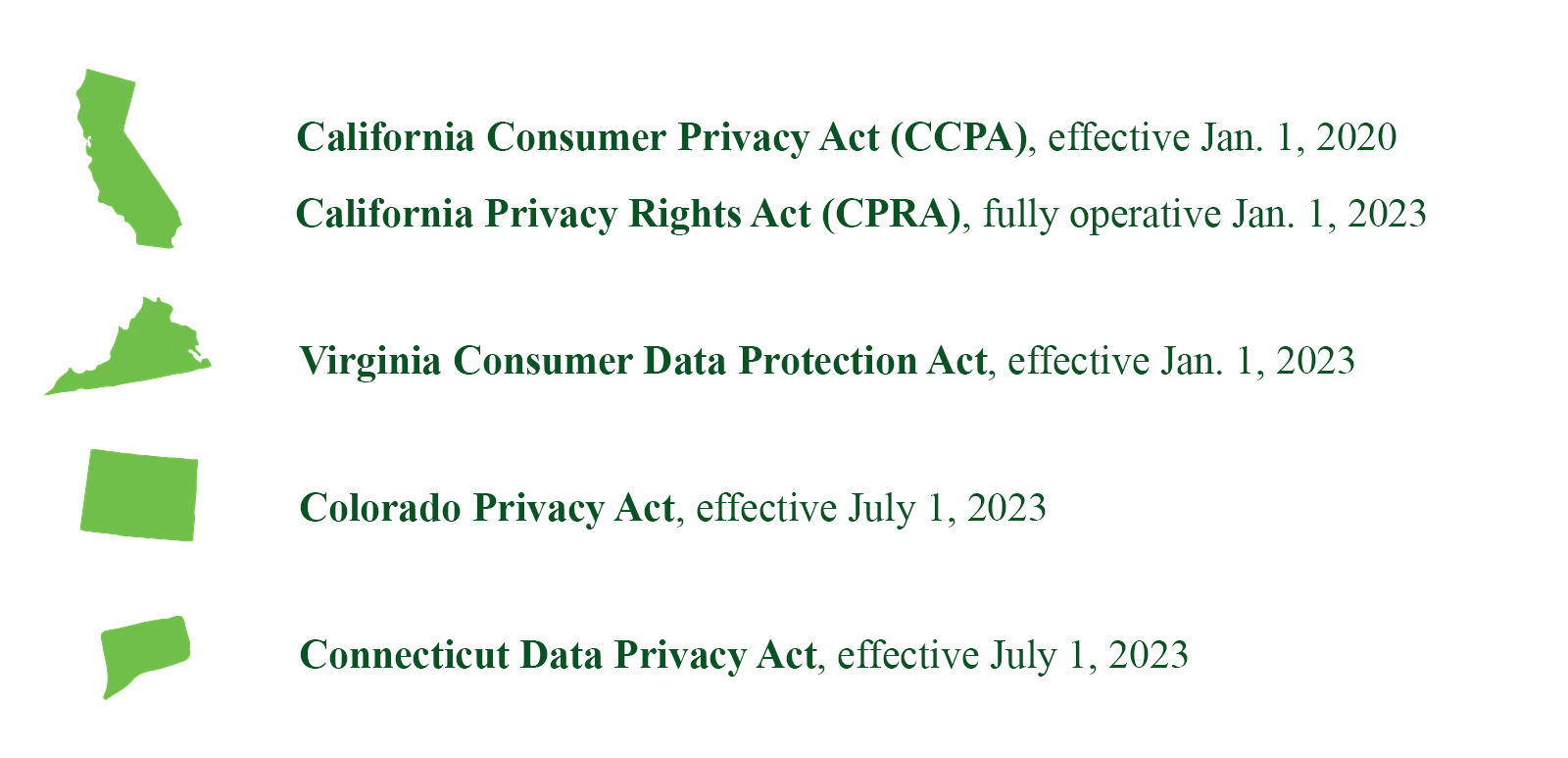
With a policy vacuum on Capitol Hill, there has been a flurry of state-level activity over the past year. Five more states passed laws in 2023, bringing the total number of state-level data privacy laws to ten.

California and Virginia already have operative data privacy laws, and on July 1, laws from two more states—Colorado and Connecticut—came into effect.
CA, VA, CO, CT privacy laws
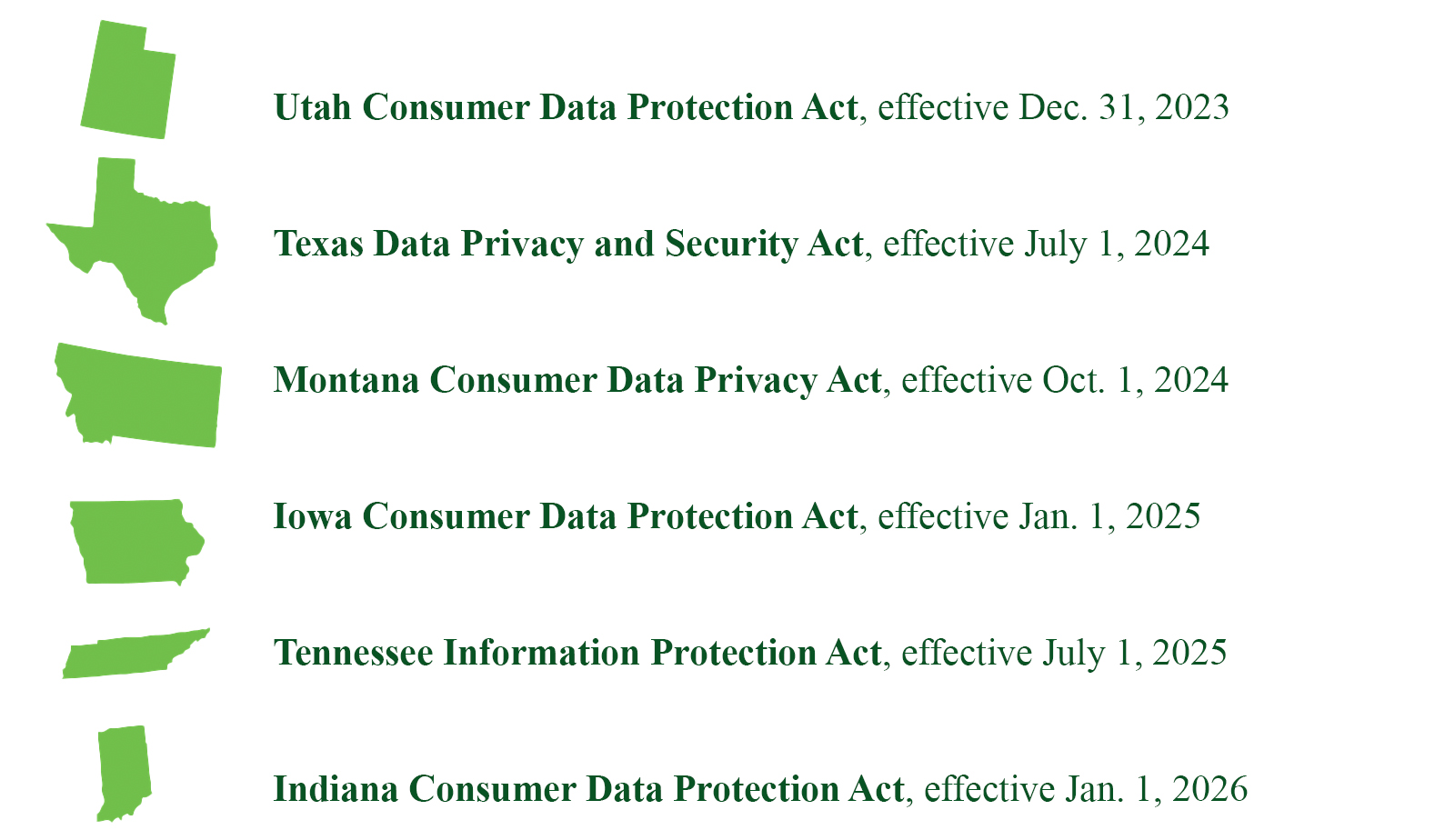
Six other states—Utah, Texas, Montana, Iowa, Tennessee, and Indiana—have passed laws; however, these have yet to take effect. Although these six states are all predominately red, each has different rules related to consumer rights and business obligations. In some cases, the differences are massive.
UT, TX, MT, IA, TN, IN privacy laws
Take Montana, for example. According to recent reporting from Politico, Montana resisted a great deal of Big Tech lobbying. Despite complaints from the State Privacy and Security Coalition, Montana legislators refused to remove “universal opt-out requirements,” which essentially allow Montanans to opt-out of tracking with a single click. Additionally, Montana legislators refused to allow carve-outs for “pseudonymous data,” which would have allowed tech companies to continue to track consumers who have opted out.

Lobbyists advocated for a provision that would have provided companies with time to remedy a violation before accruing a fine; however, it was to no avail, as Republican Gov. Greg Gianforte and bill sponsor Sen. Daniel Zolnikov (R-MT) didn’t take the bait.

Speaking about the lobbyists’ attempts to get him to water down the bill, Zolnikov colorfully said, “I’m not an idiot, and you treating us in Montana like a bunch of rural backwoods folks is quite an insult as well.”

Suffice it to say, it is too simplistic to assume that blue-leaning states offer tougher consumer data privacy legislation than red-leaning states. In an effort to highlight the myriad differences between the states’ data privacy legislation, the International Association of Privacy Professionals (IAPP) provides an excellent chart of all the consumer privacy bills, which they update frequently. It shows the bills’ statuses: Introduced, In Committee, In Cross Chamber, In Cross Committee, Passed, and Signed.

Additionally, the chart highlights the states’ various, and varying, consumer rights—e.g., right to access; right to correct; right to delete; right to opt-out of certain processing; right to portability; right to opt-out of sales to third parties; right to opt-in for sensitive data processing; right against automated decision making, and private right of action, which is essentially the consumers’ right to seek civil damages for a business’ violation of the law.

IAPP’s chart also lists the state laws’ different business obligations—e.g., opt-in defaults, which require businesses to treat a consumer under a certain age with an opt-in default for the sale of his or her personal information; transparency requirements, risk assessments, and processing limitations.

Minimize your data collection, processing, and usage.

I would be remiss if I didn’t point out that the best course of action would be to abstain from collecting, processing, trading, selling, and otherwise handling sensitive consumer data in the first place. If possible, you should comply with the most stringent laws (e.g., CPRA, GDPR) and adhere generally to the principle of data minimization, which states that one should only handle user data that is essential to the task at hand, and only for as long as that task takes.

However, not every company can completely abstain from processing consumer data. For such companies, here are a few ways to navigate the myriad data privacy laws in the states:

Identify which, if any, laws apply to your business.

Each state has a different threshold for companies doing business in its state. There are thresholds that pertain to the number of customers in the state, the percentage of revenue attributable to the sale of personal data, and a minimum number of customers.

For example, the Virginia law—which incidentally was based on a bill drafted by an Amazon lobbyist—only pertains to either (1.) businesses that have at least 100,000 customers in Virginia, or (2.) businesses that have at least 25,000 consumers and make at least 50 percent of its gross revenue from the sale of personal data. Also, if one’s business doesn’t have at least an annual revenue of $25 million, the Virginia law isn’t applicable.

Aside from these basic thresholds, there are many other ways in which a state’s law may not pertain to your business. States have different regulations related to the types of data that an organization is allowed to collect and how that data can be used.

Some states have processing loopholes; for example, laws in Iowa, Utah, and Indiana—some of the weakest in the country—have a rather broad definition of what it means to “sell” user data. If you’re not explicitly charging money for user data in those states, you’re likely in the clear.

Review your service contracts with third-party vendors; frequently update your internal and external privacy policies, and have an incident response plan in case of a cyberattack.

As a best practice, it’s prudent to build data protection clauses directly into the contracts you have with your third-party vendors. Even if it’s not required by law today, it may be down the road. You don’t want to be held liable for data protection mistakes made by your vendors. Also, when in doubt, put things in writing. Auditors—and regulators—need to see written procedures for information collecting practices. Also, have an incident response plan and ensure that your privacy policies are up-to-date and accurate.

Err on the side of caution, and look to California and Europe.

Of the ten state laws in the U.S., California is the most stringent; thus, you’re probably in compliance with the other state-level laws if you comply with the CPRA. However, every business operates differently; these laws are quite granular, and I’m not a lawyer. Thus, in the short term, be sure to have your chief security officer and legal team assess the ten laws.

In the long term, Congress will eventually pass a federal data privacy law. So, if you’re compliant with GDPR in 2023, you’ll most likely be all set by the time the federally mandated bill comes down the pike—whenever that may be.

John Donegan

John Donegan

Enterprise Analyst, ManageEngine

Want to read<br>this article on the go?

Want to read
this article on the go?

Do it on the ManageEngine
Insights app.

Published on August 18, 2020 | 4 min

Now that the dust has settled, it feels like a good time to assess the recent Twitter attack that compromised 130 accounts, including those of prominent politicians and influential public figures.

Although many pundits initially speculated that the attack was conducted by foreign powers, it turned out to be the rather unsophisticated work of a 17-year-old hacker from Florida and two co-conspirators.

What happened: an account takeover campaign facilitated via social engineering

Through a phone spear phishing attack, at least one hacker convinced a Twitter employee that he was a co-worker in the IT department, which allowed him to gain credentials to Twitter’s customer service panel.

In total, the hackers gained access to 130 accounts. For 45 of these, they reset the users’ passwords, logged on, and tweeted from the account. Additionally, the bad actors accessed the direct messages of 36 accounts, and downloaded personal Twitter data from eight accounts.

The hackers initially tried to sell access to several accounts on the dark web. According to the New York Times, they attempted to sell accounts with “cool user names, like @w”; however, after selling the accounts, the hackers would subsequently reclaim access to the accounts, and kick the buyers out. Israel-based cybercrime intelligence firm Hudson Rock believes these transactions occurred at least 36-48 hours before Twitter and the rest of the world even noticed the breach on July 15.

Ultimately, on July 15, the hackers pivoted to the Bitcoin scam we’re now familiar with: they used popular accounts—like those of Joe Biden, Elon Musk, and Barack Obama—to solicit money from the accounts’ unsuspecting followers.

The bad actors made off with 12.98 BTC, or roughly $118,000. That said, it was by no means a successful hack, as the main culprit is incarcerated and facing 30 felony counts.

From a public relations standpoint, Twitter did a decent job addressing the breach and providing frequent updates. As quickly as possible, their incident response team was able to secure the internal systems; revoke the hackers’ access; disable all verified accounts, and lock any accounts where passwords had been recently changed. Nevertheless, the damage was already done—from both a reputational standpoint and a financial one.

The biggest lessons learned

As this case study shows, far too many Twitter employees had access to the company’s admin platform. By Twitter’s own admission, 1500 employees had access to Twitter’s “agent tools.” This greatly simplified the hackers’ social engineering efforts, as they had plenty of potential victims, and eventually one or two fell for the spear phishing attack.

1. Limit the number of employees with privileged access

In the aftermath of the attack, professional pentester Rachel Tobac emphatically tweeted, “I’m hoping companies all over the world learn from this example: attackers can’t leverage these tools if your employees don’t have back end access to make these account changes. Reduce admin privileges now.”

2. Consistently monitor the workers who do have access to backend systems

With privileged session monitoring, you can keep track of those few people in our organization with elevated access to important resources. By keeping logs of access to backend admin tools—and frequently reviewing these logs—you can quickly identify any unusual activity.

Additionally, through the use of privileged user behavior analytics tools, you can identify employees’ baseline behavior and then detect if he or she deviates from this baseline. As an example, perhaps a privileged user normally accesses the backend system from a certain location or certain time of day; any deviation from this baseline activity would automatically trigger an alert.

If Twitter had AI-driven anomaly detection tools in place, they could have potentially identified unusual access from an unusual location, allowing IT personnel to prevent the breach—or at the very least, reduce the incident response time.

Some tools even let you capture privileged users’ sessions and archive them as video files, which in turn can help in the event of an investigative audit.

3. Pair privileged users’ activity with event logs

Through context-aware event correlation, it is possible to monitor privileged administrators’ behavior and end user behavior simultaneously. For example, in the case of the Twitter hack, IT personnel could have recognized that end users—in this case, high-profile Twitter accounts—were tweeting similar messages. If this type of activity was flagged, as well as anomalous behavior from a privileged user, they could have expedited, and even automated, the proper incident response.

Although this hack was a public relations nightmare for the social media behemoth, the bad actors were ultimately caught and nobody was hurt. Moreover, and perhaps most importantly, the incident highlights the merits of adequate privilege access management software.

John Donegan

John Donegan

Enterprise Analyst, ManageEngine

Want to read<br>this article on the go?

Want to read
this article on the go?

Do it on the ManageEngine
Insights app.

Subscribe to incident response

Thanks for subscribing to ManageEngine Insights. If you do not receive our welcome email, please check your SPAM folder.