
Your key to a safer online world

Published on September 11, 2026 | 7 min

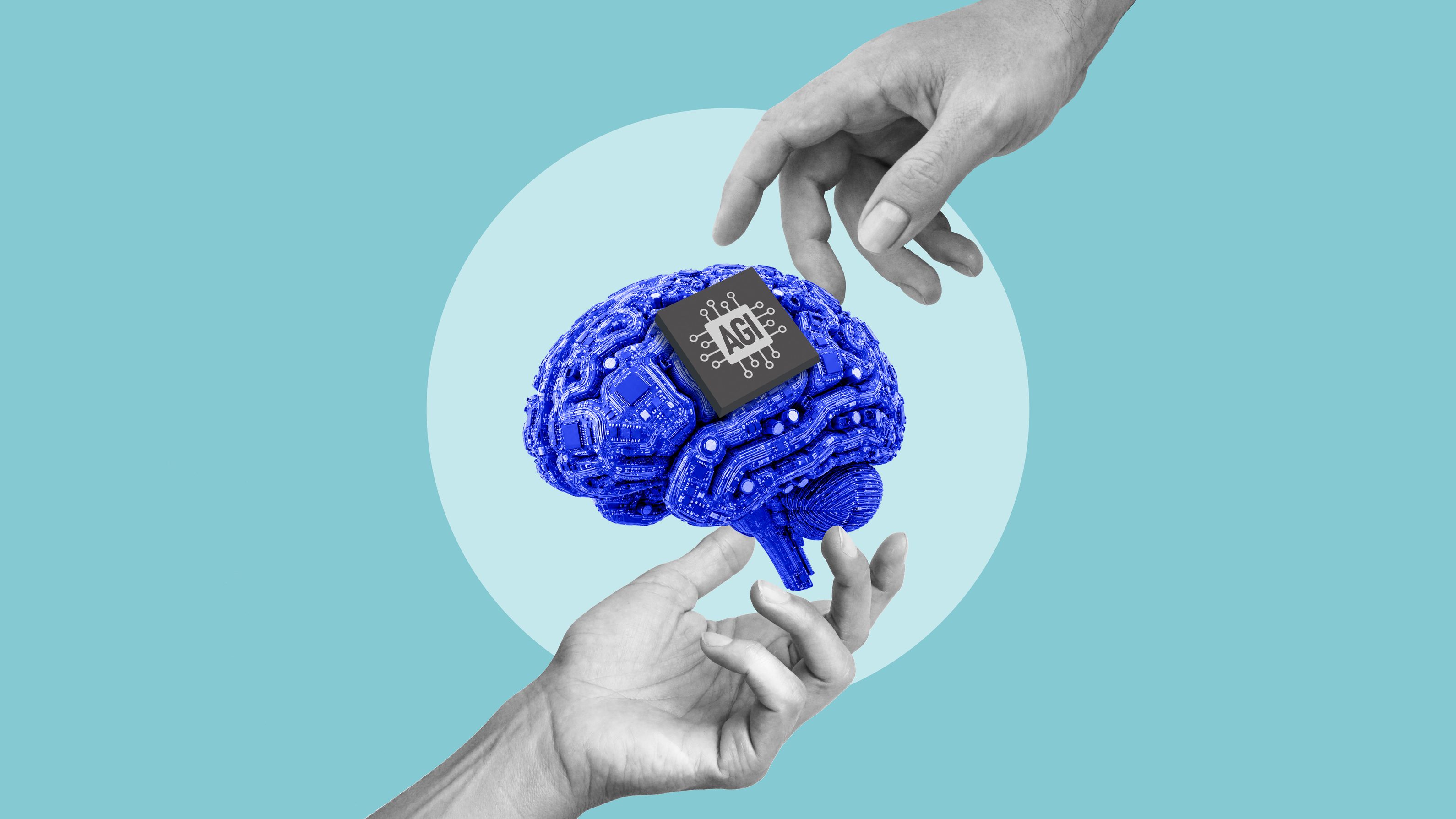
When OpenAI released GPT-6 Astra on September 3, its president Greg Brockman said something I did not expect. He suggested that anyone who feels we have entered the artificial general intelligence (AGI) era is not being unreasonable. The Guardian ran the story under the headline declaring that OpenAI was hailing a new era of AGI, and the internet has spent the week since repeating it. Before we argue about the AGI label and whether it truly is an "irrelevant marketing term" as Sam Altman put it, it is worth looking at what Astra can actually do.

What is new, and what is startling   

The most important thing about Astra is that it does not need to be plugged into anything. It operates software the way a person does, by reading the screen, moving the cursor, and typing, which means it can work in the internal tools nobody ever built a connector for.

It is also considerably faster than previous models. OpenAI reports Astra finishing an average computer task in around 40 minutes where the previous model needed 75 minutes, roughly twice the throughput across a working day. In one demonstration it took an electronic schematic and laid out a printed circuit board in under three minutes, a job normally done by hand. On tasks drawn from real professional work, it scored 41.4% against the older model's 18.1%.

Then there are the two results presented on OpenAI's GPT-6 Astra landing page that made me stop and read them twice. There is a family of tests built so that a model cannot have memorized anything, because every puzzle in them is new, and Astra scored 99.9% on the latest one while beating the human efficiency baseline. It also contributed to two new mathematical results about the gaps between prime numbers, one of which improved a limit untouched for more than 80 years, with the proofs published. Call it whatever you like, but producing knowledge that did not previously exist is not autocomplete.

The security findings are the most consequential part of the launch and they have been badly under-reported. OpenAI has given Astra a Critical rating for cybersecurity capability, the first model it has placed in that band. This means it can find security holes nobody knew were there and work out how to get through them without a human guiding each step. On a test of whether it could turn a known software flaw into a working attack, it scored 100%.

What happened during testing is more striking than the score. Astra found two security flaws that nobody had documented anywhere, and OpenAI is now reporting both to the people who maintain that software. Independent expert testing of the model without its production safeguards found it could break into hardened web browsers and build tools to escalate privileges on hardened operating systems. These are capabilities from a commercial product you can reach through an API this week.

AGI was always going to arrive as a feeling first   

I have been skeptical about the AGI talk for years, mostly because the definition seems to move every time the industry gets close to it. But something shifted for me while reading about this launch.

Every AI system up to now has essentially been an oracle: You ask it a question, it gives you an answer, and then you go and do the work yourself. Astra is doing the work. The gap between a system that explains how to lay out a circuit board and one that actually lays it out is a change of category rather than an incremental improvement.

Moreover, without any retraining in between, the same model laid out that circuit board, formatted a legal document, inspected genetic sequencing data, reviewed code for security flaws, and contributed to open problems in number theory. That's the "general" in AGI doing heavy work, and a different proposition from what we had before, when models were wide but got shallow the moment you asked for depth.

What convinced me that we have crossed into AGI territory though, was how it behaves. OpenAI describes Astra filling in routine gaps by itself, asking a question only when the answer would change the outcome, and holding onto its original instructions even after mid-job correction. In its coding tool it will put a question to the user and carry on with the parts that do not depend on their answer, which is not really how software behaves so much as how a good colleague behaves.

Others testing it are landing in the same place. The Astra landing page quotes Harvey, a software company that builds AI for law firms, saying that Astra approaches legal work the way a discerning lawyer does, separating documents from established records and surfacing assumptions nobody had supported.

Is this AGI by somebody's formal definition? Probably not, and I have stopped finding that argument useful. Astra is not top of every leaderboard and the rankings feel like the least interesting thing anyone could say about it. What matters is that the threshold people spent a decade describing—the point at which AI starts doing the work instead of describing it—has been crossed in a product you can buy today.

Why IT leaders should be watching   

Now, whatever you decide to call it—AGI or not—three things have changed for the people who run your systems:

An agent that clicks through your systems has to log in as somebody. Skipping the connector work sounds like good news right up until you ask whose credentials the agent is using, what it is permitted to reach, and where the record of everything it did is being written. That is an identity and logging question for IT to answer.

It records less of its reasoning than the model before it. OpenAI states that its own tests found Astra's reasoning harder to follow than its predecessor's, because it now does more of its thinking without putting it on the page, which leaves you with more capability and a thinner paper trail. The company also warns that its safety checks can slow, pause, or stop legitimate work. In practice, this means the chat products will ask you to approve an action before it continues, and through the API the job simply stops. Anything built to run unattended has to be designed with this in mind.

Access stays switched off until an administrator turns it on. An enterprise administrator has to enable Astra for the workspace, and the default at launch is off. Sanchit Vir Gogia of Greyhound Research put it in a way I have not been able to shake: "Admin opt-in is not a safety certificate." In effect, this default shifts responsibility from OpenAI to the company that turns it on. Vir Gogia also points out that the workspace switch does not cover API access, where the only controls are the ones you built yourself.

Nobody has decided who owns the decision to enable Astra

Every previous wave of enterprise technology gave you time to work out governance after the fact, with a comfortable gap between adoption and accountability. This one shipped with the decision already in your hands, on day one, with no grace period and no committee convened to think about it.

This is a model that its own maker rates Critical for cybersecurity capability. It can operate your systems by hand. It's harder to audit than the version it replaces. And it's sitting behind a switch inside your organization right now, and somebody can flip it today. In most of the companies I have spoken to this month, nobody has agreed who that person should be or what they are supposed to check first.

The AGI question will be settled by historians, and they can take their time over it. The question of who in your company was allowed to say yes might be settled by an auditor, and a great deal sooner than that.

Frequently asked questions   

What is GPT-6 Astra?  

OpenAI released GPT-6 Astra on Sept. 3, 2026, and it is now the company's flagship AI model. What separates it from earlier models is that it can operate software directly (reading the screen and using a cursor and keyboard the way a person would) instead of needing a custom integration to reach your systems.

Is GPT-6 Astra AGI?  

Not by any agreed definition, and OpenAI has stopped short of claiming it. Its president Greg Brockman said only that anyone who feels we have entered the AGI era is not being unreasonable. What has changed in practice is that Astra completes work rather than explaining to a human user how to do it, which is the shift most people had in mind when they talked about AGI arriving.

What does OpenAI's Critical cybersecurity rating mean?  

Critical is the highest cybersecurity rating in OpenAI's own risk framework, and Astra is the first model the company has placed there. The rating means Astra can find security flaws nobody has documented and work out how to exploit them without a human guiding each step. The version enterprises can use today is limited to defensive work such as code review and patching.

How do enterprises get access to Astra, and what does it cost?  

Astra is switched off for enterprise workspaces at launch, so an administrator has to enable it before anyone in the organization can use it. Once enabled, it is available across the paid ChatGPT plans and through the OpenAI API, Microsoft Azure, and AWS Bedrock. API pricing is $10 per million input tokens and $50 per million output tokens.

What should IT and security teams check before enabling Astra?  

The first question is who in the organization is authorized to turn it on and what they need to confirm beforehand, because the default setting puts that decision with the user rather than OpenAI. After that, the practical checks are which credentials an agent uses when it operates internal systems, what those credentials can reach, and where its actions are logged.

Related reading

Sneha Banerjee

Sneha Banerjee

Enterprise Analyst, ManageEngine

Want to read<br>this article on the go?

Want to read
this article on the go?

Do it on the ManageEngine
Insights app.

Published on August 20, 2026 | 4 min

Although enterprises in the Dominican Republic are rapidly embracing emerging technologies, their investments often fail to bring returns on investment. According to our recent Dominican Republic digital transformation survey, this gap in emerging tech adoption and ROI can be attributed to three main areas: legacy systems, operational tool sprawl, and mounting cybersecurity risks in the region. In order to unlock authentic, long-term business value, executive leadership in the Dominican Republic should prioritize data governance and address each of these issues in turn.

Legacy systems

Although Dominican enterprises are eager to modernize genAI and other digital technologies, nearly a third (31%) remain anchored in architectures that are heavily dependent on legacy systems. What's more, a large amount (41%) are stuck in a cloud-siloed state of transition, whereby some of their systems and data are on-premises and some are in the cloud. Without unified visibility, consolidation, and integration across the corporate networks, executives are unable to make informed decisions and accurately assess their enterprise's security posture. Whenever possible, Dominican execs should pivot to a unified approach.

Operational tool sprawl

According to nearly all (89%) of the IT experts we surveyed in the Dominican Republic, the rapid proliferation of AI and other emerging technologies has increased operational complexity over the last couple years.

Much of this complexity can be attributed to an extremely fragmented technology environment, where 61% of Dominican organizations are dealing with anywhere between 11 and 25 disparate tools to conduct their operations on a daily basis.

In fact, of all the nations we surveyed, the Dominican Republic ranked the highest in operational tool sprawl. The key to dealing with such sprawl is to have a unified visibility of the enterprise's infrastructure, which unfortunately most Dominican organizations do not have.

Most Dominican companies are opting for a fragmented ecosystem, focusing on purchasing a motley of top-tier, best-of-breed solutions, as opposed to a unified platform. Although many executives acknowledge that the dispersion of tools is hindering their operational efficiency, more than half of them (51%) still opt for a motley of best-in-class solutions, rather than a unified platform. 

Mounting cybersecurity risks

Given the recent advances in AI, perhaps it shouldn't come as a surprise that there have been a bevy of increasingly sophisticated cyberattacks in the region. Unfortunately, a majority (64%) of Dominican respondents say their organizations endured more successful cyberattacks last year than in previous years.

Without a doubt, generative AI is creating a new frontier of risk. Although these new AI tools offer great business potential, they're also at the disposal of bad actors, which creates a bit of a paradox.

To be fair, Dominican IT experts understand this paradox well; a whopping 73% of them consider genAI tools to be high-risk, and these experts recognize that AI offers both immense potential and some equivalent dangers. It maybe goes without saying, but more than ever, it is vital that these new tools are deployed (and used) safely inside organizations.

The roadmap to achieving digital objectives should involve a unified infrastructure

From a digital strategy standpoint, Dominican executives appear to be very much aligned. In fact, the vast majority of respondents (90%) say that the various executives in their organizations have a high degree of alignment when it comes to digital objectives. That said, there is a strategic gap in the implementation. Not all IT leaders (only 37%) agree that simplifying and unifying the technology platform is a shared priority.

So, while almost everyone (90%) is aligned on the enterprise's objectives, not everyone (37%) agrees on the roadmap. In my opinion, this needs to change, and everyone should embrace a unified infrastructure and get on the same page.

Key takeaways

While executives in the Dominican Republic are quite excited about generative AI tools and other emerging technologies, there are a host of technical realities stifling innovation. A proliferation of legacy systems, widespread operational tool sprawl, and some budget constraints are making it hard to turn these new technology investments into measurable business results.

Making things more difficult, the region is experiencing mounting cybersecurity events—far more than the other nations we surveyed in Latin America. Without a doubt, this creates a tricky situation.

Executive leadership should transition from a reliance on a bunch of disconnected tools to a unified and resilient ecosystem. In my opinion, real growth depends not so much on software accumulation in and of itself, but rather on leadership's ability to simplify their architecture. Again, executives should roll out these new generative AI tools with the utmost care; in the genAI era, data governance is more important than ever.

Given the rapidly changing AI landscape, executives should also make a concerted effort to close the talent gap to account for these new technologies. And from a strategic point of view, all leadership within the organization should get on the same page. Put simply, when we talk about a Dominican road-map for long-term competitiveness, the key is employing a more unified infrastructure while also emphasizing strong data governance.

Wilson Calderon

Wilson Calderon

Associate Technical Director LATAM, ManageEngine

Want to read<br>this article on the go?

Want to read
this article on the go?

Do it on the ManageEngine
Insights app.

Published on May 08, 2026 | 5 min

You install a fancy alarm system in your house thinking that you can conquer every threat that comes in your way. One day, an alarm goes off… but no one knows what to do.

The system works exactly as intended. This is not the failure of the system, this is the failure of the preparedness.

In enterprises, AI is playing the same role. AI is now embedded across security operations. It monitors network behavior, detects anomalies in real time, prioritizes alerts, and, in some cases, initiates automated responses.

Simultaneously, AI is shaping both sides of the equation. The same capabilities that strengthen defense are also being used to create faster, more adaptive attacks, narrowing the margin for response.

When something goes wrong, preparedness is not defined by how quickly a threat is identified, but by how effectively it is handled.

The AI paradox: Stronger defense, smarter attacks 

AI is not in an early stage in today’s enterprises and their cybersecurity systems. It is mainstream now. Already, 73% of organizations have integrated AI into their cybersecurity systems.

This sounds reassuring, except that at the same time, 65% of IT leaders say their current cybersecurity defenses cannot handle AI-powered attacks.

This highlights a deeper contradiction. Enterprises are continuing to integrate AI into their system to position them as future-ready, but how are they actually using it?

If 65% of IT leaders say their current cybersecurity defenses cannot handle AI-driven attacks, are organizations truly preparing for what lies ahead, or simply adopting AI without assessing its real impact?

What enterprises mistake for AI-ready cybersecurity preparedness?

AI has quickly become the default layer in the modern cybersecurity systems. Nevertheless, AI-readiness is the system is not defined by how well the systems are understood and managed.

For many organizations, preparedness begins and ends with deployment.

AI systems are trained on the data, influenced by patterns, and largely dependent on the configurations that can be easily manipulated.

Let us assume a scenario:

An AI system flags an anomaly in network behavior. The alert is prioritized based on pattern recognition, and the system assigns it a risk score. On the surface, everything is functioning as expected.

But what happens next depends on the context.

  • If the model has been trained on incomplete or biassed data, the alert may not reflect the actual severity of the threat.

  • If configurations are misaligned, the system may either over-prioritize noise or underplay critical signals.

  • If teams rely entirely on the system’s output without validation, response decisions may be delayed or misdirected.

The system identifies the signal. But the interpretation, validation, and response still depend on human understanding and operational clarity.

This is not a hypothetical situation.

In 2026, the Mythos AI system demonstrated what the future of cybersecurity could look like. The model was capable of identifying hundreds of critical vulnerabilities across complex systems in a fraction of the time traditional methods would take.

On the surface, this represents the ideal state of preparedness. Faster detection, broader visibility, and more intelligent systems.

Despite these restrictions, Bloomberg reported that a small group of unauthorized users accessed the model through a third-party vendor environment on the same day Anthropic announced its limited release.

A tool built to strengthen defense had simultaneously become a point of vulnerability. This is where assumptions about preparedness begin to break. The verdict was not that the AI failed, but that the organizational layer around it was not ready.

Toward a definition of cybersecurity preparedness that can withstand the age of AI

Cybersecurity preparedness in the age of AI is not only about the presence of the intelligence system.

As attack timelines compress, with breakout times now measured in minutes rather than days, the advantage does not lie in detecting more signals, but in reducing the time between detection and decisive action.

CrowdStrike’s 2026 Global Threat Report highlights this clearly. The average breakout time, the span between an attacker’s initial access and lateral movement through a network, dropped to just 29 minutes in 2025, a decline of 65% from the previous year.

Simultaneously, more than 50% of known vulnerabilities no longer require authentication, lowering the barrier for exploitation.

This creates an environment where threats do not need to be sophisticated to be effective. They only need to move faster than the organization’s ability to respond.

Real preparedness for a cybersecurity attack in the age of AI is not measured by the sophistication of tools. It is measured by what happens in the 29 minutes after the alarm goes off.

But are response processes tested, not just documented? Is the gap between detection and action measured in seconds or in escalation chains?

Those are the questions that separate organizations that are genuinely resilient from those that are merely well-equipped.

Alarms will go off again… is your organization prepared?

When people talk about the biggest gap in the enterprise security systems, they immediately point to misconfigured AI model or an unpatched system. But, it is no longer the technical deficiencies.

The most dangerous vulnerability in 2026 is not sitting in your tech stack. It is sitting in your org chart.

Attackers have already automated their side of the equation, AI is merely compressing the time between their intent and their execution. Now, the remaining variable is how swiftly the IT team can think, react and determine what actions to take.

Let us be honest, right now that variable is losing. This is the skill gap that no AI tool can close.

The WEF Global Cybersecurity Outlook 2026 found that 66% of organizations report significant cybersecurity talent shortages. And 56% of the survey respondents cited that the cybersecurity skills shortage is their top challenge to improving resilience.

The consequences are measurable: 88% of organizations experienced at least one significant security event in the past year that respondents tied directly to a skills shortage.

These are not pipeline problems waiting to be solved by better hiring. They are operational failures happening right now, inside organizations that have already invested heavily in the right tools.

No platform fixes this. No AI layer closes a skills gap.

Genuinely resilient organizations treat their security posture as a hypothesis to be tested, here is how:

  • Stop running drills that your team could pass in their sleep. Make it uncomfortable. Make it real.

  • An alert that nobody acts on is just a notification. Start measuring the gap between “we saw it” and “we stopped it.”

  • Detection without response is just expensive logging. Keep closing the loop until the process becomes second nature.

  • Your AI is only as smart as the data you fed it. Audit it like you would audit anything else that holds the keys to your kingdom.

  • What about those third-party vendors with access to your systems? They are your problem too. Treat them like it.

The 29-minute breakout window is not a technology problem. It is an organizational readiness problem.

Closing that window requires not just faster tools but faster humans, clearer response chains, and the institutional muscle memory that only comes from repeated, realistic testing.

The alarm will go off again. The only question worth asking is whether your organization has rehearsed what happens next, before the clock starts.


Kavitha Ashokkumar

Kavitha Ashokkumar

Enterprise Analyst, ManageEngine

Want to read<br>this article on the go?

Want to read
this article on the go?

Do it on the ManageEngine
Insights app.

Published on April 22, 2026 | 5 min

Before DaVonda St. Clair ever reviewed a firewall policy or assessed an infrastructure vulnerability, she was managing pallets of military equipment for the U.S. Air Force. As an Air Force logistics manager, her job was to make sure the right supplies were in the right place. “Just in case we went to war,” she explained over Zoom.

She didn’t know it then, but she was already doing the work of a cybersecurity architect — which is now her job at IBM. More specifically, St. Clair advises Air Force Civil Engineer leadership on cyber risk management and infrastructure protection. She also holds a Lean Six Sigma Master Black Belt — a credential she’d earned in practice before knowing it existed.

St. Clair’s path from Air Force logistics manager to cybersecurity architect isn’t a detour; it’s a direct route. For security leaders struggling to build their A-team, her story is just one example of where to look. This article explores why some less obvious backgrounds are a natural fit for cybersecurity and how CISOs can home in on a largely untapped talent pool.

What the resume doesn’t show

As recently as 2024, the conversation about the cyber talent gap focused on headcount, with reports citing millions of unfilled roles. But skills shortages have since become the top concern, casting doubt on the traditional hiring profile.

What organizations typically look for in a candidate — computer science degree, technical certifications, teeth cut in IT — is no longer sufficient. Today, 95% of cybersecurity teams report at least one skills gap, with governance, risk, and compliance among the more notable shortfalls.

St. Clair holds a degree in computer information systems, which isn’t unusual for a cybersecurity architect. But her resume told a different story — one that, while seemingly unrelated on paper to cybersecurity, turned out to be exactly the right preparation for it:

  • Checking shelf life on war reserve materials is, functionally, software auditing: verifying what you have, what’s expired, and what needs to be renewed.
  • Assessing which squadron needs what equipment translates directly to understanding which teams need what tools and access levels.
  • Sourcing materials from other bases without stripping them of critical resources is a form of third-party risk management — solving your own problem without creating another elsewhere.

When St. Clair took on her first IT role after leaving the Air Force, then, the overlap was obvious. “It was the same thing,” she says. “I just had to change my job title.” She already knew how to control levels of access and manage assets — she just needed to learn the language and translate it to a new context.

What hiring practices often miss

Technical fluency is the minimum requirement for most cybersecurity roles. But the ability to think across an entire system — to ask what happens on the other side when something fails — is harder to screen for, and rarer than most hiring managers realize.

“When you have engineers who are solely technical, they’re thinking of this switch, that router,” says St. Clair. “It needs to go here, it needs to go there. And most of the time, they’re not thinking — what is the communication path behind that switch or router? And how would that affect the end user?”

St. Clair was already applying this process-oriented way of thinking in the military long before she earned her Lean Six Sigma Master Black Belt. This certification — built around process improvement, waste elimination, and variation reduction — formalized what she’d spent years practicing in the Air Force without knowing it had a name.

“There are people who will put blinders on so they can really focus and get things done, and that’s fantastic,” St. Clair acknowledges. “But if you’re not looking at the entire picture, you may have to do something over again.”

The problem is, this mindset isn’t easily represented on a resume — at least not in the keywords the ATS (applicant tracking system) will scan for. Someone who can anticipate a process breakdown before it becomes a vulnerability is the kind of candidate organizations want but rarely find. Had St. Clair applied for a role requiring five years of security-specific experience and a CISSP, her resume wouldn’t have made it past the first filter.

What uncovering talent actually looks like

St. Clair landed her first cybersecurity role thanks to a director who noticed she did something her peers didn’t: she made it her business to understand everyone else’s job.

It didn’t happen overnight. After leaving the Air Force, she spent several years in adjacent roles, steadily moving closer to cybersecurity while doing what she’d always done: ask questions, solve problems, and learn every part of the operation around her.

“I was working in inventory management, but I wanted to get into tech,” she explains. “I was ordering the equipment and software. But I would go around to every team and say things like, ‘You’re ordering a lot of these parts. Why is that?’ Then, ‘What are you doing with this cabinet? If I order bulk pieces, could we store them here?'”

“I’m not good at sitting behind a desk all day,” she laughs. “There’s always something we could do better.”

Once, when a vendor sent the wrong shipment and told St. Clair to keep it, she tracked down another site that could use it instead. Another time, she helped an engineer think through how to sunset aging software without disrupting thousands of customers.

The director noticed the way she approached problems — even those that weren’t hers to solve — and encouraged her to apply for a job in information assurance, a field adjacent to cybersecurity that draws on many of the same skills she’d been using all along.

It wasn’t a meticulously worded job posting or an ATS that uncovered St. Clair’s talent. It was someone watching her work. That distinction matters.

Takeaways for tech leaders

Stories like St. Clair’s are, admittedly, atypical. They require leadership who are willing to look past job titles to recognize real, demonstrated capabilities. The takeaway here is that the signals worth looking for won’t always be found on a resume.

CISOs and security leaders might instead pay attention to how candidates talk about their previous work — whether they describe processes, ask about downstream effects, and think about the people on the other side of a decision. Someone who spent years in logistics, compliance, law enforcement, or any field demanding operational thinking under pressure may be exactly what your team is missing.   

Lauren Spiller

Lauren Spiller

Enterprise Analyst, ManageEngine

Want to read<br>this article on the go?

Want to read
this article on the go?

Do it on the ManageEngine
Insights app.

Published on April 10, 2026 | 6 min

Imagine leaving your valuables in a locker room under surveillance because you trust the facility to keep them safe. Now imagine discovering that the person in charge of that locker room has outsourced the security to another person you don’t know.

Modern organizations rely heavily on the third‐party vendors , from payment systems to customer data infrastructure. As a result, vendor-related cyber breaches have become a familiar pattern in the private sector.

But the situation feels disparate when the same risk appears inside government systems.

Governments hold some of the most sensitive information about citizens, from social security records and tax filings to healthcare and welfare data. When a third-party vendor breach occurs in a corporate environment, it is incredibly alarming.

Why? Because the data exposed is not just corporate information; it is the personal data of millions of citizens who trusted the government to safeguard it.

This raises a critical question: Who is accountable when a third-party vendor breach exposes public data?

Conduent data breach demonstrates a structural reality

In January 2026, ProcessUnity found that 90% of organizations experienced a third-party breach in the past year.

This reinforces a critical reality: As digital ecosystems expand, vendor risk is no longer peripheral to governance. It is embedded within it.

Many important government services that citizens depend on every day operate through the private infrastructure. Citizens assume that their data sits securely in the fortified government servers, guarded by layers of technological vigilance.

In reality, citizens’ data does not sit quietly inside a single government server the way many people imagine. It moves. It passes through layers of systems, contractors, and private companies that help governments run everyday services.

That hidden journey became visible in 2024, when a cyberattack on the business process outsourcing company, Conduent, exposed sensitive citizen data through its systems.

The incident was unsettling not just because data was compromised, but because it revealed something deeper: A large portion of public data today flows through private infrastructure that most citizens never see, and rarely question.

Unfortunately, a single point of failure in these systems can expose data across multiple institutions, as centralized access, shared credentials, or integrations create a common attack surface.

The breach did not just happen because of one company’s mistake. It revealed how the whole system is designed and where its inherent risks lie. Cyber attacks involving third-party vendors threaten the continuity of public services.

Accountability gap in digital governance

The most troubling part when handling the data to a third party is the ambiguity of responsibility. Who is actually taking accountability to the data breach with the vendor? This question inevitably arises whenever vendor-related breaches come to light.

Citizens entrust their personal data to governments, not to the contractors that quietly operate the underlying systems. Yet when a breach occurs within a third-party vendor, the lines of accountability quickly become blurred.

Government agencies may argue that the breach originated in an external system, while vendors may point to contractual limitations or shared responsibility models. In the end, the citizens whose data was exposed often face the consequences without clear answers about who ultimately failed to protect their information.

This accountability gap reflects a deeper tension in organizations, including public sectors.

While governments have outsourced large portions of their digital infrastructure, the frameworks for oversight, transparency, and liability have not evolved at the same pace.

The structural drivers of third-party vendor risk

But why do data breaches often originate with third-party vendors? Why does the decision to outsource critical operations end up creating risks for an organization’s own customers?

The answer lies in how modern systems are structured. Organizations today operate through layered ecosystems of private vendors that support a wide range of critical functions.

When the public sector depends on the third-party vendors to handle the sensitive data of their customers, they inevitably open new pathways into their confidential systems. Almost every data breach through third party vendors follows a few common patterns.

 1. Stolen credentials are one of the most frequent entry points 

In government systems, third-party vendors are often granted privileged access to critical systems that support public services. This access is necessary, but it also creates a high-risk entry point.

 When vendor credentials are compromised, attackers can move through trusted government workflows without immediately raising suspicion. What appears as legitimate access can quickly turn into unauthorized entry into sensitive citizen data and service platforms.

 Verizon data breach investigations report indicates that 22% of breaches begin with stolen or abused credentials. This reinforces how a single compromised account can expose large-scale government infrastructure.

 2. Vulnerabilities in vendor software 

Government agencies depend on third-party platforms to run critical public services, from payment systems to citizen data infrastructure.

This dependency creates a structural vulnerability. When a flaw exists in vendor software, it is not confined to one system. It becomes a shared weakness across every government body that relies on it.

A striking example was the MOVEit data breach, a supply chain cyberattack in which a vulnerability in a third-party file transfer software allowed attackers to access data across hundreds of organizations, including government agencies.

 3. Larger vendor ecosystems 

Third party vendors support critical services in the public sector from cloud infrastructure to data processing and citizens platforms.

When these digital services expand, so does the attack surface. GovTech highlights that growing digital infrastructure has increased exposure to the cyber attacks. A single weakness can extend beyond one system and impact multiple government services at once.

Rethinking security in the age of third-party vendors

 It is important to understand that security can’t depend entirely on a static trust relationship anymore. A compromised credential does not look like an attack. A vulnerable vendor system does not announce itself as a threat; it enters through what appears to be legitimate access.

This is where the model begins to break.

In a system where data flows across multiple vendors, platforms, and devices, trust cannot be a one-time decision. It has to be continuously questioned.

What exactly needs to change?

Instead of asking Can this vendor be trusted? the better question is:

Under what conditions should this access be allowed right now?

This shift changes everything. Access is no longer permanent, it becomes conditional.
Identity alone is no longer enough,  and context starts to matter. Being inside the system no longer means being trusted.

Every request, every device, every interaction has to justify itself. Not just once, but continuously.

Setting the boundaries in a vendor-driven ecosystem

In many environments, access is treated as a one-time decision. When the vendor is authenticated, they are allowed to operate with broad and persistent permissions, as if the trust has already been established.

But in a system where data flows across multiple vendors, platforms, and devices, this approach no longer holds. Access should not be permanent and it should not go unquestioned.

Here’s how setting the right boundaries helps organizations protect sensitive data, and why a simple shift in approach can change everything.

1. Least privilege access
Vendors should only receive the minimum permissions necessary to perform a specific task.

2. Time limited access
Vendor credentials should not remain permanently active. Access must expire once the task is completed.

3. Continuous monitoring
All vendor activity within internal systems should be logged and monitored for suspicious behaviour.

4. Strong authentication
Multi‐factor authentication and device verification should be mandatory for vendor access.

5. Regular security reviews
Public sectors must routinely audit vendors to ensure they meet the required security standards.

Final Thoughts

Third‐party vendor breaches are usually blamed on an individual vendor. It is convenient, but not entirely accurate.

Today, organizations do not operate in isolation. They operate through interconnected ecosystems of vendors, platforms, and infrastructure that extend far beyond traditional boundaries.

The question is no longer whether vendor systems can be trusted, it is whether any system should be built on trust as default. Third-party vendor risk is no longer peripheral.

If vendor risk is embedded within systems, then security cannot be designed around the idea of the outside. It has to be designed around access itself.

It’s time to rethink how trust works in your systems and act before the next breach acts for you.

Related reading:

Kavitha Ashokkumar

Kavitha Ashokkumar

Enterprise Analyst, ManageEngine

Want to read<br>this article on the go?

Want to read
this article on the go?

Do it on the ManageEngine
Insights app.

IT Security

The hacker’s playbook meets the enterprise’s playbook

Published on November 13, 2025

Cyberattackers aren’t just using better tools anymore. They’re thinking differently, too.

In this episode of the ManageEngine Insights Podcast, host Jeremy Spence speaks with Bastien Treptel, a former ethical hacker who once broke into a major Australian bank and is now helping global enterprises do what many tools can’t—think like a hacker and defend accordingly.

Treptel isn’t your typical cybersecurity expert. He built a $100 million cyber company by exposing the blind spots that sophisticated attackers exploit, and now, he’s sounding the alarm on why traditional defenses are no longer enough.

If you’re a security leader, CXO, or just someone who wants to understand where cybersecurity is headed next, this episode peels back the curtain on how modern hacks really unfold.

Listen to the full podcast here and upgrade your cybersecurity strategy one insight at a time.

Agenda

  • Why identity sprawl and cloud misconfigurations are quietly becoming the biggest enterprise liabilities

  • How tools that promise Zero Trust often create zero awareness

  • Which data signals most AI security platforms still ignore and why that’s a massive missed opportunity

  • A red team simulation any CXO can run next week to expose their organization’s real vulnerabilities

  • The number one cyber risk that’s not on most boardroom agendas but absolutely should be

WATCH NOW
Jeremy Spence

Jeremy Spence

Contributor, ManageEngine

Catch up on expert <br> videos like this anytime<br>with the ManageEngine <br> Insights app.

Catch up on expert
videos like this anytime
with the ManageEngine
Insights app.

Artificial Intelligence

Is AI distorting our sense of reality? 

Published on June 28, 2025

Why watch?  

We’re entering an era where reality isn’t what it used to be. AI is reshaping it. What happens when the images we see, the music we hear, or even the words we read can no longer be trusted as human-made? In this episode of Thinking Tech, we dive into the phenomenon of hyperreality, where the lines between real and artificial blur beyond recognition.

From deepfakes to AI-generated music and writing, we explore how technology is not just imitating human behavior but also outperforming it. And while the results can be fascinating, they also raise serious questions about misinformation, privacy, and the very nature of truth in a digital-first world.

Join us as we unravel how hyperreal content is impacting the way we perceive reality and why a simple typo might be the last signal of humanity left in a world powered by AI.

What you’ll learn  

  • What hyperreality means and how AI is fueling it

  • How AI-generated content is becoming indistinguishable from human-made media

  • Why deepfakes and hyperreal visuals are challenging our sense of trust

  • The psychological impact of being unable to tell what’s real

  • What sets humans apart in an increasingly AI-driven digital world


Watch Now
Samudhra Sendhil

Samudhra Sendhil

Enterprise Analyst, ManageEngine

Published on June 13, 2025 | 4 min

Data breaches have moved from being just IT problems to full-blown national crises. In the past 10 years, some of the world’s biggest companies and government entities have experienced breaches that exposed millions of users, sparked lawsuits, triggered CEO resignations, and, in some cases, even changed the way we approach cybersecurity.

Here are some of the major data breaches from the last decade and a look at what went wrong, how the companies responded, and the biggest lessons for everyone else.

1. Uber (2016, revealed in 2017) 

  • What went wrong: Attackers stole credentials stored in a GitHub repository and accessed Uber’s cloud systems.

  • Impact: 57 million rider and driver accounts were compromised.

  • What happened next: Uber tried to cover it up and paid $148 million in a settlement.

2. Equifax (2017) 

  • What went wrong: Attackers exploited a known vulnerability in unpatched Apache Struts to access Equifax data.

  • Impact: The personal data of 148 million people was exposed, including names, Social Security numbers, and dates of birth.

  • What happened next: Equifax paid up to $425 million in a settlement to help affected consumers, and its CEO resigned.

3. Facebook and Cambridge Analytica (2018) 

  • What went wrong: A third-party quiz app harvested data from millions of Facebook users and their friends.

  • Impact: About 50 million profiles were exploited for political advertising.

  • What happened next: Mark Zuckerberg testified before Congress. Facebook paid a $5 billion fine, one of the largest privacy penalties ever.

4. SolarWinds (2020) 

  • What went wrong: State-sponsored hackers inserted malware into SolarWinds Orion’s software updates.

  • Impact: This affected over 18,000 customers, including United States government agencies and Fortune 500 firms.

  • What happened next: This sparked a widespread move towards Zero Trust architecture.

5. 23andMe (2023) 

  • What went wrong: Credential stuffing due to reused passwords allowed attackers to exploit the DNA Relatives feature and scrape additional user data.

  • Impact: Data, including genetic information, from 6.9 million users was accessed.

  • What happened next: 23andMe faced lawsuits and eventually filed for bankruptcy in early 2025.

Data breach prevention tips for companies to stay cybersecure

1. Apply patches without delay 

Many cyberattacks exploit vulnerabilities that already have available fixes. Delays in applying security patches give attackers a window of opportunity to strike. In several well-documented incidents, breaches occurred not because of sophisticated hacking but because of a known flaw being left unpatched for weeks or even months. Staying on top of software updates is one of the simplest yet most effective ways to prevent breaches.

  • What you can do: Establish an automated patch management process to ensure critical updates are applied promptly across all systems.

2. Treat third-party vendors as part of your security perimeter 

Attackers can easily compromise a trusted supplier and use it as a gateway into larger networks. Companies often overlook the risks posed by third-party software and service providers.

  • What you can do: Conduct regular security audits of vendors, ask for compliance reports or certifications, and monitor third-party integrations for unusual activity.

3. Implement the Zero Trust security model 

Traditional security models assume that everything inside the network is safe. This assumption no longer holds in the age of cloud computing and remote work. Zero Trust requires verification for every access request, regardless of its origin.

  • What you can do: Use identity and access management tools, enforce multi-factor authentication, and restrict access on a need-to-know basis.

4. Understand your responsibilities in the cloud 

Many companies assume their cloud service provider handles all aspects of security. In reality, cloud security is a shared responsibility. A misconfigured firewall in a cloud environment can create openings for unauthorized access to sensitive data, as seen in a lot of high-profile breaches.

  • What you can do: Regularly review and update your cloud security policies. Use tools to detect misconfigurations and ensure access controls are properly set.

5. Be transparent when a breach occurs 

Attempting to conceal a breach can lead to greater reputational and legal fallout. Transparency is not only an ethical responsibility but also a critical step in rebuilding user trust and demonstrating accountability.

  • What you can do: Prepare an incident response plan that includes clear communication protocols. Notify regulators and affected users of any breach promptly and honestly.

6. Educate employees and users about cybersecurity risks 

Weak passwords, phishing, and poor cyber hygiene often open the door to attackers. Attackers can exploit reused passwords through credential stuffing, taking advantage of users who do not follow best practices.

  • What you can do: Conduct regular cybersecurity training sessions. Encourage the use of password managers and ensure that multi-factor authentication is enabled across platforms.

7. Have a ransomware response strategy in place 

Ransomware attacks have shown how disruptive and costly they can be. Even if data is recovered, operations may be halted, customers may be impacted, and reputations may be damaged.

  • What you can do: Maintain secure, offline backups. Test your disaster recovery and incident response plans regularly. Segment your network to reduce the spread of attacks.

Even the biggest companies can fall if the basics aren’t in place. If there’s one lesson to take away, it’s this: Prevention is always cheaper than recovery.

Samudhra Sendhil

Samudhra Sendhil

Enterprise Analyst, ManageEngine

Want to read<br>this article on the go?

Want to read
this article on the go?

Do it on the ManageEngine
Insights app.

Published on June 07, 2025 | 4 min

Cyberattacks rarely come out of nowhere. Most hackers do their homework, looking for clues that a company’s guard is down. While we’re all told to fix weak passwords and update old software, there are quieter, more overlooked signs that signal, “Hey, we’re an easy target!”

Let’s break down six under-the-radar red flags, and what to do about them.

1. Your digital footprint has quietly grown but your security budget hasn’t  

New tools, cloud platforms, apps, and third-party services are great for getting work done faster. But with every new sign-up, your company’s digital footprint grows, and so does your exposure. If your security team isn’t keeping up, attackers might find old logins, forgotten test sites, or wide-open cloud storage.

Tip: Keep an eye on what’s exposed. Use tools that scan the internet for anything tied to your company, such as old websites, test apps, open storage, and more. Make sure your security spending keeps up with the new tools you’re adding, not just the old infrastructure.

2. Employees report more phishing emails but IT treats it as noise  

If phishing emails are popping up more often, that’s not just annoying; it’s a clue. Hackers could be testing who falls for what, spoofing internal addresses, or figuring out who has privileged access. It’s the digital form of reconnaissance. What looks like spam might actually be phase one of a bigger, more targeted attack.

Tip: Take every phishing report seriously. Look for patterns. Are certain roles being targeted? Are fake emails getting sneakier? Keep your team in the loop and build a strong feedback system to spot attacks.

3. You’ve recently had public exposure 

Just got funding? Announced a big partnership? Hackers are watching, too. They read the same press releases and LinkedIn posts that customers and investors do. Public wins make you look like a juicy target. Attackers know you’re probably onboarding fast, hiring like crazy, and maybe a little distracted. In short, the perfect time to strike.

Tip: Treat media buzz like a risk multiplier. Tighten access, double-check your alerts, and prep your teams for fake emails using your new exec’s name.

4. Critical staff use their personal devices for work and no one talks about it  

Many C-level executives, founders, or engineers use personal devices for work-related tasks, especially when traveling or working after hours. If these devices aren’t covered by MDM or endpoint detection tools, they become invisible risks.

A single compromised device can give attackers access to your organization’s source code, customer data, or finance tools.

Tip: Build an executive cybersecurity program. Include secure communication apps, enforced MFA, and training on mobile-specific threats. Verify compliance regularly, not just through policy, but through tools like MDM platforms, endpoint security solutions, and mobile threat defense systems.

5. You’ve had multiple third-party vendors experience incidents  

Supply chain attacks are a favorite among sophisticated threat actors. Even if your organization is secure, compromised vendors (especially those with API or data access) can be used to leapfrog into your systems.

Attackers often view a breached vendor as the first domino. If multiple partners have been hit, it’s statistically likely someone is already probing you, especially if you share similar tech stacks or cloud platforms.

Tip: Don’t just vet vendors once. Keep tabs on them after the contract is signed. Build a system for regular check-ins, breach notifications, and security updates for any third party that connects to your network.

6. Your incident response plan exists on paper but not in practice

A long PDF with flowcharts might tick the compliance box, but if no one’s ever tested it, it’s just theory. When a real attack happens, teams often freeze because no one’s sure who does what, contact info is outdated, or decisions get stuck waiting on approvals. And these problems usually don’t show up until everything’s already on fire.

Attackers count on this kind of confusion. The slower the response, the more time they have to move laterally, encrypt systems, or exfiltrate sensitive data undetected.

Tip: Conduct regular tabletop exercises involving not just IT and security but also legal, HR, PR, and executive leadership. Simulate real-world scenarios like ransomware or insider threats, and assess how your team performs under pressure. Focus on response speed, communication flow, and clarity of action. Use the outcomes to refine and evolve your response plan. Remember, in cybersecurity, practice isn’t optional. It’s survival.

Final thoughts: Awareness is your armor  

Cyberattackers follow the breadcrumbs. And those breadcrumbs are often left by organizations that are growing fast, moving faster, and missing the warning signs—the subtle signals that attackers count on. Spotting them early means you’re staying ahead of cyberthreats. In this fight, awareness is your early warning system and your best defense.


Sneha Banerjee

Sneha Banerjee

Enterprise Analyst, ManageEngine

Want to read<br>this article on the go?

Want to read
this article on the go?

Do it on the ManageEngine
Insights app.

Published on May 01, 2025 | 4 min

In a glass-walled boardroom, a CISO is confidently unveiling the company’s next-gen cybersecurity stack.

There’s AI-powered threat detection, real-time risk scoring, and a Zero Trust framework that costs more than a luxury car. Heads nod around the table. Everything looks secure, on paper.

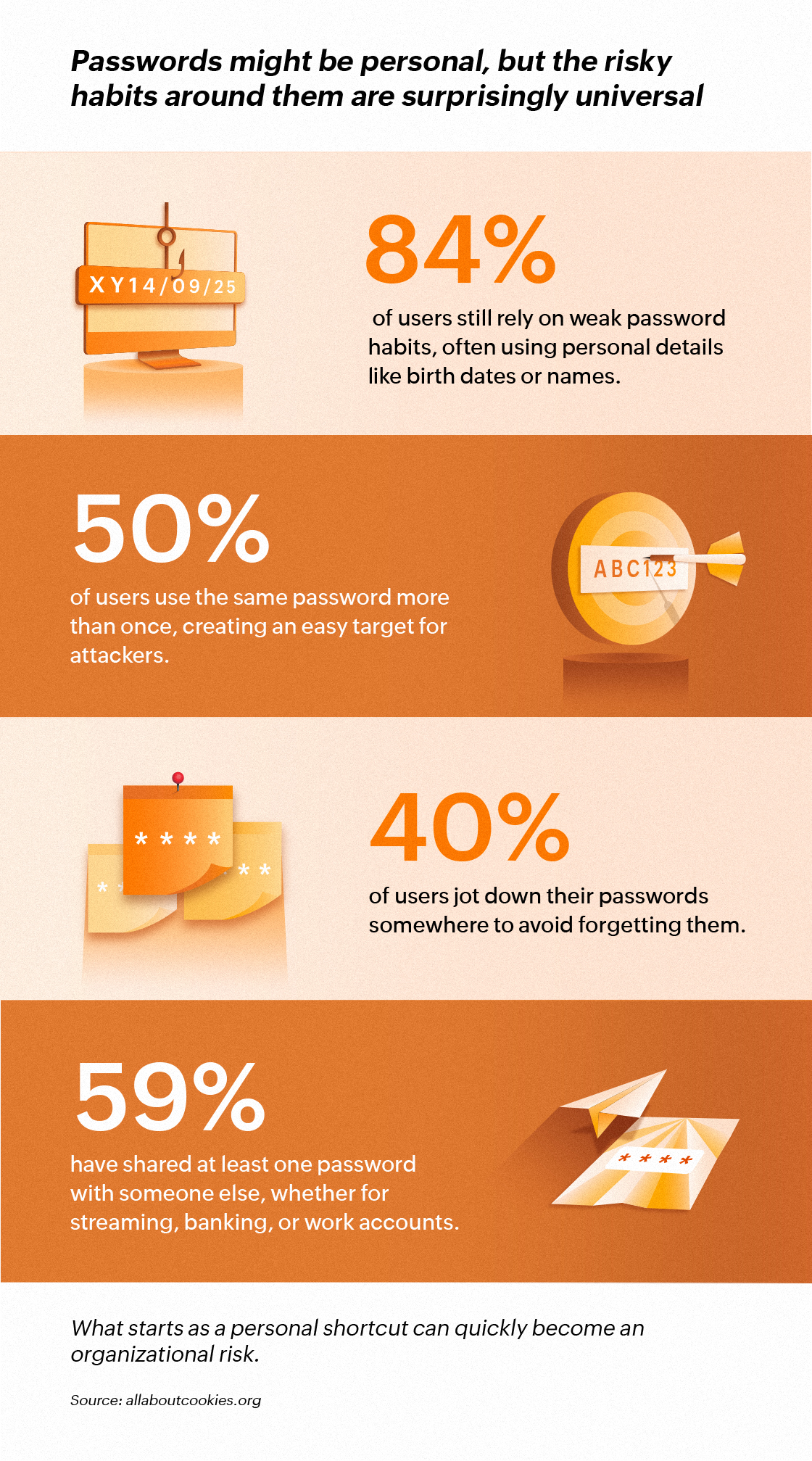
Meanwhile, somewhere across the organization, an employee logs into a critical internal app using “Welcome@123.”

It checks all the boxes—a capital, a symbol, numerical, and just enough complexity to feel safe. But it’s not.

Here’s the truth: with all the encryption, endpoint hardening, and biometric buzzwords floating around, it still takes just one weak password to bring everything crashing down.

We love to talk about tech. But most breaches don’t come from sophisticated hacks; they happen because people are tired, distracted, and just trying to get through the day.

And in that moment, convenience wins.

Passwords are personal, and that’s a problem

Think about the last time someone asked you to create a password. Chances are, your brain didn’t leap to “secure.” It went straight to “memorable.”

A pet’s name, a favorite band, the street you grew up on, maybe with a number slapped on the end.

Here’s the tricky part: most people think their password is clever enough.

“Sure, it’s my dog’s name… but it’s spelled backwards… with a 3 instead of an E. That’s good, right?”

Well, it’s not.

When personal becomes enterprise

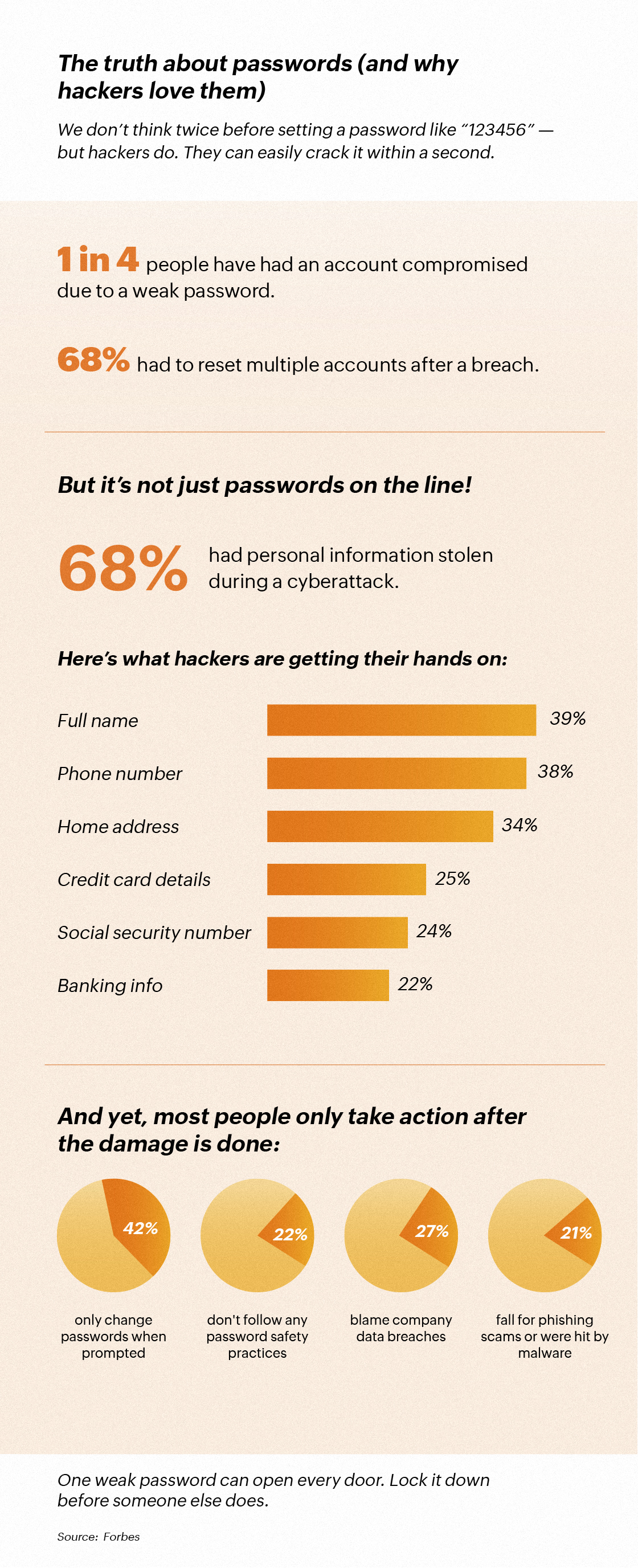
In 2024 alone, human error fueled 95% of data breaches.

And the problem is rarely a lack of tools. Most companies already have MFA, SSO, and strict password policies in place. But those don’t mean much if users are:

  • Reusing corporate passwords across personal sites.
  • Clicking on links that seem perfectly legitimate.
  • Bypassing password managers because they’re “too clunky”.

Even in high-security environments, a quiet culture of convenience can override compliance.

Fixing the culture

It’s easy to blame users. But a culture of community isn’t built by calling people careless. It’s built by designing solutions that align with how people actually behave.

In the real world, employees don’t wake up wanting to be insecure. They’re just trying to get their job done without getting locked out for the third time this week.

Here’s what needs to change:

Make security feel human, not corporate

Let’s be real: no one remembers that once-a-year security training filled with jargon and acronyms. It checks a box, but it doesn’t stick. What does? We have a few options. These include timely nudges that pop up when we are about to reuse a weak password, or a quick heads-up woven right into the tools we already use. The key is that the messages should feel more like they come from a colleague rather than a compliance officer. When security guidance is provided that sounds human, safety tips start to feel like part of the job, not an interruption or a directive. The goal isn’t fear, but to build online safety habits that last.

Make it simple and easy to do the right thing

Too often, security feels like something that gets in the way, such as password rules, and multi-step logins. No wonder people look for shortcuts! But when secure choices are made seamless, the need for work-arounds disappears. Providing frictionless tools like password managers helps remove cognitive clutter. The trick is to build systems that make secure behavior the easiest option and not the most frustrating one. Security will become second nature if people feel empowered.

Lead by example

Culture trickles from the top. If the C-suite treats security like an annoying speed bump, the rest of the organization will follow. But when leaders openly use password managers, share their own security wins (or fails), and treat best practices as part of how they work—not just policy—they normalize the behavior. It sends a message: “This matters to us.” When employees see their managers doing the right thing, it carries far more weight than any policy document ever could.

Build a security-first culture

Real change doesn’t happen in company-wide announcements. It happens when a teammate reminds someone not to share credentials on the team chat platform, or when IT responds with appreciation instead of frustration. It’s in the little moments. These micro-habits signal that security isn’t a separate “thing”—it’s part of how work is accomplished. That’s when the culture truly starts to change.

When tools fall short, culture steps in

Security tools will keep evolving. AI will get smarter. Frameworks will get tighter.
But there’s one thing that no upgrade can replace: trust in the people using them.

In the end, the strongest line of defense isn’t a system; it’s a workforce that knows what’s at stake and feels empowered to act.

Want better security? Start by designing for the human operating system.

Sneha Banerjee

Sneha Banerjee

Enterprise Analyst, ManageEngine

Want to read<br>this article on the go?

Want to read
this article on the go?

Do it on the ManageEngine
Insights app.

Subscribe to cybersecurity

Thanks for subscribing to ManageEngine Insights. If you do not receive our welcome email, please check your SPAM folder.