
Published on April 22, 2026 | 5 min

Before DaVonda St. Clair ever reviewed a firewall policy or assessed an infrastructure vulnerability, she was managing pallets of military equipment for the U.S. Air Force. As an Air Force logistics manager, her job was to make sure the right supplies were in the right place. “Just in case we went to war,” she explained over Zoom.

She didn’t know it then, but she was already doing the work of a cybersecurity architect — which is now her job at IBM. More specifically, St. Clair advises Air Force Civil Engineer leadership on cyber risk management and infrastructure protection. She also holds a Lean Six Sigma Master Black Belt — a credential she’d earned in practice before knowing it existed.

St. Clair’s path from Air Force logistics manager to cybersecurity architect isn’t a detour; it’s a direct route. For security leaders struggling to build their A-team, her story is just one example of where to look. This article explores why some less obvious backgrounds are a natural fit for cybersecurity and how CISOs can home in on a largely untapped talent pool.

What the resume doesn’t show

As recently as 2024, the conversation about the cyber talent gap focused on headcount, with reports citing millions of unfilled roles. But skills shortages have since become the top concern, casting doubt on the traditional hiring profile.

What organizations typically look for in a candidate — computer science degree, technical certifications, teeth cut in IT — is no longer sufficient. Today, 95% of cybersecurity teams report at least one skills gap, with governance, risk, and compliance among the more notable shortfalls.

St. Clair holds a degree in computer information systems, which isn’t unusual for a cybersecurity architect. But her resume told a different story — one that, while seemingly unrelated on paper to cybersecurity, turned out to be exactly the right preparation for it:

  • Checking shelf life on war reserve materials is, functionally, software auditing: verifying what you have, what’s expired, and what needs to be renewed.
  • Assessing which squadron needs what equipment translates directly to understanding which teams need what tools and access levels.
  • Sourcing materials from other bases without stripping them of critical resources is a form of third-party risk management — solving your own problem without creating another elsewhere.

When St. Clair took on her first IT role after leaving the Air Force, then, the overlap was obvious. “It was the same thing,” she says. “I just had to change my job title.” She already knew how to control levels of access and manage assets — she just needed to learn the language and translate it to a new context.

What hiring practices often miss

Technical fluency is the minimum requirement for most cybersecurity roles. But the ability to think across an entire system — to ask what happens on the other side when something fails — is harder to screen for, and rarer than most hiring managers realize.

“When you have engineers who are solely technical, they’re thinking of this switch, that router,” says St. Clair. “It needs to go here, it needs to go there. And most of the time, they’re not thinking — what is the communication path behind that switch or router? And how would that affect the end user?”

St. Clair was already applying this process-oriented way of thinking in the military long before she earned her Lean Six Sigma Master Black Belt. This certification — built around process improvement, waste elimination, and variation reduction — formalized what she’d spent years practicing in the Air Force without knowing it had a name.

“There are people who will put blinders on so they can really focus and get things done, and that’s fantastic,” St. Clair acknowledges. “But if you’re not looking at the entire picture, you may have to do something over again.”

The problem is, this mindset isn’t easily represented on a resume — at least not in the keywords the ATS (applicant tracking system) will scan for. Someone who can anticipate a process breakdown before it becomes a vulnerability is the kind of candidate organizations want but rarely find. Had St. Clair applied for a role requiring five years of security-specific experience and a CISSP, her resume wouldn’t have made it past the first filter.

What uncovering talent actually looks like

St. Clair landed her first cybersecurity role thanks to a director who noticed she did something her peers didn’t: she made it her business to understand everyone else’s job.

It didn’t happen overnight. After leaving the Air Force, she spent several years in adjacent roles, steadily moving closer to cybersecurity while doing what she’d always done: ask questions, solve problems, and learn every part of the operation around her.

“I was working in inventory management, but I wanted to get into tech,” she explains. “I was ordering the equipment and software. But I would go around to every team and say things like, ‘You’re ordering a lot of these parts. Why is that?’ Then, ‘What are you doing with this cabinet? If I order bulk pieces, could we store them here?'”

“I’m not good at sitting behind a desk all day,” she laughs. “There’s always something we could do better.”

Once, when a vendor sent the wrong shipment and told St. Clair to keep it, she tracked down another site that could use it instead. Another time, she helped an engineer think through how to sunset aging software without disrupting thousands of customers.

The director noticed the way she approached problems — even those that weren’t hers to solve — and encouraged her to apply for a job in information assurance, a field adjacent to cybersecurity that draws on many of the same skills she’d been using all along.

It wasn’t a meticulously worded job posting or an ATS that uncovered St. Clair’s talent. It was someone watching her work. That distinction matters.

Takeaways for tech leaders

Stories like St. Clair’s are, admittedly, atypical. They require leadership who are willing to look past job titles to recognize real, demonstrated capabilities. The takeaway here is that the signals worth looking for won’t always be found on a resume.

CISOs and security leaders might instead pay attention to how candidates talk about their previous work — whether they describe processes, ask about downstream effects, and think about the people on the other side of a decision. Someone who spent years in logistics, compliance, law enforcement, or any field demanding operational thinking under pressure may be exactly what your team is missing.   

Lauren Spiller

Lauren Spiller

Enterprise Analyst, ManageEngine

Want to read<br>this article on the go?

Want to read
this article on the go?

Do it on the ManageEngine
Insights app.

Published on June 07, 2025 | 4 min

Cyberattacks rarely come out of nowhere. Most hackers do their homework, looking for clues that a company’s guard is down. While we’re all told to fix weak passwords and update old software, there are quieter, more overlooked signs that signal, “Hey, we’re an easy target!”

Let’s break down six under-the-radar red flags, and what to do about them.

1. Your digital footprint has quietly grown but your security budget hasn’t  

New tools, cloud platforms, apps, and third-party services are great for getting work done faster. But with every new sign-up, your company’s digital footprint grows, and so does your exposure. If your security team isn’t keeping up, attackers might find old logins, forgotten test sites, or wide-open cloud storage.

Tip: Keep an eye on what’s exposed. Use tools that scan the internet for anything tied to your company, such as old websites, test apps, open storage, and more. Make sure your security spending keeps up with the new tools you’re adding, not just the old infrastructure.

2. Employees report more phishing emails but IT treats it as noise  

If phishing emails are popping up more often, that’s not just annoying; it’s a clue. Hackers could be testing who falls for what, spoofing internal addresses, or figuring out who has privileged access. It’s the digital form of reconnaissance. What looks like spam might actually be phase one of a bigger, more targeted attack.

Tip: Take every phishing report seriously. Look for patterns. Are certain roles being targeted? Are fake emails getting sneakier? Keep your team in the loop and build a strong feedback system to spot attacks.

3. You’ve recently had public exposure 

Just got funding? Announced a big partnership? Hackers are watching, too. They read the same press releases and LinkedIn posts that customers and investors do. Public wins make you look like a juicy target. Attackers know you’re probably onboarding fast, hiring like crazy, and maybe a little distracted. In short, the perfect time to strike.

Tip: Treat media buzz like a risk multiplier. Tighten access, double-check your alerts, and prep your teams for fake emails using your new exec’s name.

4. Critical staff use their personal devices for work and no one talks about it  

Many C-level executives, founders, or engineers use personal devices for work-related tasks, especially when traveling or working after hours. If these devices aren’t covered by MDM or endpoint detection tools, they become invisible risks.

A single compromised device can give attackers access to your organization’s source code, customer data, or finance tools.

Tip: Build an executive cybersecurity program. Include secure communication apps, enforced MFA, and training on mobile-specific threats. Verify compliance regularly, not just through policy, but through tools like MDM platforms, endpoint security solutions, and mobile threat defense systems.

5. You’ve had multiple third-party vendors experience incidents  

Supply chain attacks are a favorite among sophisticated threat actors. Even if your organization is secure, compromised vendors (especially those with API or data access) can be used to leapfrog into your systems.

Attackers often view a breached vendor as the first domino. If multiple partners have been hit, it’s statistically likely someone is already probing you, especially if you share similar tech stacks or cloud platforms.

Tip: Don’t just vet vendors once. Keep tabs on them after the contract is signed. Build a system for regular check-ins, breach notifications, and security updates for any third party that connects to your network.

6. Your incident response plan exists on paper but not in practice

A long PDF with flowcharts might tick the compliance box, but if no one’s ever tested it, it’s just theory. When a real attack happens, teams often freeze because no one’s sure who does what, contact info is outdated, or decisions get stuck waiting on approvals. And these problems usually don’t show up until everything’s already on fire.

Attackers count on this kind of confusion. The slower the response, the more time they have to move laterally, encrypt systems, or exfiltrate sensitive data undetected.

Tip: Conduct regular tabletop exercises involving not just IT and security but also legal, HR, PR, and executive leadership. Simulate real-world scenarios like ransomware or insider threats, and assess how your team performs under pressure. Focus on response speed, communication flow, and clarity of action. Use the outcomes to refine and evolve your response plan. Remember, in cybersecurity, practice isn’t optional. It’s survival.

Final thoughts: Awareness is your armor  

Cyberattackers follow the breadcrumbs. And those breadcrumbs are often left by organizations that are growing fast, moving faster, and missing the warning signs—the subtle signals that attackers count on. Spotting them early means you’re staying ahead of cyberthreats. In this fight, awareness is your early warning system and your best defense.


Sneha Banerjee

Sneha Banerjee

Enterprise Analyst, ManageEngine

Want to read<br>this article on the go?

Want to read
this article on the go?

Do it on the ManageEngine
Insights app.

Published on May 01, 2025 | 4 min

In a glass-walled boardroom, a CISO is confidently unveiling the company’s next-gen cybersecurity stack.

There’s AI-powered threat detection, real-time risk scoring, and a Zero Trust framework that costs more than a luxury car. Heads nod around the table. Everything looks secure, on paper.

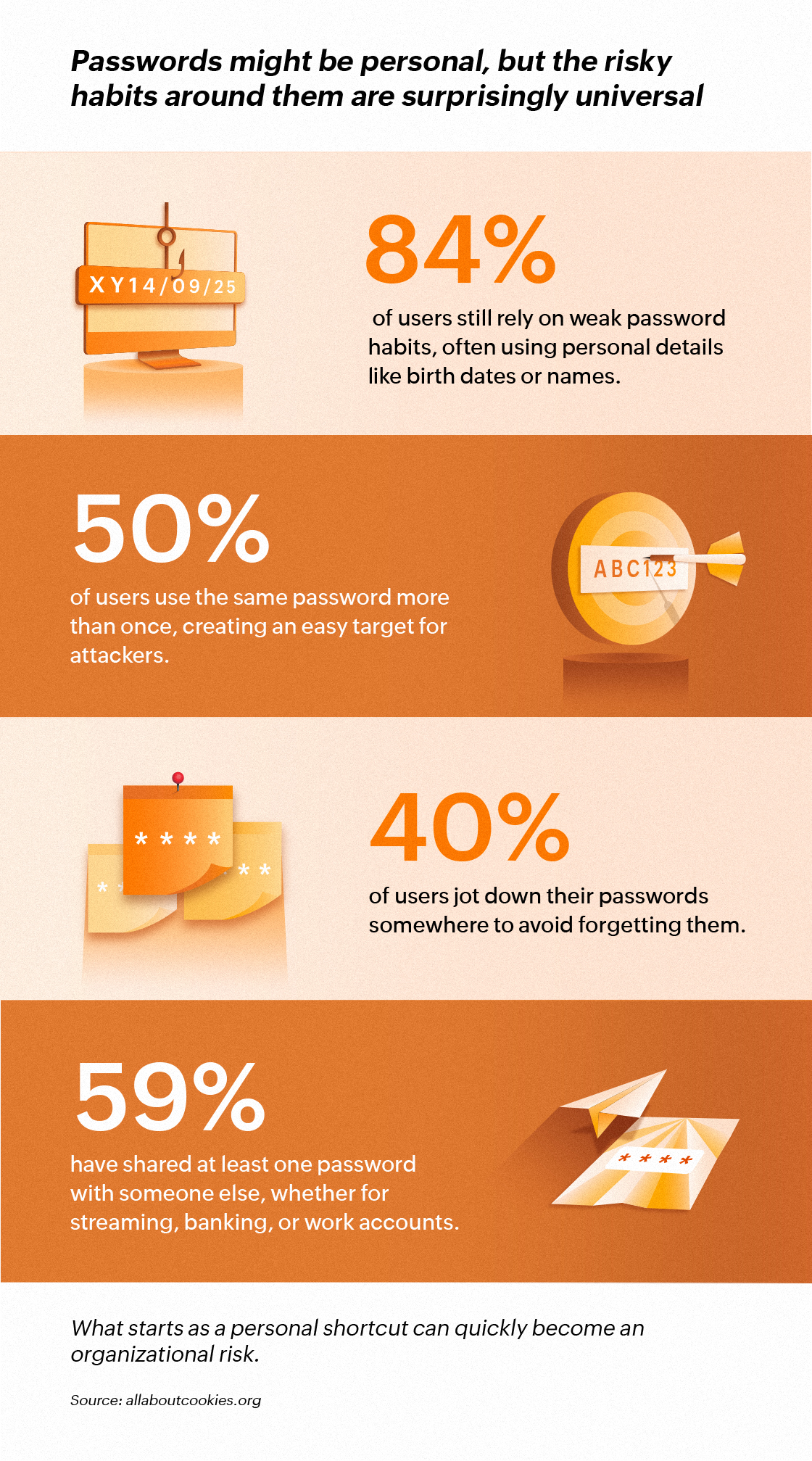
Meanwhile, somewhere across the organization, an employee logs into a critical internal app using “Welcome@123.”

It checks all the boxes—a capital, a symbol, numerical, and just enough complexity to feel safe. But it’s not.

Here’s the truth: with all the encryption, endpoint hardening, and biometric buzzwords floating around, it still takes just one weak password to bring everything crashing down.

We love to talk about tech. But most breaches don’t come from sophisticated hacks; they happen because people are tired, distracted, and just trying to get through the day.

And in that moment, convenience wins.

Passwords are personal, and that’s a problem

Think about the last time someone asked you to create a password. Chances are, your brain didn’t leap to “secure.” It went straight to “memorable.”

A pet’s name, a favorite band, the street you grew up on, maybe with a number slapped on the end.

Here’s the tricky part: most people think their password is clever enough.

“Sure, it’s my dog’s name… but it’s spelled backwards… with a 3 instead of an E. That’s good, right?”

Well, it’s not.

When personal becomes enterprise

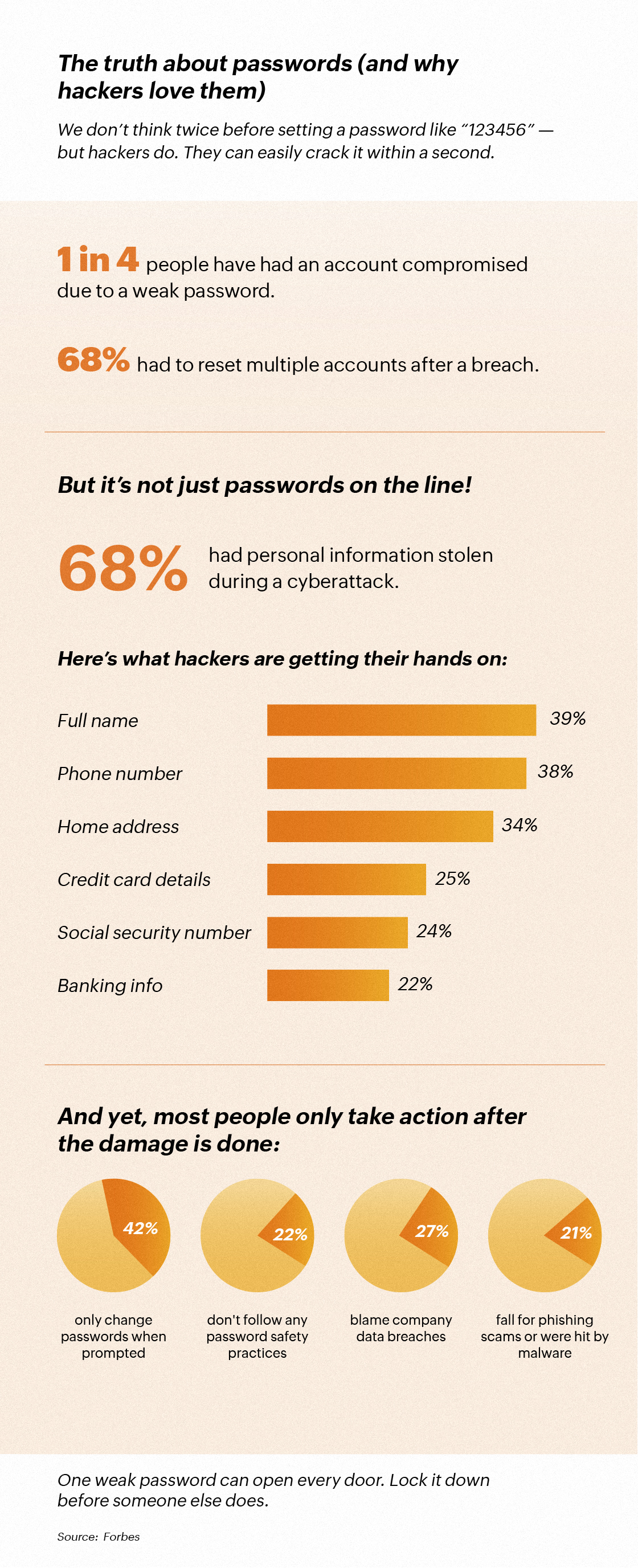
In 2024 alone, human error fueled 95% of data breaches.

And the problem is rarely a lack of tools. Most companies already have MFA, SSO, and strict password policies in place. But those don’t mean much if users are:

  • Reusing corporate passwords across personal sites.
  • Clicking on links that seem perfectly legitimate.
  • Bypassing password managers because they’re “too clunky”.

Even in high-security environments, a quiet culture of convenience can override compliance.

Fixing the culture

It’s easy to blame users. But a culture of community isn’t built by calling people careless. It’s built by designing solutions that align with how people actually behave.

In the real world, employees don’t wake up wanting to be insecure. They’re just trying to get their job done without getting locked out for the third time this week.

Here’s what needs to change:

Make security feel human, not corporate

Let’s be real: no one remembers that once-a-year security training filled with jargon and acronyms. It checks a box, but it doesn’t stick. What does? We have a few options. These include timely nudges that pop up when we are about to reuse a weak password, or a quick heads-up woven right into the tools we already use. The key is that the messages should feel more like they come from a colleague rather than a compliance officer. When security guidance is provided that sounds human, safety tips start to feel like part of the job, not an interruption or a directive. The goal isn’t fear, but to build online safety habits that last.

Make it simple and easy to do the right thing

Too often, security feels like something that gets in the way, such as password rules, and multi-step logins. No wonder people look for shortcuts! But when secure choices are made seamless, the need for work-arounds disappears. Providing frictionless tools like password managers helps remove cognitive clutter. The trick is to build systems that make secure behavior the easiest option and not the most frustrating one. Security will become second nature if people feel empowered.

Lead by example

Culture trickles from the top. If the C-suite treats security like an annoying speed bump, the rest of the organization will follow. But when leaders openly use password managers, share their own security wins (or fails), and treat best practices as part of how they work—not just policy—they normalize the behavior. It sends a message: “This matters to us.” When employees see their managers doing the right thing, it carries far more weight than any policy document ever could.

Build a security-first culture

Real change doesn’t happen in company-wide announcements. It happens when a teammate reminds someone not to share credentials on the team chat platform, or when IT responds with appreciation instead of frustration. It’s in the little moments. These micro-habits signal that security isn’t a separate “thing”—it’s part of how work is accomplished. That’s when the culture truly starts to change.

When tools fall short, culture steps in

Security tools will keep evolving. AI will get smarter. Frameworks will get tighter.
But there’s one thing that no upgrade can replace: trust in the people using them.

In the end, the strongest line of defense isn’t a system; it’s a workforce that knows what’s at stake and feels empowered to act.

Want better security? Start by designing for the human operating system.

Sneha Banerjee

Sneha Banerjee

Enterprise Analyst, ManageEngine

Want to read<br>this article on the go?

Want to read
this article on the go?

Do it on the ManageEngine
Insights app.

Published on July 20, 2024 | 4 min

Generation Z has the dubious distinction of being the most dangerous demographic—at least from a corporate cybersecurity perspective.

According to a May 2024 ManageEngine study, Gen Zers have supplanted Millennials as the generational cohort that poses the greatest security threat.

Poor password hygiene

To be fair, the majority of respondents from every generation fail to vary their online passwords adequately. Overall, 59% of study respondents reported using the same password across multiple accounts.

Generally speaking, the younger the cohort, the more likely they are to reuse passwords. According to the study, 53% of Baby Boomers, 57% of Gen Xers, and 66% of Millennials reported reusing passwords. Gen Z was in a tier of their own, however, as 72% of them reportedly reuse passwords.

Asked about how they “keep track of their passwords,” 15% of Gen Zers said they liked to keep their passwords the same because it’s easier to remember them that way. Somewhat surprisingly, Boomers vary their passwords more often; in fact, only 6% of Boomers like to keep all their passwords the same. That said, Boomers (57%) do write down their passwords more than any other demographic.

A nonchalant approach to cybersecurity

Gen Z is quite laid back when it comes to cyber vigilance. As an example, their generational cohort is the most likely (82%) to connect phones and laptops to public Wi-Fi. To be fair, many Boomers (47%), Gen Xers (69%), and Millennials (75%) also reported doing this.

Additionally, Gen Zers don’t seem overly concerned about phishing scams. A number of Gen Zers (14%) were not concerned at all about phishing, and only 25% were very concerned. On the other end of the spectrum, Boomers (42%) were very concerned about phishing, and only a few (4%) claimed to be unconcerned at all.

Although this is speculation, it’s plausible that these percentages could be due to Gen Zers’ advanced media literacy—and older users may be more susceptible to scams in general.

That said, perhaps Boomers do have cause to be concerned, as many of them (49%) said their personal information has been comprised by a data breach. Nevertheless, Gen Zers’ behavior is the most likely to have repercussions for organizations.

Gen Zers’ behavior is likely to have the most repercussions

At this juncture, it is worth noting that Gen Zers have not had their personal data leaked as often as the older cohorts. In fact, only 41% of Gen Zers reported having their personal information leaked as a result of a data breach. This percentage seems rather high, until one looks at Millennials (54%), Gen Xers (51%), and Baby Boomers (49%).

On another interesting note, Gen Zers appear to be the least trusting demographic of the bunch. More than any other cohort, Gen Zers (54%) say they would lose trust in a business in the aftermath of a data breach.

Now, it very well could be that Gen Zers are not worried about things like data breaches, scams, and phishing attacks because they are younger, quite technologically savvy, and perhaps, they just haven’t experienced such events yet.

Nevertheless, the fact remains: Gen Zers pose the greatest risk to organizations’ cybersecurity for an obvious reason: they’re entering the workforce in increasingly large numbers. Conversely, to cite an obvious example, when a retired Baby Boomer suffers a data breach, he or she is rarely on a corporate network. And the survey data tells this story quite clearly.

Boomers (43%) and Gen Zers (43%) “clicked on links via text and email from unknown senders” at the same rate. However, the Gen Zers’ clicks caused far more corporate collateral damage.

According to the survey, a number (4%) of Gen Zers who opened links from unknown senders said that their organization got a virus as a result. This percentage was twice as high as all other surveyed demographics.

In short, Gen Zers are currently the most dangerous cybersecurity offenders. To be sure, all demographics need to improve their cybersecurity hygiene, but Gen Zers are packing the biggest punch.

Other key survey findings

The majority (59%) of consumers are using the same password across multiple online accounts, a slight increase from ManageEngine’s 2023 findings.

Only 77% of consumers said they’d change their password following a cyberattack or data breach.

Nearly 60% say they would still trust companies with their personal information in the aftermath of a data breach or cyberattack.

Nearly half (45%) of respondents say they generally trust big tech organizations (such as Amazon, Apple, Google, and Meta) to keep their personal data secure.

Methodology

During May 2024, ManageEngine, in partnership with Dynata, conducted a consumer survey, which targeted 1,000 adults across the United States, aged 18 and up. Figures for age, education, employment, gender, income, and region were weighted to bring them into line with their actual proportions in the population. That said, the sample is based on those who agreed to participate; thus, no sampling error estimates could be calculated. Baby Boomers were classified as those born between 1946-1964 (60-78), and respondents born between 1997-2012 (12-27) were classified as Gen Zers.

John Donegan

John Donegan

Enterprise Analyst, ManageEngine

Want to read<br>this article on the go?

Want to read
this article on the go?

Do it on the ManageEngine
Insights app.

IT Security

Decoding the trust factor in technology

Published on July 05, 2024

Why watch?

In today’s dynamic digital landscape, trust has become the cornerstone of successful online interactions and transactions. As our lives become increasingly intertwined with digital technology, understanding and fostering digital trust is more important than ever. Whether you’re a business leader, a tech enthusiast, or simply someone who values online security and privacy, this episode of Thinking Tech offers essential insights that will help you navigate the digital world with confidence.

We’ll break down the concept of digital trust, explaining how it influences our interactions with technology, companies, and each other. You’ll gain insights into how digital trust impacts your business and why it’s crucial for maintaining secure and reliable digital environments.

What you’ll learn

  • What digital trust is.

  • The impact of trust on organizational success.

  • The five pillars of digital trust.

  • How to build a strong foundation of transparency and credibility.

Watch Now
Priyanka Roy

Priyanka Roy

Senior Enterprise Evangelist, ManageEngine

Published on February 16, 2024 | 7 min

In the past five years, the digital world has experienced unprecedented changes. While the physical world waged war against a deadly virus, the digital world thrived as a space for remote work, social interactions, and e-commerce.

As of 2023, 16% of all businesses have moved to complete and permanent remote operations, and by 2025, over 22% of the entire American workforce will have ceased to work on-premises.

While there are countless industries that cherished and perished from this sudden and drastic change, there was one that witnessed unrealistic growth—the cyber insurance industry.

To understand how that happened, let us look at the events of the early 2020s.

One small step for business, one giant leap for the industry

The hastened pursuit of a digital workspace came with a lot of straightforward benefits, like cost-cutting in terms of capital and logistics. But this came at the expense of leaving multiple IT network backdoors unchecked and unregulated.

This consequentially led to a plague of security incidents spreading over the digital world. Ranging from phishing and DDoS attacks to malware and viruses, and especially ransomware, data breaches ran wild throughout the digital diaspora. In 2020, one in six cyberattack victims faced a ransomware attack, and about half of them paid the ransom.

This is where it gets tricky.

If a company has an active cyber insurance policy during the attack, the insurer is liable to bear the fiscal demands of a cyberattack. In order to capitalize on such a crucial investment, all businesses with any form of digital presence rushed to purchase a cyber insurance plan. This led to the cyber insurance industry growing bigger than it was ever predicted.

The trend continues, and now, the global cyber insurance market has almost tripled in value over the span of three years. Even then, only 55% of all companies with an online presence have a cyber insurance policy in place. It now has a steady CAGR of 26.1% and is estimated to grow a sizable $84.62 billion in market share in less than 10 years.

But, there’s a catch!

Cyber insurers are losing money

Yes, you read that right. Though the global cyber insurance market will go down in history for having some of the fastest industry growth ever witnessed, individual cyber insurers are facing heavy losses.

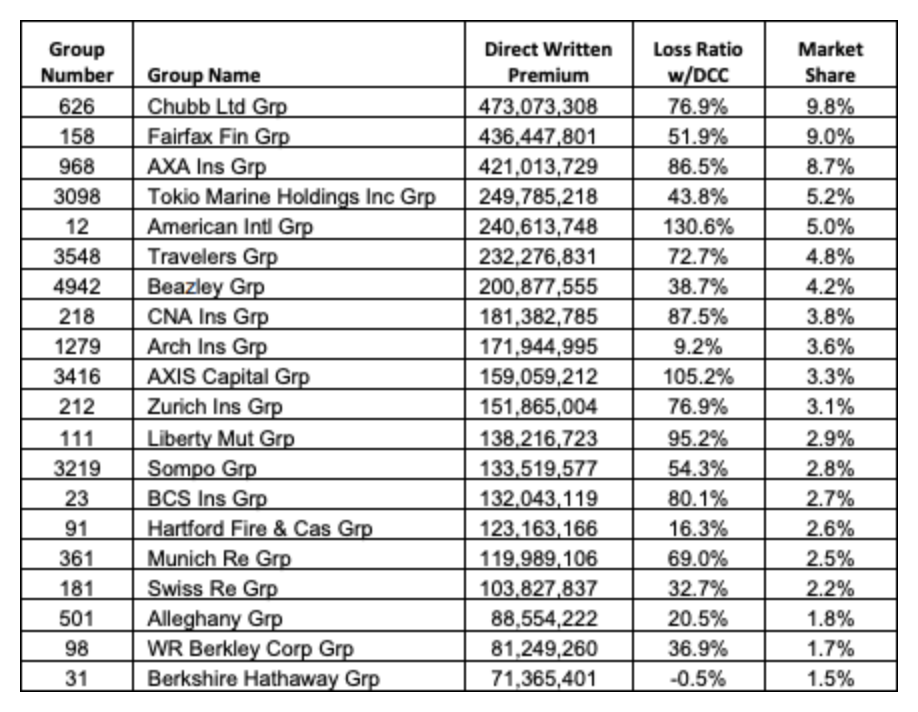
Here are the numbers.

Source: The National Association of Insurance Commissioners, 2022

This recent report from the National Association of Insurance Commissioners (NAIC) the total amount of premiums written and the respective loss ratios of the top 20 United States insurance groups. Among the worst is a loss ratio of 130.6% by the American Intl Grp and a loss ratio of 105.2% by the AXIS Capital Grp.

Why is the loss ratio important?

The loss ratio is an insurance company’s total claims written, plus the insurer’s costs for handling those claims, divided by the total in premiums earned by the insurer—and this does not even include the overhead costs of running an insurance company.

To give you a fair idea of what the stats mean, ideally, an insurer would like to have a loss ratio of 40%. At 60%, things start to get a little tight. If it rises more than 60%, employees worry about losing their jobs.

The top 20 US insurers, who cumulatively hold over 81% of the market share, are at an average loss ratio of 60%. That means, though an exponentially high number of organizations pay for cyber insurance policies, the insurance companies are still losing money due to a high number of claims.

So, in order to find a solution to this paradox, cyber insurance companies decided to address the issue’s root cause: too many risky clients.

Stricter cyber insurance qualification metrics

Cyber insurers have been giving out more money than they’re making. This is because the majority of policyholders lack proper mechanisms in place to avoid a cyberattack. On top of that, the ransomware pandemic does not seem like it will stop. Insurers have realized their products are no fool’s gold and that every company ultimately will purchase a cyber insurance policy at some point, given the rapidly increasing interest to shift to a digital marketspace.

To mitigate the costs associated with claim delivery and execution, which have been unreasonably higher than their net revenue from premiums, insurers have decided to impose stricter metrics for a business to qualify for a cyber insurance policy. On top of that, cyber insurers have also increased premium costs to absurdly high amounts if a company does not have proper software and hardware in place to thwart cyberattacks.

Finally, insurers have also radicalized many underlying policy conditions to safeguard their interests.

Read the fine print

Some of these changes include the following exclusions, limitations, and conditions.

Ransomware exclusions

It is highly likely that your cyber insurance policy will have a ransomware exclusion. The primary driver for this change stems from the Office of Foreign Assets Control (OFAC) sanctions list. This list contains a set of institutions that are considered illegal to indulge in monetary transactions with.

Cyber insurers treat this sanctions list with utmost importance in order to avoid legal complications. Most companies that were unaware of the nature of such transactions have faced coverage denials, and therefore, it is important to understand the ransomware exclusion that is likely part of your policy.

In certain cases, insurers do process waivers for transactions that may or may not fall under the above-mentioned umbrella. However, these waivers usually take six months or more to be processed. Therefore, it is important to have sufficient reserves in place to keep your business functional should you fall victim to such a massive ransomware attack. These waivers also come with a presumption of denial clause.

Besides that, there is something called “strict liability” that cyber insurance policyholders need to be aware of. It’s a legal term that means even if you were unaware of the illegal nature of a ransom transaction, you could be held accountable and be charged under a civil suit for such a violation, for which you will not be covered.

Ransomware coinsurance and sub-limits

It would be laughable to assume that the number one sees on the first page of their policy document is claimable with no exceptions. Like any other insurance policy, it is safe to assume that sub-limitation clauses are buried in between the pages of your cyber insurance policy as well.

Typically, a sub-limit bifurcates how much coverage is available for a specific type of loss. So in the case of a ransomware attack, only a part of the total amount can be claimed if your policy has a ransomware sub-limit in place, which more often than not, it does. Additionally, if you have coinsurance clauses added to your sub-limit, you’ll also be obligated to cover a part of your ransomware expenses.

So, even though you might have a cyber insurance policy worth $10M, only 30% of that may be claimed in case of ransomware attacks, and moreover, even if the 30% covers your entire ransomware costs, you will be obligated to pay a percentage of the ransomware expense regardless when there is a coinsurance clause included in the sub-limit.

Legacy hardware and software exclusions

Different carriers use different definitions for the term legacy. Most of the terms used under such clauses are also almost always vague. We would advise policyholders to be careful and get clear distinctions between what their carriers consider legacy and what they don’t.

This, however, is straightforward in terms of implementation. Carriers usually don’t like gambling on legacy hardware and software given their outdated form and function and would advise businesses to upgrade to the latest versions of hardware. But certain multi-million enterprise IT infrastructures, like mainframe servers, could prove economically unfeasible to replace.

Even if your entire business model depends on the functionality of such legacy hardware, it will likely still not be covered by your carrier, depending on the policy.

Patch conditions

Unpatched vulnerabilities are excluded from your policy in multiple ways.

One way insurers do this is by determining how long it has been since the last patch was released for a particular vulnerability and how long it took the business to implement the said patch, while considering the severity of said vulnerability. Based on that timeline, you can expect the insurance payout amount to drop accordingly.

Zero-day exclusions

This exclusion means that if your business is hit with a zero-day exploit, the carrier is not obligated to satisfy the claim. We believe the presence of this exclusion should be considered a deal-breaker because it’s impossible to know when such an exploit exists. This exclusion certainly benefits the carrier, but from a business’ point of view, it does not make sense to subscribe to such a policy. We would strongly advise finding a carrier that does not enforce zero-day exclusions.

Business harm

Business harm is now uninsurable. If a cyberattack results in extended business downtime, this cost is now completely uninsurable by industry norms. There are, however, still some carriers who provide a small amount of insurance for business harm, but it can no longer be expected.

There are no accidents, only mistakes

All forms of data breach start at one place: unauthorized access. A fortified enterprise IT network boasting millions of dollars in resilience can be easily manipulated with something as simple as a leaked password or a vulnerable certificate.

The root cause of any major cyberattack almost always starts with unauthorized access to an enterprise identity, such as domain account passwords, server certificates, and cloud entitlements. Cyber insurance carriers recognize identity security and access management as crucial cogs of a business’ IT network strategy that help exponentially reduce possibilities of a data breach. They also mandate having such controls in place in order to meet cyber insurance qualification metrics.

At any given point, all IT networks have vulnerabilities, and one can never predict the downfall of a digital entity. Therefore, it is important to reverse-engineer your IT strategy to assume a threat always and enforce Zero Trust practices at any entry point into your IT establishment.

Niresh Swamy

Niresh Swamy

Enterprise Analyst, ManageEngine

Want to read<br>this article on the go?

Want to read
this article on the go?

Do it on the ManageEngine
Insights app.

Published on November 30, 2023 | 6 min

In the digital epoch, identities have transcended simple identifiers like names and faces, evolving into complex constructs woven with personal data, behavioral attributes, and digital interactions. Enterprises must effectively manage this expanding identity paradigm as they navigate the intricacies of digital transformation.

Usernames and passwords are no longer sufficient for digital identity management (DIM). Biometrics, multi-factor authentication (MFA), and blockchain-based identity verification are now all part of this growing trend, driven by the ongoing search for enhanced security in an increasingly cyber-threatened environment.

However, the expansion of DIM brings its own set of challenges. Enterprises often grapple with fragmented identity systems, a result of deploying numerous applications, each with its distinct identity management protocols. This fragmentation not only disrupts user experiences but also impairs operational efficiency, creating significant hurdles for IT teams tasked with maintaining consistent identity governance across diverse platforms.

In the face of these challenges, strategic insight becomes indispensable for enterprises. Successfully navigating the intricacies of DIM is crucial. Businesses that excel in this area will not only enhance their security posture but also significantly improve user experiences and seamlessly adapt to future technological innovations.

Against the backdrop of this evolving landscape, identity fabric emerges as a key solution to the challenges of DIM. Identity fabric isn’t a mere flash in the pan. It extends far beyond temporary fixes to deliver a holistic approach to identity management through thoughtfully designed architecture. By integrating various identity and access management (IAM) tools into a seamless tapestry, identity fabric moves beyond traditional, isolated frameworks. By eliminating fragmentation barriers, identity fabric enables a fluid and cohesive flow of identities across different platforms, applications, and devices. This approach, both unified and streamlined, not only strengthens security and operational efficiency but also fosters an environment of trust, an essential aspect of today’s interconnected world.


Building a culture of trust

Trust is the bedrock of successful business relationships, underpinning the basis for customer and stakeholder engagement. This critical element of trust extends into the realm of digital interactions, where the assurance of both security and authenticity are of utmost importance. The digital identity of individuals or entities plays a pivotal role in these interactions, acting as a key factor in either establishing or diminishing trust. In today’s digital ecosystem, where identities are increasingly vulnerable to malicious activities, effectively managing and securing these identities is vital for sustaining and amplifying trust.

Identity fabric stands out as more than just a solution architecture; it acts as a driving force in cultivating a culture of trust within digital interactions. Its introduction marks a significant step forward in reinforcing this trust by leading the way in enabling safer, more efficient, and transparent management of digital identities. Through its well-considered design, it ensures smooth integration amongst different identity solutions, streamlines the governance of identities, and boosts operational efficiency—all essential elements in nurturing trust.

The cohesive identity management ecosystem created by identity fabric significantly diminishes the risk of cyber threats, strengthening the overall security framework of enterprises. This improvement in security goes beyond technical enhancement; it’s a vital step in building trust. When stakeholders are confident that their identities are managed both securely and efficiently, a natural sense of trust develops.

Identity fabric plays a key role in aiding enterprises to effectively navigate the complexities of regulatory compliance for data security, which is crucial in establishing trust. Adhering to data privacy laws is more than a legal obligation; it signals an enterprise’s commitment to protecting stakeholder data.

The refined user experience enabled by identity fabric is essential in cultivating trust. By simplifying the authentication process, it not only makes the user experience more seamless but also demonstrates an enterprise’s awareness of and attention to user convenience – a key factor in fostering trust.

Finally, the forward-thinking ethos of identity fabric, encouraging enterprises to adopt a unified and proactive approach in managing digital identities, underscores a commitment to trust-centered digital identity management. This anticipatory strategy reflects an enterprise’s dedication to meeting current challenges while also preparing for future developments, further enhancing trust among stakeholders.


Fortifying digital battlements

In today’s digital era, enterprise security has evolved from a mere technical requirement to an essential business strategy. The increasing digital interactions and consequent data generation pose both opportunities and challenges. On one hand, they drive business processes and customer engagement. On the other hand, they expose businesses to an array of cybersecurity threats like data breaches, identity theft, and phishing attacks. These risks are further intensified by fragmented identity systems and varied identity and access management (IAM) tools, leading to increased vulnerabilities and sluggish responses to security incidents, thereby risking the overall security posture of enterprises.

In this scenario, identity fabric offers a comprehensive approach to identity management, acting as a defense mechanism against the diverse threats in the digital environment. By integrating various IAM tools into a cohesive framework and creating a unified identity management ecosystem, identity fabric substantially minimizes potential security breaches. Its standards-based connector framework allows for smooth integration between different identity systems, enhancing access control and making it difficult for cybercriminals to find and exploit weaknesses.

The superior visibility and control provided by identity fabric play a crucial role in anticipating and preventing security threats. With its clear insight into access privileges and streamlined authentication processes, it enables enterprises to maintain tighter control over their digital resources. This proactive management of access rights not only reduces the risk of unauthorized entry but also aids in quick detection and response to security incidents, vital for limiting damage and maintaining enterprise security.

Additionally, identity fabric’s adaptability in incorporating emerging technologies like blockchain, AI, and machine learning into its framework is a significant boon for enterprise security. This integration capability allows for the implementation of advanced security measures, including real-time threat monitoring, predictive threat detection analytics, and data encryption.

Reflecting again on the notion of cultivating a culture of trust, the security assurance provided by identity fabric is integral. When stakeholders are confident in the secure management of their digital identities, and enterprises are equipped to counter threats efficiently, an environment conducive to both trust and security is established.

Identity fabric’s unified approach to identity management represents a key strategic tool for enterprises to address the primary challenges of digital identity management. By creating a secure and trustworthy environment, identity fabric equips enterprises to face the volatile digital world confidently, ensuring both resilience and continuity in a landscape frequently disrupted by threats.


Adapting to the future

As enterprises progress deeper into the digital era, the continuous evolution of digital identity management (DIM) is of paramount importance. The landscape is marked by emerging trends like decentralized identity, blockchain-based authentication, and the incorporation of artificial intelligence (AI) and machine learning (ML) in identity verification and fraud detection. These developments offer promising prospects for heightened security, privacy, and a more user-focused approach to identity management. However, they also bring challenges such as integrating these new technologies into existing frameworks, ensuring the scalability of identity management solutions, and maintaining compliance within this rapidly changing tech environment.

In this dynamic context, adopting a versatile and adaptable identity management framework like identity fabric is a strategic move for enterprises. Crafted with foresight, identity fabric’s abstraction layer is key to its scalability and smooth integration of emerging technologies, allowing enterprises to seamlessly incorporate innovations like blockchain, AI, and ML into their identity management systems, thereby keeping pace with advances in security and identity management.

The cohesive and integrated approach of identity fabric lays a solid foundation for enterprises to adapt and evolve with the changing digital identity landscape. Its standards-based connector framework enables smooth coordination between various identity solutions, ensuring agility and responsiveness as new trends and technologies emerge in identity management.

This adaptability and forward-thinking design of identity fabric are crucial in continuing the themes of cultivating trust and reinforcing enterprise security. An adaptable identity management framework not only bolsters security but also engenders trust amongst stakeholders, who recognize the enterprise’s ability to skillfully navigate technological advancements while safeguarding the security and privacy of digital identities.


The final stitch

In the intricate pattern of today’s digital landscape, where the threads of enterprise security and individual identity are intricately interlaced, identity fabric serves as a visionary blueprint for the future. It reinforces the notion that trust is the most valuable currency in the digital realm, and that safeguarding this trust through robust security measures is paramount.

As enterprises continue to navigate the ever-evolving challenges of digital identity management, the principles embedded in identity fabric offer a beacon of guidance. By adopting this unified, adaptive approach, organizations can not only protect their digital assets but also cultivate a culture of trust that resonates with customers, stakeholders, and employees alike. Ultimately, embracing identity fabric is not just a smart move—it’s an essential step towards forging a resilient, trusted, and secure digital future.

Debanjali Ghosh

Debanjali Ghosh

Technical Evangelist, ManageEngine

Want to read<br>this article on the go?

Want to read
this article on the go?

Do it on the ManageEngine
Insights app.

Published on October 27, 2023 | 4 min

Cyberattacks have become so common that there’s one every 39 seconds.

Sensitive data has always been a prime target of cybercriminals. “During the first quarter of 2023, more than six million data records were exposed worldwide through data breaches,” says a Statista report. Attackers tend to target high-value data such as payment details, PII, healthcare records, authentication credentials, insurance records, and more.

Data breaches are an expensive problem. Based on IBM’s cost of a data breach report, the global average cost of a data breach in 2023 was $4.45 million. The actual cost of a data breach amounts to more than just money lost to ransom, the cost of investigating the breach, or the revenue lost due to business downtime. Additional expenses include fines related to regulatory compliance violations, legal and audit fees, the fall of stock prices for publicly listed companies, and customer retention costs due to reputational damage.

While organizations are doing their best to adopt effective strategies to protect sensitive data, there’s no 100% foolproof cybersecurity system.

More and more organizations are acknowledging the fact that they are far more vulnerable to sophisticated attacks than ever before. The risk to business continuity and increase in the cost of data breaches have forced mature organizations to focus on bringing their cyber risk scores down to acceptable levels and minimizing the impact of a data breach.

Time matters

“Time is the new currency in cybersecurity both for the defenders and the attackers…early detection and fast response can significantly reduce the impact of a breach.”

                                                                                              IBM’s Cost of a Data Breach Report 2023

According to IBM’s Cost of a Data Breach Report 2023, the average data breach life cycle is 322 days—meaning it takes that long for organizations to identify and contain an active breach. This period usually gives attackers enough time to get away with their plan and access sensitive data and client records. The close relationship between response time and a data breach is a critical factor that can define the impact and severity of a data breach on an organization.

Take the case of one of the biggest breaches to date, the Equifax data breach. Hackers exfiltrated sensitive data of more than 148 million consumers—40% of the American population. Equifax had failed to patch a known vulnerability, making it easier for the attackers to enter its system. While the breach was discovered on July 29, 2017, it’s believed that the breach had occurred much earlier, possibly as early as May 2017. But Equifax made the public disclosure only on Sept. 7, more than a month after its discovery. This delay in detection and response gave attackers plenty of time to exfiltrate sensitive data. And this cost the company dearly. Equifax was fined $700 million for the breach. The Equifax data breach is a perfect example of the grave effects of a delayed response time.

In the business world, time is money. The same is true in the case of a data breach. A shorter mean time to detect (MTTD) means less time for cybercriminals to steal or tamper with sensitive data. And a faster response means better chances of controlling the damage caused by the breach. Both these factors can indirectly help reduce the total cost of a data breach. This means every second after a breach starts is pivotal and can directly determine the impact of the breach.

AI and automation can help

The good news is that AI and automation can be helpful in preventing and mitigating data breaches. IBM’s report shows that organizations that used both AI and automation reduced the data breach life cycle by 108 days. In fact, “organizations that deployed security AI and automation extensively saw, on average, nearly $1.8 million lower data breach costs than organizations that didn’t deploy these technologies.”

AI-based solutions can be a powerful instrument to curb data breaches. AI has the power to monitor and analyze large volumes of transactional data to detect fraudulent activities, anomalies, and unusual behavior. The implementation of AI-driven fraud detection systems can help banks save around $10 billion annually according to a study by Juniper Research. Automation, on the other hand, can help reduce data breach detection time and ensure quick incident response.

A survey by Capgemini Research Institute reports that 75% of cybersecurity executives use AI in network security, and another survey by BlackBerry found that “the majority (82%) of IT decision-makers plan to invest in AI-driven cybersecurity in the next two years and almost half (48%) plan to invest before the end of 2023.”

Being prepared

Preventing a breach might be implausible, but how an organization navigates its response to a breach is significant. Conducting regular security audits to ensure security measures are up to date, investing in a swift breach response system, and providing employees security awareness training can help organizations be better prepared. Additionally, investing in the right data security tools, leveraging AI and automation, and implementing Zero Trust principles can help reduce the time taken to detect and respond to a data breach, or even keep it from happening in the first place.

Breaches can be an expensive problem. However, with the right mindset, tools, and technology, IT teams can respond quickly to contain a breach and minimize its damaging consequences.

Athira Jayakumar

Athira Jayakumar

Enterprise Analyst, ManageEngine

Want to read<br>this article on the go?

Want to read
this article on the go?

Do it on the ManageEngine
Insights app.

Published on May 05, 2023 | 5 min

Passwords have been the cornerstone of digital security since time immemorial. They are such a critical aspect of our security infrastructure and practices that we have an entire day, the first Thursday of May, dedicated to raising awareness about the importance of setting strong passwords and maintaining good online security habits. Unfortunately, passwords are also considered to be one of the biggest security weak links. A recent report by Verizon found that compromised passwords are involved in 81% of all data breaches. As cyberattacks and criminals become increasingly sophisticated with each passing day, adopting the latest technological developments to hone their skills, and the need for stronger and more secure authentication methods have become imperative.

Enter passwordless authentication, a new way to authenticate users without the need to enter passwords every time.

Why do we need passwordless authentication?

In a password-based authentication process, regardless of whether multi-factor authentication (MFA) has been adopted, the first step involves the user entering their username and password, which serves as proof of their identity.

However, this process has two major disadvantages. The first problem arises when users choose weak and predictable passwords. Weak passwords can be easily guessed, stolen, or hacked, leaving sensitive data vulnerable to cybercriminals. More than 24 billion login credentials are already available in the public domain, according to research by Digital Shadows. Password reuse is also a common problem, as users often use the same password for multiple accounts. This makes it very easy for cybercriminals to gain access to multiple accounts with just one stolen password.

The second problem arises when even after choosing strong passwords, users fail to remember them. Having to constantly reset passwords can quickly lead to frustration which can then make people careless about where they store their passwords. You’d be surprised at how fast an annoyed user can abandon security for the sake of convenience and store their passwords in an Excel sheet! This frustration and carelessness can then bring us back to square one, where users set easy and predictable passwords just so that they don’t forget them easily.

Coming back to multi-factor authentication, although it certainly helps to have an additional layer of security, MFA adoption rates have been abysmally low. Microsoft engineers reportedly said that 99.9% of the compromised accounts they track every month don’t use MFA. More importantly, MFA is also not immune to cyberattacks as hackers have discovered multiple ways, such as MFA bombing and man-in-the-middle attacks, to capture MFA details, such as any one-time passwords (OTPs) sent during the validation process. According to a recent study by SecureAuth, security experts are also worried about the risks associated with traditional MFA, with 55% reporting that relying on OTPs using texts and phone calls leaves them open to cyberattacks.

Removing the password barrier

These challenges can be eliminated with the adoption of passwordless authentication methods. In addition to providing a more convenient and user-friendly authentication experience, passwordless login methods also significantly reduce the risk of cybercrimes and data breaches.

These new authentication methods use alternative forms of identification, such as biometrics, hardware tokens, and passkeys. Biometric authentication uses unique physical characteristics such as fingerprints, or facial recognition to authenticate users. Hardware tokens are physical devices that generate one-time passwords (OTPs) or cryptographically signed messages. Passkeys, also known as FIDO2 keys, are small USB or NFC devices that allow users to authenticate without the need for a password.

The Fast Identity Online (FIDO) alliance is an open industry association that was established to develop and promote awareness about authentication standards that help reduce the world’s over-reliance on passwords. The alliance has developed a global authentication standard known as FIDO authentication, which forms the foundation for passkeys. The unique selling proposition of passkeys is that they are strong, phishing-resistant, and are designed so that there are no shared secrets. Passkeys are essentially a pair of cryptographic keys—a public key and a private key—generated by the user’s authorized device.

Any application or website that the user wants to log into stores a copy of the user’s public key when they log in, but the private key is stored only on the authorized device. After this device validates the user’s identity, usually with the help of biometric authentication tools, the two keys come together to grant access to the desired destination.

The security advantages of adopting passkeys are multifold. Passkeys cannot be guessed or shared between users as they are a unique combination of cryptographic keys. Further, they are resistant to phishing attempts because they’re unique to each site or app that the user wants to access. As a result, they won’t work on fake or look-alike sites and applications. To top it off, all these capabilities also mean that passkeys cannot be stolen by hacking into a company’s server or database.

It is not surprising then that many tech companies are now deliberating making passkeys available to their users. Apple has made passkeys available to its iOS 16 users for a while now, and Google just took its step into the passwordless future by announcing that its users can now use passkeys to log in to their Google accounts across all platforms.

Making the transition to a passwordless world

The choice to adopt passwordless authentication depends upon the needs of the organization. It’s not a one-size-fits-all solution that can be quickly implemented without much forethought. It depends upon the IT security strategy, needs, and budget of an organization and requires a detailed plan before implementation.

While it may seem like a daunting task, it can be executed smoothly with the right approach. Here are a few suggestions to make the transition easier:

1. Start small: Begin with a pilot program to test the new authentication method before rolling it out to the entire organization.

2. Educate your users: Provide training and resources to help employees understand the benefits and proper usage of the new authentication method.

3. Use a phased approach: Roll out the new authentication method in phases, starting with low-risk applications and select departments and gradually moving to higher-risk ones.

4. Offer continuous support: Provide support and resources to those who might need assistance with the new authentication method.

5. Monitor and evaluate: Continuously monitor and evaluate the new authentication method to ensure it is effective and meets the needs of the organization.

Any change or modernization is met with apprehension and resistance in the beginning, but don’t let it deter your efforts. While passwords may have been the default go-to until now, the rate of data breaches we’re witnessing and the rapid pace of advancements in cybersecurity threats mean that organizations need to adopt more secure authentication practices quickly. Whether or not passkeys truly take over for passwords is yet to be seen, but organizations need to prepare themselves for a future when passwords become obsolete and passwordless authentication is the order of the day.

Priyanka Roy

Priyanka Roy

Senior Enterprise Evangelist, ManageEngine

Want to read<br>this article on the go?

Want to read
this article on the go?

Do it on the ManageEngine
Insights app.

Published on October 02, 2022 | 5 min

Cybersecurity Awareness Month is upon us, and this year’s theme is “See yourself in cyber.” According to the Cybersecurity & Infrastructure Security Agency (CISA), the theme was developed to demonstrate that “while cybersecurity may seem like a complex subject, ultimately, it’s really all about people.”

The theme may not be sophisticated, but it wasn’t created for cybersecurity specialists or other IT professionals. Instead, it was created to “ensure all individuals and organizations make smart decisions whether on the job, at home or at school – now and in the future.” CISA wants to raise cybersecurity awareness for everyone, especially your users.

That’s good news for you and other IT pros. CISA is calling out cybersecurity culture and making it central to your organizations’ cybersecurity success. “See yourself in cyber” basically democratizes cybersecurity, extending that responsibility beyond the IT department and distributing it across the organization. The theme extends the trend to democratize IT overall. And it issues a call to action: If you want to harden the cybersecurity of your organization, harden the cybersecurity of its culture.

Far from hard

If an organization’s culture is most accurately characterized by the way its users behave—and it is*—then judging by the numbers, the cybersecurity culture of most organizations is far from hard.

Verizon reports that 82% of the data breaches in 2021 involved people who fell for phishing, business email compromise, and other social engineering attacks or people who contributed to malware, ransomware, and other attacks. For the same year, Cisco says that phishing victims alone accounted for 90% of all data breaches while the World Economic Forum traces human error to 95% of cybersecurity issues.

“See yourself in cyber” advocates four simple actions that everyone can take to lower those numbers and improve cybersecurity, for their organizations and for themselves: 

  • Enable multi-factor authentication

  • Use strong passwords

  • Recognize and report phishing attacks

  • Update their software

Notice that none of the action items above requires cybersecurity technologies. There’s no software to buy or hardware to install, just behaviors to adopt and actions to take. That’s not a cost-cutting quirk of CISA and the US government, by the way. Vendors and consultants of every security stripe are advising users, for free, to slow down and investigate suspicious communications no matter how they’re delivered—email, text, website, voice, in person or on paper.

And if your users consistently perform those actions, the improvement in your cybersecurity culture will be significant, as will be the improvement in their own cybersecurity posture .

*About that asterisk: Actions speak louder than words when it comes to organizational culture. The values, beliefs, and ethics found in your organization’s mission, vision, and values statements only reflect its real culture if they consistently guide your users’ behavior. Otherwise, they reveal the culture your organization aspires to have some day rather than the one it has today. 

Cultivating consistent behavior 

To encourage users’ consistent, cyber-secure behavior, you should “make cybersecurity part of the organization’s fabric,” writes Beth Stackpole for MIT’s Sloan School of Management. Do that at all levels of the organization, from leaders in the C-suite to users on the front lines. 

Leaders need to prioritize cybersecurity, in word and deed, so that the rest of the organization embraces it as an intrinsic value. Users need to be aware of the cybersecurity threats and believe that their organization supports cyber-secure action. 

Seeking ways to weave cybersecurity into every level of organizational culture, Stackpole spoke with Keri Pearlson, executive director of Cybersecurity at MIT Sloan. The points below are informed by recommendations made by Pearlson and others.

Make it personal. Cybersecurity needs a champion within your organization. The cybersecurity champion may be a C-level executive—your CEO, CIO, or CISO—or another exec, whether a technologist or not. The champion is the authority on promoting the behaviors and beliefs that establish cybersecurity as a cultural priority. The champion keeps their eye on the cybersecurity ball, setting the vision and expectations as well as inspecting progress.

Make it meaningful. Cybersecurity must be defined in a way that’s meaningful for your users. They need to understand that this value is important to them and to the organization. Stackpole writes that one organization used the phrase “protect our data and systems” in lieu of the word “cybersecurity.” The substitution “made a huge difference…in building a culture of cybersecurity” because the word didn’t resonate for users while the phrase did.

Make it official. Hold users accountable for cybersecurity by making it an official part of their jobs. Let them know what is expected of them, what cyber-secure behavior looks like, and what actions to take or to avoid. Reward users when their actions promote cybersecurity, and correct them when their actions inhibit it.

Make it second nature. Beyond awareness and education of cybersecurity threats, users need to know what to do if they wind up clicking a link in a phishing email or giving out login credentials to a vishing scammer. Drill the responses into users’ with training exercises that include information such as who to contact, resources to lockdown or take offline, and other actions they can take to mitigate damage.

Make it holistic. Your organization’s values don’t exist in a vacuum, each isolated from the others. They exist in an interwoven whole that is greater than the sum of its interdependent parts. When you weave cybersecurity into your corporate culture, every other value the organization prizes and acts on is affected.

What happens to innovation, time to market, and user experience, for instance, when cybersecurity becomes a priority? Is the organization willing to let productivity sag as users work more slowly, cautiously, and deliberately? As different values rise and fall in importance over time, questions like these will emerge. Make sure that everybody in the organization knows the answers.

Make it realistic. At the end of the day, your users are still people. They’re going to have bad days, sleepless nights, get stuck in traffic, argue with family or friends, and endure countless other diminishments of body, mind, or spirit. While consistent, cyber-secure action is a laudable goal, set realistic expectations for your users: Look for their best efforts, not perfection.

See you in cyber

By encouraging the democratization of IT security in this year’s Cybersecurity Awareness Month campaign, CISA paints a promising future for IT teams and for the organizations they serve. For years, we’ve been watching information technology seep into every nook and cranny of our lives, on the job and off. Now, we can look forward to cybersecurity pervading our lives, and simultaneously hardening our organization culture.

Brent Dorshkind

Brent Dorshkind

Enterprise Analyst, ManageEngine

Want to read<br>this article on the go?

Want to read
this article on the go?

Do it on the ManageEngine
Insights app.

Subscribe to IT security

Thanks for subscribing to ManageEngine Insights. If you do not receive our welcome email, please check your SPAM folder.