
Published on October 31, 2024 | 4 min

Initially signed into law back in March 2022, the Cyber Incident Reporting for Critical Infrastructure Act (CIRCIA) requires CISA to develop new reporting requirements for critical infrastructure companies that incur cyberattacks or make ransomware payouts.

Supplementing CIRCIA, in April 2024, the Department of Homeland Security issued a notice for proposed rulemaking, and the subsequent period for public comments ended on July 3, 2024. It was initially supposed to end on June 3, but they pushed it out a month. At any rate, the wheels are in motion.

The notice for proposed rulemaking addressed how exactly CISA would implement CIRCIA, as well as the logistics surrounding covered entities’ reporting and retention of information related to cyber incidents and ransom payments.

Now, CISA intends to publish the final rule in September of 2025, with the law not formally taking effect until 2026; nevertheless, covered entities need to prepare as soon as possible.

Covered entities affected by CIRCIA

In the United States, 85% of all critical infrastructure entities are privately owned; hence, it is important to have an effective public-private partnership between the government and the private sector.

CIRCIA primarily affects 16 different critical infrastructure sectors: chemical; commercial facilities; communications; critical manufacturing; dams; defense industrial bases; emergency communications; energy; financial services; food and agriculture; government facilities; healthcare and public health; information technology; nuclear reactors, materials, and waste; transportation services; water and wastewater systems.

According to CISA’s estimates, over 300,000 entities will be covered by CIRCIA. Many of these entities, including companies in healthcare, energy, and agriculture, will likely be surprised to learn that they are covered by the proposed rules. Thus, the first thing to do is to find out whether your organization is covered by the upcoming law.

CIRCIA’s reporting and retention requirements

Once the requirements do take effect, covered entities have to report all “substantial cyber incidents” to CISA within 72 hours. To be more specific, that is 72 hours after the organization has a “reasonable belief” that an incident has occurred.

If the cyber incident involves a ransomware attack and a payment is made, the organization must report that incident within 24 hours.

Even though covered entities do not technically have to report cyber incidents until 2026, CISA is encouraging covered entities—critical infrastructure organizations of a certain size—to begin reporting today.

As far as what exactly constitutes a “substantial cyber incident,” this could be: (1.) a substantial loss of confidentiality, integrity, or availability of data; (2.) a serious impact on the resiliency of operational systems and processes; (3.) a significant business or industrial disruption; (4.) a ransomware payment or attack; or (5.) unauthorized access to the system facilitated via a third party or supply chain compromise.

Penalties for noncompliance

Failure to comply with CIRCIA will result in extremely harsh criminal and civil penalties.

Any individual who interferes with CISA’s ability to acquire accurate information can incur fines and land in jail for up to five years. If domestic or international terrorism is involved, the potential jail time increases to eight years. Also, if an individual in the organization refuses to comply with a request for information or a subpoena, CISA can then send the case to the Attorney General to levy criminal or civil penalties.

The CIRCIA timetable and other concerns

First of all, the 2022 law stipulates that 18 months after the comment period closes, CISA then has 18 months to finalize the regulations. Given that the comment period ended on July 3, 2024, that puts the approximate start date at January 3, 2026. Assuming no other delays, from that day on, Congress then has 60 days to review the rules before they become effective.

Now, many covered organizations are likely concerned about negative publicity and economic fallout from complying with CIRCIA. CISA is taking steps to address this. The agency promises only to release anonymized and aggregated data. Moreover, all covered organizations can designate their comprised data as being either commercial, financial, or proprietary, and it will be handled accordingly. Additionally, all this information is exempt from FOIA disclosures. Hopefully, this assuages some concerns.

Preparing for these new reporting requirements

Despite CIRCIA not taking effect until early 2026, it is vital that covered organizations take a proactive approach. After confirming that the law does, indeed, apply to your company, it’s important to assess the efficacy of your security tools.

To that end, it is important to be able to show regulators and auditors that your organization has proper cyber hygiene, adequate reporting processes, incident response, and recovery plans. Through the use of data mapping, you can begin to assess which records need to be retained in the event of an incident.

Of course, effective planning will likely involve many different departments. It’s wise to designate a compliance team, including specific personnel to do the actual reporting if there’s a substantial cyber incident.

Unfortunately, given the amount of cyberattacks on American critical infrastructure entities, I expect that CIRCIA will, indeed, be enforced in 2026. If your organization is covered under the law, I’d recommend preparing today.


John Donegan

John Donegan

Enterprise Analyst, ManageEngine

Want to read<br>this article on the go?

Want to read
this article on the go?

Do it on the ManageEngine
Insights app.

Published on October 02, 2022 | 5 min

Cybersecurity Awareness Month is upon us, and this year’s theme is “See yourself in cyber.” According to the Cybersecurity & Infrastructure Security Agency (CISA), the theme was developed to demonstrate that “while cybersecurity may seem like a complex subject, ultimately, it’s really all about people.”

The theme may not be sophisticated, but it wasn’t created for cybersecurity specialists or other IT professionals. Instead, it was created to “ensure all individuals and organizations make smart decisions whether on the job, at home or at school – now and in the future.” CISA wants to raise cybersecurity awareness for everyone, especially your users.

That’s good news for you and other IT pros. CISA is calling out cybersecurity culture and making it central to your organizations’ cybersecurity success. “See yourself in cyber” basically democratizes cybersecurity, extending that responsibility beyond the IT department and distributing it across the organization. The theme extends the trend to democratize IT overall. And it issues a call to action: If you want to harden the cybersecurity of your organization, harden the cybersecurity of its culture.

Far from hard

If an organization’s culture is most accurately characterized by the way its users behave—and it is*—then judging by the numbers, the cybersecurity culture of most organizations is far from hard.

Verizon reports that 82% of the data breaches in 2021 involved people who fell for phishing, business email compromise, and other social engineering attacks or people who contributed to malware, ransomware, and other attacks. For the same year, Cisco says that phishing victims alone accounted for 90% of all data breaches while the World Economic Forum traces human error to 95% of cybersecurity issues.

“See yourself in cyber” advocates four simple actions that everyone can take to lower those numbers and improve cybersecurity, for their organizations and for themselves: 

  • Enable multi-factor authentication

  • Use strong passwords

  • Recognize and report phishing attacks

  • Update their software

Notice that none of the action items above requires cybersecurity technologies. There’s no software to buy or hardware to install, just behaviors to adopt and actions to take. That’s not a cost-cutting quirk of CISA and the US government, by the way. Vendors and consultants of every security stripe are advising users, for free, to slow down and investigate suspicious communications no matter how they’re delivered—email, text, website, voice, in person or on paper.

And if your users consistently perform those actions, the improvement in your cybersecurity culture will be significant, as will be the improvement in their own cybersecurity posture .

*About that asterisk: Actions speak louder than words when it comes to organizational culture. The values, beliefs, and ethics found in your organization’s mission, vision, and values statements only reflect its real culture if they consistently guide your users’ behavior. Otherwise, they reveal the culture your organization aspires to have some day rather than the one it has today. 

Cultivating consistent behavior 

To encourage users’ consistent, cyber-secure behavior, you should “make cybersecurity part of the organization’s fabric,” writes Beth Stackpole for MIT’s Sloan School of Management. Do that at all levels of the organization, from leaders in the C-suite to users on the front lines. 

Leaders need to prioritize cybersecurity, in word and deed, so that the rest of the organization embraces it as an intrinsic value. Users need to be aware of the cybersecurity threats and believe that their organization supports cyber-secure action. 

Seeking ways to weave cybersecurity into every level of organizational culture, Stackpole spoke with Keri Pearlson, executive director of Cybersecurity at MIT Sloan. The points below are informed by recommendations made by Pearlson and others.

Make it personal. Cybersecurity needs a champion within your organization. The cybersecurity champion may be a C-level executive—your CEO, CIO, or CISO—or another exec, whether a technologist or not. The champion is the authority on promoting the behaviors and beliefs that establish cybersecurity as a cultural priority. The champion keeps their eye on the cybersecurity ball, setting the vision and expectations as well as inspecting progress.

Make it meaningful. Cybersecurity must be defined in a way that’s meaningful for your users. They need to understand that this value is important to them and to the organization. Stackpole writes that one organization used the phrase “protect our data and systems” in lieu of the word “cybersecurity.” The substitution “made a huge difference…in building a culture of cybersecurity” because the word didn’t resonate for users while the phrase did.

Make it official. Hold users accountable for cybersecurity by making it an official part of their jobs. Let them know what is expected of them, what cyber-secure behavior looks like, and what actions to take or to avoid. Reward users when their actions promote cybersecurity, and correct them when their actions inhibit it.

Make it second nature. Beyond awareness and education of cybersecurity threats, users need to know what to do if they wind up clicking a link in a phishing email or giving out login credentials to a vishing scammer. Drill the responses into users’ with training exercises that include information such as who to contact, resources to lockdown or take offline, and other actions they can take to mitigate damage.

Make it holistic. Your organization’s values don’t exist in a vacuum, each isolated from the others. They exist in an interwoven whole that is greater than the sum of its interdependent parts. When you weave cybersecurity into your corporate culture, every other value the organization prizes and acts on is affected.

What happens to innovation, time to market, and user experience, for instance, when cybersecurity becomes a priority? Is the organization willing to let productivity sag as users work more slowly, cautiously, and deliberately? As different values rise and fall in importance over time, questions like these will emerge. Make sure that everybody in the organization knows the answers.

Make it realistic. At the end of the day, your users are still people. They’re going to have bad days, sleepless nights, get stuck in traffic, argue with family or friends, and endure countless other diminishments of body, mind, or spirit. While consistent, cyber-secure action is a laudable goal, set realistic expectations for your users: Look for their best efforts, not perfection.

See you in cyber

By encouraging the democratization of IT security in this year’s Cybersecurity Awareness Month campaign, CISA paints a promising future for IT teams and for the organizations they serve. For years, we’ve been watching information technology seep into every nook and cranny of our lives, on the job and off. Now, we can look forward to cybersecurity pervading our lives, and simultaneously hardening our organization culture.

Brent Dorshkind

Brent Dorshkind

Enterprise Analyst, ManageEngine

Want to read<br>this article on the go?

Want to read
this article on the go?

Do it on the ManageEngine
Insights app.

Published on May 18, 2021 | 4 min

In the wake of the ransomware attack on Colonial Pipeline, President Biden issued an executive order and called upon the U.S. Senate to quickly confirm his nominees for National Cyber Director and Director of the Cybersecurity and Infrastructure Security Agency—Chris Inglis and Jen Easterly, respectively. Inglis and Easterly, both former NSA operatives, will be tasked with protecting state and federal networks from ransomware attacks, among other things.

In his remarks on the Colonial Pipeline incident, Biden vowed to make the fight against ransomware a priority. Biden said, “Our Justice Department has launched a new task force dedicated to prosecuting ransomware hackers to the full extent of the law. And, let me say that this [Colonial] event is providing an urgent reminder of why we need to harden our infrastructure and make it more resilient against all threats.”

On the cybersecurity battlefield, Biden wants to see far more collaboration between the government and the private sector. As he explained, “I signed an executive order to improve the nation’s cybersecurity. It calls for federal agencies to work more closely with the private sector to share information, strengthen cybersecurity practices, and deploy technologies that increase reliance against cyberattacks.”

For the moment, it seems as if the quick response has been somewhat effective. DarkSide, the Ransomware-as-a-Service (RaaS) syndicate responsible for the May 7 attack on Colonial Pipeline, has gone dark. Two other ransomware groups, AKO and Everest, have followed suit, and other RaaS organizations, such as Avaddon and REvil, have issued statements saying they will abstain from targeting government, healthcare, and nonprofit organizations. However, taking cybercriminal syndicates at their word is rather absurd. After all, DarkSide had promised not to target government infrastructure in the past as well.

So, why did DarkSide target Colonial Pipeline in the first place?

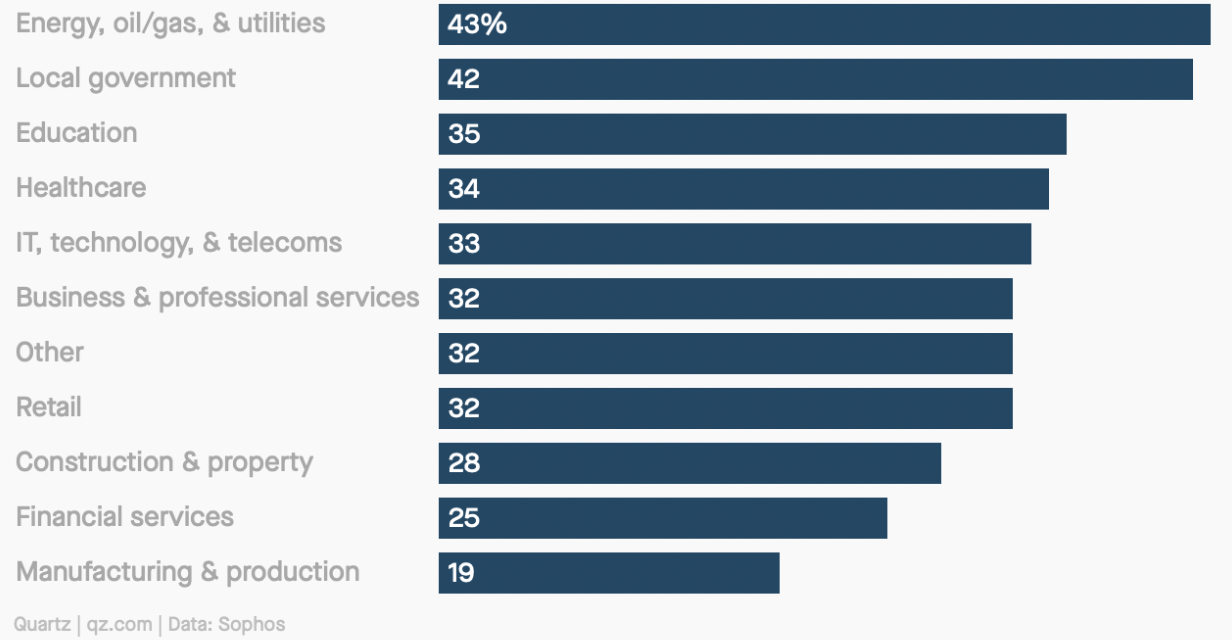
Energy companies are frequent targets, as they’re statistically the most likely to pay the ransom.

Many critical infrastructure systems tend to be older, and some were originally designed without robust security in mind. However, even more importantly, these companies are under immense pressure to maintain service. This fact alone makes such companies prime targets for ransomware attacks. Also, energy companies are more likely to pay ransoms. In a survey of 5,400 companies across the globe, Sophos researchers found that the energy sector was the most likely to pay up in the event of a ransomware attack.

Percentage of companies that paid the ransom after being hit by a ransomware attack in 2020, by sector
paying ransomware
As a caveat, it’s not only ransomware attacks that can send energy companies into a frenzy. Given that there are serious repercussions if supply chains are disrupted, energy companies have been known to succumb to well-orchestrated social engineering and phishing scams as well.

For example, in March 2019, the CEO of a U.K.-based energy firm fell victim to a deepfake audio attack, in which he was duped into transferring $234,000 to a Hungarian supplier. From there, the funds were transferred by criminals to a bank account in Mexico, and then dispersed to various locations across the globe. This was admittedly a rather brazen and unusual voice-spoofing attack; however, it’s not so surprising that the cybercriminals decided to target the energy sector in that case.

Where does the RaaS money go?

Generally speaking, RaaS organizations like DarkSide take between 20-30% of the acquired ransom. The other 70-80% goes to third-party affiliates—blackhat hackers—who gain access to a victim’s network and then deploy DarkSide’s ransomware. Working alongside law enforcement, Elliptic, a blockchain analysis firm, attempts to follow the Bitcoin ransom trail, and in this case, they were able to do so. According to their analysis of blockchain transactions, 75 BTC (a portion of the $5 million ransom paid out by Colonial Pipeline) went to a Bitcoin address; in fact, this was the same address that had received BTC from another ransomware attack on May 11.

The May 11 attack was conducted on Brenntag, a chemical distribution company. In this $4.4 million RaaS attack, hackers were able to gain access to Brenntag’s network after purchasing stolen credentials on the dark web. As an aside, it is unclear at this point exactly how hackers were able to breach the Colonial network. Nevertheless, Elliptic claims to have tracked 18% of the Colonial funds to smaller cryptocurrency exchanges, which should help law enforcement track down some of the perpetrators.

Is this the end of DarkSide?

Probably not. That said, some good things did come out of the horrific ransomware attack on the Colonial Pipeline. Ransomware-as-a-Service has become a household term on Capitol Hill, and strengthening the nation’s cybersecurity infrastructure is clearly a top priority for the Biden administration. That’s all positive.

However, the ransomware ecosystem is still alive and well, and it’s unlikely DarkSide is going gently into the good night. It is quite probable that they shut down their public-facing recruiting websites, in order to conduct an exit scam, whereby the group winds down its current operation, only to reemerge under a different shingle down the line. Nevertheless, forcing a RaaS group like DarkSide to go dark is a good first step in the long ransomware battle ahead.

John Donegan

John Donegan

Enterprise Analyst, ManageEngine

Want to read<br>this article on the go?

Want to read
this article on the go?

Do it on the ManageEngine
Insights app.

Subscribe to CISA

Thanks for subscribing to ManageEngine Insights. If you do not receive our welcome email, please check your SPAM folder.