

Published on May 18, 2021 | 4 min

In the wake of the ransomware attack on Colonial Pipeline, President Biden issued an executive order and called upon the U.S. Senate to quickly confirm his nominees for National Cyber Director and Director of the Cybersecurity and Infrastructure Security Agency—Chris Inglis and Jen Easterly, respectively. Inglis and Easterly, both former NSA operatives, will be tasked with protecting state and federal networks from ransomware attacks, among other things.

In his remarks on the Colonial Pipeline incident, Biden vowed to make the fight against ransomware a priority. Biden said, “Our Justice Department has launched a new task force dedicated to prosecuting ransomware hackers to the full extent of the law. And, let me say that this [Colonial] event is providing an urgent reminder of why we need to harden our infrastructure and make it more resilient against all threats.”

On the cybersecurity battlefield, Biden wants to see far more collaboration between the government and the private sector. As he explained, “I signed an executive order to improve the nation’s cybersecurity. It calls for federal agencies to work more closely with the private sector to share information, strengthen cybersecurity practices, and deploy technologies that increase reliance against cyberattacks.”

For the moment, it seems as if the quick response has been somewhat effective. DarkSide, the Ransomware-as-a-Service (RaaS) syndicate responsible for the May 7 attack on Colonial Pipeline, has gone dark. Two other ransomware groups, AKO and Everest, have followed suit, and other RaaS organizations, such as Avaddon and REvil, have issued statements saying they will abstain from targeting government, healthcare, and nonprofit organizations. However, taking cybercriminal syndicates at their word is rather absurd. After all, DarkSide had promised not to target government infrastructure in the past as well.

So, why did DarkSide target Colonial Pipeline in the first place?

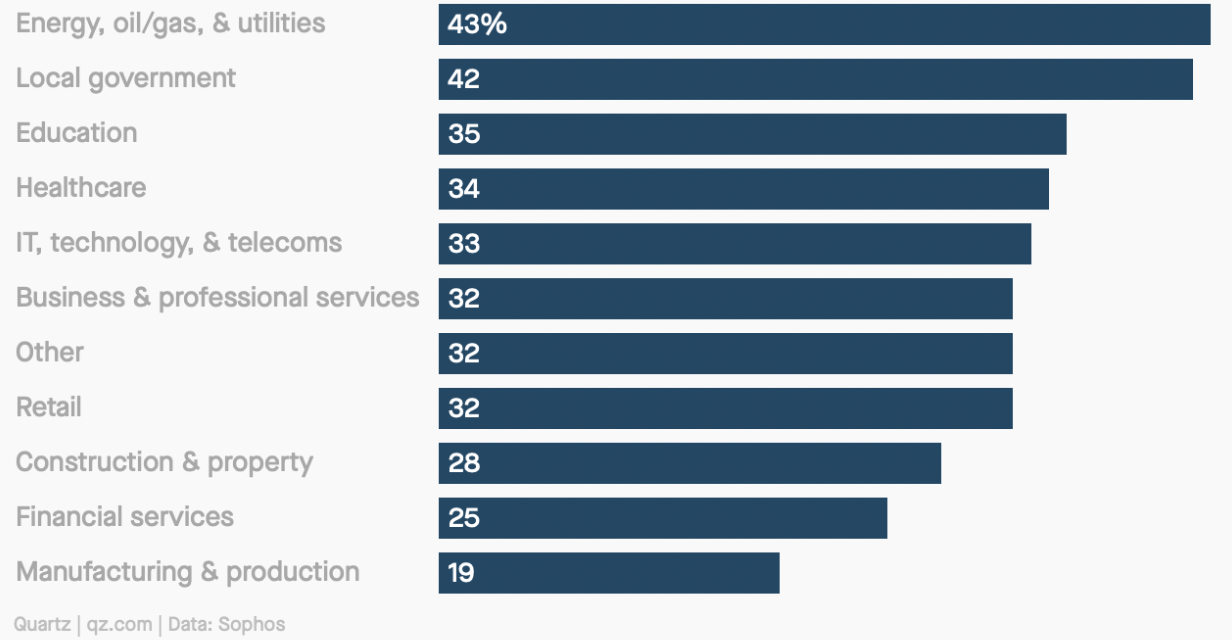
Energy companies are frequent targets, as they’re statistically the most likely to pay the ransom.

Many critical infrastructure systems tend to be older, and some were originally designed without robust security in mind. However, even more importantly, these companies are under immense pressure to maintain service. This fact alone makes such companies prime targets for ransomware attacks. Also, energy companies are more likely to pay ransoms. In a survey of 5,400 companies across the globe, Sophos researchers found that the energy sector was the most likely to pay up in the event of a ransomware attack.

Percentage of companies that paid the ransom after being hit by a ransomware attack in 2020, by sector
paying ransomware
As a caveat, it’s not only ransomware attacks that can send energy companies into a frenzy. Given that there are serious repercussions if supply chains are disrupted, energy companies have been known to succumb to well-orchestrated social engineering and phishing scams as well.

For example, in March 2019, the CEO of a U.K.-based energy firm fell victim to a deepfake audio attack, in which he was duped into transferring $234,000 to a Hungarian supplier. From there, the funds were transferred by criminals to a bank account in Mexico, and then dispersed to various locations across the globe. This was admittedly a rather brazen and unusual voice-spoofing attack; however, it’s not so surprising that the cybercriminals decided to target the energy sector in that case.

Where does the RaaS money go?

Generally speaking, RaaS organizations like DarkSide take between 20-30% of the acquired ransom. The other 70-80% goes to third-party affiliates—blackhat hackers—who gain access to a victim’s network and then deploy DarkSide’s ransomware. Working alongside law enforcement, Elliptic, a blockchain analysis firm, attempts to follow the Bitcoin ransom trail, and in this case, they were able to do so. According to their analysis of blockchain transactions, 75 BTC (a portion of the $5 million ransom paid out by Colonial Pipeline) went to a Bitcoin address; in fact, this was the same address that had received BTC from another ransomware attack on May 11.

The May 11 attack was conducted on Brenntag, a chemical distribution company. In this $4.4 million RaaS attack, hackers were able to gain access to Brenntag’s network after purchasing stolen credentials on the dark web. As an aside, it is unclear at this point exactly how hackers were able to breach the Colonial network. Nevertheless, Elliptic claims to have tracked 18% of the Colonial funds to smaller cryptocurrency exchanges, which should help law enforcement track down some of the perpetrators.

Is this the end of DarkSide?

Probably not. That said, some good things did come out of the horrific ransomware attack on the Colonial Pipeline. Ransomware-as-a-Service has become a household term on Capitol Hill, and strengthening the nation’s cybersecurity infrastructure is clearly a top priority for the Biden administration. That’s all positive.

However, the ransomware ecosystem is still alive and well, and it’s unlikely DarkSide is going gently into the good night. It is quite probable that they shut down their public-facing recruiting websites, in order to conduct an exit scam, whereby the group winds down its current operation, only to reemerge under a different shingle down the line. Nevertheless, forcing a RaaS group like DarkSide to go dark is a good first step in the long ransomware battle ahead.


John Donegan

John Donegan

Enterprise Analyst, ManageEngine

Want to read<br>this article on the go?

Want to read
this article on the go?

Do it on the ManageEngine
Insights app.

IT Security

Assessing the cybersecurity landscape

Published on April 13, 2021

In the latest installment of the ManageEngine Insights’ podcast, enterprise analyst John Donegan sits down with Andy Bates, the executive director of the Global Cyber Alliance. An expert in the field of cybersecurity, Bates discusses current IT security trends, attack vectors, crime deterrents, and other emerging issues, such as biometrics and blockchain technologies. Bates addresses user psychology as it relates to IT security, as well as some of the silver linings of the COVID pandemic.

Agenda

  • Businesses and industries most targeted by cybercrime
  • Prevalent attack vectors
  • Cybercrime-as-a-Service
  • Social engineering
  • Blockchain technologies
  • Deepfakes
  • Cybercrime deterrents
  • Psychology in cybersecurity
WATCH NOW
John Donegan

John Donegan

Enterprise Analyst, ManageEngine

Catch up on expert <br> videos like this anytime<br>with the ManageEngine <br> Insights app.

Catch up on expert
videos like this anytime
with the ManageEngine
Insights app.

Published on October 19, 2020 | 4 min

While many were impressed by Google CEO Sundar Pichai’s op-ed piece in the Financial Times, it’s unclear whether Pichai was entirely forthright with his call for increased AI regulation. In fact, it is likely that Pichai acknowledges that AI regulation is inevitable, and he wants to have an influence on the forthcoming laws.

Quite similar to Big Tech’s collective call for a federally mandated U.S. data privacy law, Pichai’s clarion call for AI regulation is an attempt to get ahead of the situation. After all, formal legislation on AI initiatives would likely overwhelm AI start-ups and benefit deep-pocket players like Google.

The AI sector is in a state of hyper growth. With $26.6 billion in VC funding and 2,200 deals in 2019, investment in AI reached an all-time high. Moreover, lobbyists for the tech industry are active on Capitol Hill, with big players like the Information Technology Industry Council (ITI) staunchly advocating for industry self-regulation.

Challenges to AI governance

Despite the influx of money pouring into AI initiatives across the globe, it’s vital that tech companies are not allowed to operate with impunity. Issues such as surveillance, digital manipulation, autonomous weapons, technological unemployment, and criminal justice bias are too real to ignore.

Deepfake Audio and Video
Within the past few years, deepfake audio has already been used to swindle a handful of companies. As an example, an energy company executive was recently tricked into wiring $220,000 to a Hungarian organization because he thought the request came from his boss.

Even more problematic than voice phishing, or vishing, is the potential for deepfake audio and video to disrupt elections and sow distrust in news media. Big Tech has readily acknowledged the potential threat of these generative adversarial networks (GANs), going so far as to join forces with each another to address the issue. Amazon, Facebook, Microsoft, and the Partnership on AI recently solicited help in creating deepfake identification technologies from developers across the globe. Their Deepfake Detection Challenge (DFDC) offered over a million dollars in prizes.

Facial Recognition Biases
According to the recent NIST report on facial recognition biases, Face Recognition Vendor Test (FRVT) Part 3: Demographic Effects, African Americans experience the highest rates of false positives among all races. NIST examined the majority of facial recognition algorithms—189 software algorithms from 99 vendors—and found that these algorithms disproportionately affected African Americans. It is feared that such tools, if put into practice, could result in false accusations of innocent people.

Surveillance Concerns
In recent months, Pichai has addressed the dangers of facial recognition technologies. In fact, he’s pledged that Google will never sell its proprietary algorithms, as he’s concerned that they could be misused. The European Union also worries about facial recognition technology, to the point where they are considering a five-year moratorium on the use of facial recognition in public spaces. This would give governments the time necessary to identify rules and ethical guidelines before the technology is deployed on a wide scale.

Google’s Pichai supports such a moratorium; however, other Big Tech leaders do not. For example, Microsoft President Brad Smith doesn’t support the moratorium, nor does he promise not to sell facial recognition software at a later date. That said, Smith does agree that there needs to be more regulation in general.

Potential solutions

Although powerful lobbyist groups, like ITI, argue that any regulation of AI technologies will stifle innovation, the societal risks of not regulating AI are too serious to ignore. Tesla CEO Elon Musk, who admittedly can be a bit alarmist at times, believes that AI will eventually be able to simulate consciousness and “outthink us in every way.” A strong advocate of AI regulation, Musk co-founded OpenAI, an artificial intelligence research company, and he has also called for an AI regulatory agency, similar to the FAA for aviation or the FDA for food, drugs, and medical devices.

In addition to Pichai and Musk, other Big Tech execs have offered solutions as well. The policy principals at IBM created an AI regulatory framework that calls for an AI ethics official, mandatory checking for biases, an assessment of the potential for harm, and explainable AI (XAI).

Also, as AI increasingly runs on IoT devices, including smartphones, cars, and wearables, federated machine learning can help from a privacy perspective. Federated learning is the practice of training your AI algorithm on the IoT device itself. Rather than sending all the algorithmic data to a central server or cloud, only relevant data summaries are sent back to the central server. During federated machine learning, the data transfers can be made even more secure via homomorphic encryption and differential privacy.

In regard to managing facial recognition issues, it would be prudent to put forth a moratorium on surveillance technologies in public spaces, and to also employ additional layers of protection on devices. At this point in time, such additional layers of protection include “smile to unlock” and “liveness detection” technologies.

Lastly, the acting forces behind AI regulation should come from outside industry professionals and trade associations. Presently, there is only one organization that is comprised of both industry and non-industry participants: the Partnership on AI. Such partnerships are a step in the right direction.

John Donegan

John Donegan

Enterprise Analyst, ManageEngine

Want to read<br>this article on the go?

Want to read
this article on the go?

Do it on the ManageEngine
Insights app.

Published on April 16, 2020 | 3 min

As Chairman of the House Intelligence Committee Adam Schiff recently declared at a congressional hearing, “Advances in AI and machine learning have led to the emergence of advanced, doctored types of media—so called ‘deepfakes’–that enable malicious actors to foment chaos, division, or crises. And they have the capacity to disrupt entire campaigns, including that of the Presidency.” According to the BBC, there have already been several instances of criminals employing deepfake audio to impersonate CEOs and facilitate wire transfers.

Despite its real potential for harm, deepfake technology is merely an advanced version of existing technologies, such as Adobe Photoshop and video editing software. With every new technology, comes a host of detractors who emphasize the potential effects. It’s important to remember that the technology itself is agnostic; it can be used to help or to harm. David Doermann, director of the AI Institute at the University of Buffalo, says, “There’s nothing fundamentally wrong, or evil, about the underlying technology; like basic image and desktop editors, deepfakes [are] only a tool. And there are a lot more positive aspects of generative networks than there are negative ones.” That said, deepfake audio and video do create cause for concern, especially when they are combined with social media platforms. 

When deepfake video is shared on social media, the files are shrunk down and compressed, making it exponentially more difficult to decipher that the file isn’t real. Attributions and trace evidence are destroyed while the synthetic media is spreading like wildfire. This can have serious side effects. Considering the possibility of a deepfake video going viral the night before an IPO, BU Law Professor Danielle Citron laments, “The market will respond far faster than we can debunk it.” Also, the proliferation of deepfake media will lead to what Citron calls “the liar’s dividend,” which is the idea that people will begin to doubt whether or not content is real, allowing liars to proclaim things they actually said were not said. Addressing this trust decay, Citron says, “We’ve already seen the ‘liar’s dividend’ happen in practice from the highest of the bully pulpits. So, I think we’ve got a real problem on our hands.” 

Software companies are leading the fight

In December 2019, Facebook, along with Microsoft, the Partnership for AI, and a group of academics, launched a “Deepfake Detection Challenge,” offering $10m in prizes to contributors who can help develop deepfake detection software. This contest wraps in 2020. There are a handful of software companies focusing on media manipulation detection as well, including Deeptrace Labs in Amsterdam, ZeroFox in Baltimore, TruePic in San Diego, and of course, the Department of Defense’s Defense Advanced Research Projects Agency (DARPA)’s MediFor (Media Forensics) team is also working vigilantly in the space.

Enterprises can protect themselves from the imminent threat of deepfake audio and video

Part of the solution will be to provide comprehensive AI education. Although legislators may require search engines and social media companies to identify and provide watermarks on synthetic media, we need to educate our own employees about deepfake technologies as well. Deepfake audio, in particular, is getting increasingly prolific; so it’s important for employees to be wary of any phone calls that don’t sound quite right. These calls could be social engineering attempts. As far as deepfake videos are concerned, they can be can identified by blurriness and changes in skin tone around the perimeter of the facial region. Also, be on the look for unnatural movements and lighting as well.

John Donegan

John Donegan

Enterprise Analyst, ManageEngine

Want to read<br>this article on the go?

Want to read
this article on the go?

Do it on the ManageEngine
Insights app.

Subscribe to deepfake audio

Thanks for subscribing to ManageEngine Insights. If you do not receive our welcome email, please check your SPAM folder.