

Published on February 09, 2023 | 7 min

Taking a cue from the food industry, IoT manufacturers should embrace privacy and security “nutrition labels,” as these labels will allow privacy-focused companies to differentiate themselves.

Consumers are eager for transparency in this space, and IoT manufacturers would be wise to embrace these labels before a government mandate arrives—and to be sure, government involvement is on the horizon.

The U.S. Cyberspace Solarium Commission (CSC), now operating as a non-profit, non-governmental organization, has been tasked with “establish[ing] a national cybersecurity certification and labeling authority.” Initially created to assist critical infrastructure providers’ technology procurement decisions, this cybersecurity labeling program will affect much of the consumer products sector.

It remains to be seen what this labeling program will look like. In October 2022, the CSC met with roughly 50 representatives from academia, NGOs, and the private sector. At this workshop, there were some of the usual suspects—Amazon, Comcast, Google, Intel, LG, Samsung, Sony, Consumer Reports—and of course, various lobbying groups.

After the summit, a White House official said the IoT device ratings may be based on cybersecurity elements, such as vulnerability remediation, whether data is encrypted, and interoperability with other products; however, it will surely include privacy elements, including whether data has been collected on consumers.

According to reporting from CyberScoop, a policy member from the R Street Institute  left the summit believing that “more extensive privacy standards around data collection and sharing could be considered as part of the ratings system down the road.”

Without a doubt, this IoT device privacy labeling initiative owes a debt to important work from Carnegie Mellon University. In fact, CMU researcher Yuvraj Agarwal was in attendance at the summit.

The Carnegie Mellon CyLab Security and Privacy Institute

After four years of research, Pardis Emami-Naeni, Yuvraj Agarwal, Lorrie Cranor, and their colleagues have created a robust prototype of a nutrition label for IoT devices.

Made up of 47 different privacy, security, and general attributes, the prototype has two layers. The first layer, which is designed to be displayed prominently on the product package, is aimed at everyday consumers. The second layer, available online via a link or QR code, is aimed at software engineers or knowledgeable consumers seeking more detailed information.
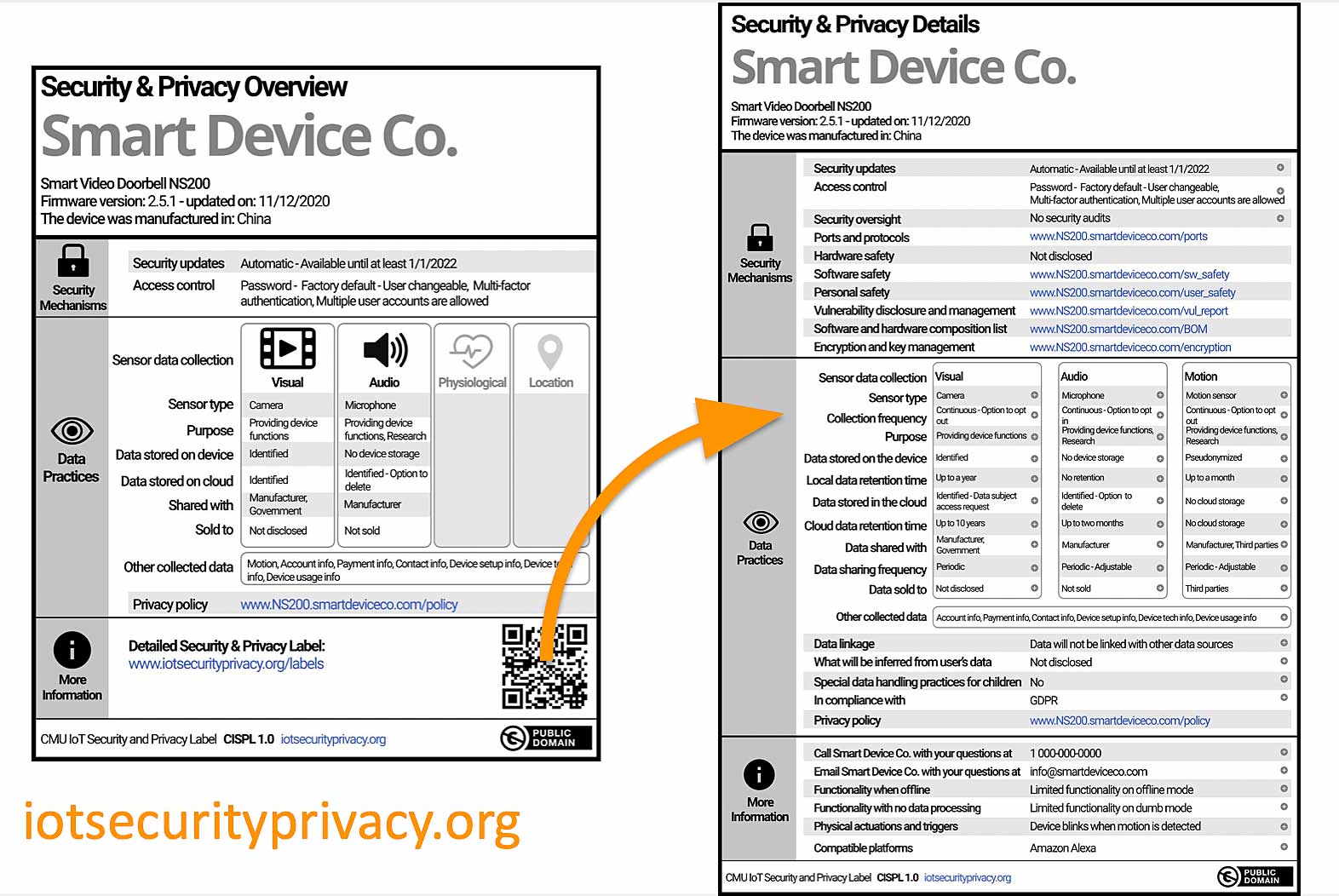
The CMU researchers didn’t come up with this nutrition label out of a vacuum. It’s the result of the four studies below.

“Exploring how privacy and security factor into IoT device purchase behavior” 1/2019

The researchers found that privacy and security were among the most important factors that consumers consider when purchasing an IoT device. In fact, privacy and security are the most important factors, after features and price.

“Ask the experts: What should be on an IoT privacy and security label?” 12/2019

In this study, the researchers interviewed 22 privacy and security experts to ascertain what exactly to include in their label. There were experts from academia, NGOs, government, and of course various entities within the tech world, including several working in policy roles at hardware and software companies.

“Which privacy and security attributes most impact consumers’ risk perception and willingness to purchase IoT devices?” 6/2021

To improve their label design, this study helped the researchers learn which privacy and security label attributes influence consumer risk perception and willingness to purchase. The researchers learned that consumers were more willing to buy products when they knew their information wouldn’t be retained or shared with third parties.

As Emami-Naeini et al. write, “Participants frequently expressed concerns about not knowing how their information would be used if it was shared with or sold to third parties.”

“Are consumers willing to pay for security and privacy of IoT devices?” 10/2022

Through this study, the researchers learned that, yes, consumers are willing to pay a significant premium for security and privacy.

Given that privacy and security are admittedly related, it’s perhaps unsurprising that there was a lack of consensus as to whether or not privacy and security attributes should be presented in separate sections. Half of the experts felt separate sections were appropriate, and the other half wanted to combine them into one section.

An examination of the relationship between security and privacy

Through the course of these studies, there was quibbling among experts about the difference between privacy and security. Some believed that security was easier to quantify, and that privacy was more contextual and subjective.

As Emami-Naeini et al. write, “When defining security, almost all experts (21 out of 22) mentioned the CIA triad of confidentiality, integrity, and availability. However, experts had different definitions for privacy. Some experts (9 out of 22) defined privacy as having transparency and control over data practices and some experts defined privacy as the confidentiality aspect of security (8 out of 22).”

A few experts pointed out that privacy is inherently dependent upon individuals’ respective comfort levels and personal preferences. That’s technically true; however, the fact remains: it is quite simple to quantify privacy. Either a company is collecting consumers’ data or it is not. Companies either sell that data to third parties, or they do not. If companies are indeed collecting user data, they can gain consumer trust by explicitly laying out their methods and disclosing the reasons why they’re collecting user data in the first place.

Will we see security and privacy labels soon?

The ball is rolling, but the timetable for label adoption is unclear.

Voluntary label adoption seems unlikely, although CMU CyLab researchers believe that label adoption could come from retailers.

Cranor et al. write, “Retailers could incentivize adoption by requiring manufacturers of products they sell to label their products, or even by promoting labeled products; for example, by placing them at the top of search results.”

Now, big box stores, like Best Buy, certainly could refuse to carry IoT devices if the manufacturers refused to carry the privacy label. However, this seems a bit far-fetched unless retailers find a financial incentivize to to do so.

To be fair, retailers could theoretically mandate that IoT manufacturers place privacy/security labels on their packages. It’s not without precedent.

We’ve seen this with application developers and online app marketplaces

In December 2020, Apple famously began requiring that all applications in its App Store disclose data collection practices. To use the App Store, Apple required all third-party apps to disclose what type of data the app collects and whether that data is used to track users.

Shortly after Apple’s privacy nutrition label launch, Google followed suit with its own label initiative for Google Play.

A quick caveat: Washington Post tech columnist Geoffrey Fowler pointed out that Apple doesn’t immediately verify that the third-party apps’ privacy information on the Apple App Store is accurate. On the labels, there is a disclaimer that reads, “The developer indicated that the app’s privacy practices may include handling of data as described below. This information has not been verified by Apple.” Thus, even with Apple’s intervention, the nutrition label content is still based upon developer self-reporting, at least initially.

Like online marketplaces (e.g., Google Data Safety and Apple Privacy Nutrition), retailers could intervene and mandate that IoT manufacturers use privacy labels; however, the far more likely scenario is that widespread adoption of IoT privacy labels will come from a government mandate.

Another caveat: It’s worth emphasizing that these labels won’t be forced upon IoT manufacturers. All labels will be voluntary in nature.

The current state of security and privacy label legislation

Senator Ed Markey and Congressman Ted Lieu have been trying to get an IoT device certification law passed for years. Although their Cyber Shield Act never received a vote on the House or Senate floor in 2017 or 2019, they reintroduced the bill in March 2021.

According to the language in the bill, The Shield Act “requires the Department of Commerce to establish the Cyber Shield Program, a voluntary program to identify and certify covered products. These products are consumer-facing physical objects that meet industry-leading cybersecurity and data security benchmarks and that can (1) connect to the internet; and (2) collect, send, or receive data or control the actions of a physical object or system.”

Although unlikely to pass, the content within the Shield Act of 2021 is influencing the White House and CSC. Directly after the October 2022 White House workshop, Ed Markey’s camp issued a press release, praising the work toward what Markey describes as an “Internet of Things cyber label.”

According to the release, “As Americans install tens of millions of internet-connected devices for their homes, cybersecurity protections have never been more important. That’s why we introduced the Cyber Shield Act to create a voluntary consumer label indicating whether a device meets high cybersecurity benchmarks. We applaud the White House today on their announcement that they will adopt a similar approach and deliver a win for American families so that they have the information they need to safeguard their privacy at home. An Internet of Things cyber label is a critical step to returning power to consumers and strengthening cybersecurity protections.”

We’ll have to wait and see if this voluntary IoT label program ever comes to fruition; however, the ball does appear to be rolling.

Key takeaways

IoT privacy nutrition labels are coming down the pike; however, they will be voluntary at first. Keeping it voluntary isn’t necessarily a bad thing. Consumers will be certainly take notice of IoT manufacturers who opt not to use the labels.

If the privacy labels work as intended, IoT device manufacturers—and likely other industries—will be forced to compete on privacy and security, which is a net positive for consumers. Also, journalists will increasingly cover the security/privacy of specific devices, which will further drive consumer awareness.

Also, even if many consumers are initially confused by the labels, this will change over time. After all, we take food nutrition labels for granted today, when we go to the grocery store.

When mandatory food nutrition labeling came on the scene back in 1990 (the Nutrition Labeling and Education Act), it surely was met with resistance from reluctant actors in the food industry. We can expect that this privacy labeling initiative will be met with some similar resistance. Nevertheless, companies that operate in good faith would certainly be wise to embrace this labeling effort. It can only help them stand out from the pack.


John Donegan

John Donegan

Enterprise Analyst, ManageEngine

Want to read<br>this article on the go?

Want to read
this article on the go?

Do it on the ManageEngine
Insights app.

Published on January 25, 2023 | 5 min

The internet was created by the people and for the people. These days, it’s an integral aspect of our digital landscape and is so deeply ingrained in our daily routines that we can no longer envision completing tasks without it.

While the internet revolutionized life as we knew it, the Internet of Things (IoT) is going one step further to integrate our physical world into computer-based systems.

The IoT boom is taking place at a time where there are more things connected to the internet than there are people in the world. By 2025, there will be approximately 25 billion devices connected to the internet.

Unfortunately, as an increasing number of devices are connected to the internet, and as new AI technologies enter the market everyday to make our lives easier, policy-makers are struggling to catch up. Take the 2016 Mirai DDoS attack on Dyn, Inc., for example, where a global IoT botnet attack resulted in widespread disruption to internet service for users across North America and Europe. A study later found that after the 2016 attack on Dyn, 14,000 websites stopped using Dyn as their domain provider.

While this attack happened because of a combination of factors, including the vulnerabilities in IoT devices and the use of default usernames and passwords, it was also partly due to outdated security architecture and inadequate cybersecurity practices. An IT department may not always be aware of all the devices present on an organization’s network, or it may lack resources to fix security vulnerabilities. 

A double-edged sword for enterprises?

As IoT technology continues to become a vital part of enterprises’ push towards digital transformation, ethical considerations surrounding data and communication have become a significant concern.  

Using IoT data to personalize the customer experience can be a game-changer for businesses, enabling them to gain in-depth insights into their customers’ behavior and preferences. For example, a store can place IoT sensors at particular points to track customer behavior. These sensors can be placed at product displays, on shopping carts, or at checkout counters to collect data on customer movement, product interactions, and purchase decisions. By analyzing if customers are regularly buying a specific product, businesses can use this information to recommend similar products, promote cross-selling, or offer discounts on that product to boost sales.

The use of IoT data and other advanced data collection methods has made it easier for organizations to monitor and predict user behavior, with AI systems simplifying the process of understanding user needs.

The changes brought upon by these technologies represent a significant change in the way businesses engage with consumers and how consumers experience these interactions. However, this has also led to concerns about the potential for misuse of personal data and the perpetuation of biases.

Collecting and analyzing user data can be seen as a violation of privacy, which can damage the trust and reputation of an organization. Furthermore, using this data to coerce user behavior can be perceived as manipulative, as it can be used in ways that users may not fully understand.

From a cybersecurity perspective, such technologies increase enterprises’ attack surfaces because they collect and transmit vast amounts of sensitive information. Many of the devices that host this technology have weak security features, making them vulnerable to hacking and malware attacks.

Additionally, IoT devices transmit data over networks, and if these networks are not secure, it can allow hackers to gain access to the data and the devices themselves. According to a Forbes report, cyberattacks on IoT devices surged by 300% to more than 2.9 billion events in 2019 alone.

With the additional data and faster speeds offered by 5G, businesses may find it harder to detect and investigate any potential insider threats. A malicious employee or contractor could potentially access sensitive information and exfiltrate large amounts of data quickly before you or your team can even detect it.

Furthermore, it’s important for organizations to understand that the pace at which 5G and IoT have been developing has far outpaced the creation of security standards. With security gaps, vulnerabilities, and thousands of endpoints popping up every day, it leaves organizations vulnerable to data breaches and cyberattacks.

Mitigating risks for organizations

As we increasingly rely on digital technology to manage aspects of our lives, we are entrusting more of our personal information to these connected devices. It’s crucial to stay vigilant and continuously assess and update your organization’s security measures to protect against potential threats. It’s important to stay informed, educated, and proactive with your security approach. 

At this point, there is a lack of a uniform standard across the industry to evaluate the security of IoT devices, making it difficult for consumers to know if their devices and online habits are effectively protecting their data.

So, where do we begin? As a rule of thumb, organizations should be transparent with customers about how their data is being collected, used, and shared. They should also consider hiring data experts to help them manage and analyze the data effectively and in compliance with laws and regulations.

You could also start with your people. Be aware that employees who are responsible for the proper use of IoT devices within organizations, as well as those who are deploying IoT devices and 5G networks in your organization, may lack proper security training. This lack of knowledge can lead to vulnerabilities that can be exploited by cyberattackers. This is a common issue since often new technologies are deployed before adequate security measures can be put in place.

It’s crucial to make sure your staff are properly trained and are aware of the security risks of IoT devices and 5G networks. This includes providing regular training, hiring staff with a security background, or using third-party experts to assist with deployment and configuration.

To mitigate these risks further, businesses can implement other robust security measures to protect the integrity of their systems and devices from cyberthreats; this includes implementing privileged access controls, encrypting all sensitive data, identifying and patching vulnerabilities even before they can occur, crafting the most appropriate incident response plans, monitoring third-party vendors, and implementing a continuous monitoring program. These measures should regularly be reviewed and updated to adapt to new threats and technologies.

By ensuring that your team is equipped with the knowledge and skills to secure these new technologies, you can protect your organization from potential cyberthreats.

Related reading:

Samudhra Sendhil

Samudhra Sendhil

Enterprise Analyst, ManageEngine

Want to read<br>this article on the go?

Want to read
this article on the go?

Do it on the ManageEngine
Insights app.

Published on April 06, 2022 | 6 min

Let’s start with the rather ominous etymology of the word, “metaverse.”

The word first entered the cultural vernacular in 1992 when Neal Stephenson’s dystopian science-fiction novel “Snow Crash” hit book shelves. The novel became a favorite of Silicon Valley titans, including Google co-founder Larry Page.

Snow Crash’s metaverse described a virtual world—one that humans visit via augmented reality, the internet, and eye goggles. Just like Mark Zuckerberg’s vision, the characters in Snow Crash enter the metaverse embodied in an avatar of their choosing.

In Stephenson’s novel, humans primarily enter the metaverse as a way to escape their dystopian existence on Earth. The main character, satirically named Hiro Protagonist, enters the metaverse in an effort to stop a computer virus that causes real-life brain damage.

Addiction

In Snow Crash, there’s a subculture of people who opt to spend all their time in the metaverse; these metaverse addicts are called “gargoyles” in the novel—make of that what you will.

Cryptocurrencies

The characters in Snow Crash use encrypted electronic currency to buy virtual real estate in the metaverse—much like what is happening today on blockchain-enabled VR platforms, like Decentraland and Sandbox.

Stephenson’s metaverse feels prescient. We’ll discuss addiction and cryptocurrency usage later. But to begin with,

What is the metaverse?

According to Meta’s blog, the metaverse is “the next evolution of social connection.” Okay, but wait a second, was Facebook the first evolution of social connection? If so, this doesn’t inspire much confidence, as it’s not clear that Meta has a handle on the civic and media effects of their legacy business.

And it’s not just me. Many media scholars take umbrage with Zuckerberg’s plans. In an op-ed for CNN, media theorist Douglass Rushkoff writes,

“Going Meta is Facebook’s escape hatch; it’s Zuckerberg’s way of telling us (and his investors) to forget about all the destruction his platforms have caused, and instead to look at the big picture. But if you look hard enough, you’ll see it’s not a big picture at all. It’s a tiny network of virtual worlds, connected by a business plan that always leaves its users with less than they started with. No, to get through the portal to Facebook’s metaverse, to go in the direction that Zuckerberg is pushing us, we must leave our humanity behind.”

A harsh assessment by Rushkoff, but not invalid.

It’s important to note that Meta is not the only company currently building out the metaverse. Deep-pocketed players, including Google, Roblox, Microsoft (“Minecraft”), and Epic Games (“Fortnite”), all have substantial metaverse footholds. Additionally, there are smaller, more egalitarian entities in the space—namely, Mysilio and Uhive.

At any rate, Zuckerberg seems to be leading the charge at the moment. As Zuckerberg explains, “You can think about the metaverse as an embodied internet, where instead of just viewing content, you are in it.” Zuckerberg, and others, see the metaverse as the next iteration of the internet. And much like the dot-com boom in the 1990’s, when people rushed to buy up domain names, we’re starting to see individuals and organizations buying NFTs and planting their corporate flags in the metaverse.

Without being overly alarmist, it’s worth examining what the creation of this metaverse will entail from privacy, security, and public policy standpoints.

The metaverse will be hard to police.

As initially reported by the Financial Times, a March 2021 employee memo from Meta CTO Andrew Bosworth admitted that moderating people’s behavior in the metaverse “at any meaningful scale is practically impossible.” Granted, this was over a year ago, but it is certainly worth noting. Historically, Meta has not been able to reign in the widespread, well-documented negative societal effects plaguing their legacy businesses, especially Facebook and Instagram.

Also, potential addiction, rampant harassment, and assault aside, most transactions in the metaverse will run on the blockchain. Since blockchain technologies are generally unregulated (there’s not a centralized authority to recover stolen assets), it remains to be seen how theft will be policed in the metaverse.

Stakeholders hope to learn from the early days of the internet.

To be sure, the internet’s nascent days revolutionized commerce; however, this didn’t happen seamlessly. For example, websites in the early 1990’s were littered with scams. Bad actors took advantage of users’ unfamiliarity with the technology; they created sites to impersonate banks, organizations, and other entities. Undoubtedly, phishing campaigns, crypto jacking, and other scams will be prevalent in the metaverse as well.

Social engineering will be intense.

Microsoft, in a recent post entitled, “The metaverse is coming. Here are the cornerstones for securing it,” acknowledges that the metaverse will be ripe for social engineering attacks.

It’s one thing to receive a fake request from a colleague’s email address, and quite another to look at your colleague’s (albeit, an avatar) face and process that same request. There is little doubt that avatars will be falsified, stolen, and weaponized by bad actors.

Microsoft rightly contends that security is a team sport; Charlie Bell, Microsoft EVP of Security writes, “Today, ISPs, cloud providers, device manufacturers—even industry rivals in these markets—recognize the need to work together on security issues.” Of course, Microsoft is a stakeholder in the metaverse, and they are financially incentivized to try to prepare for the litany of security and privacy issues that lay ahead.

Security and privacy concerns abound.

From a security perspective, the cyber attack surface will expand significantly. There will be IoT devices and wearables from multiple vendors; sensors will collect data all throughout offices and homes; and metaverse companies will actively process a colossal amount of user behavior in real time. As mentioned before, the use of avatars will make it easier for bad actors to commit fraud, and the prevalence of cryptocurrency transactions will make it easier for them to hide their ill-gotten gains.

Things are equally concerning from a privacy perspective. Companies that run the metaverse will use AR/VR devices that collect a ton of personally identifiable information (PII), including financial and personal data. After all, how else will the businesses and organizations in the metaverse verify who we users are? Even more problematic is the fact that many of these businesses will want to collect biometric data, such as fingerprints and facial recognition.

Zuckerberg is currently spending billions in an effort to replicate the physical sense of touch in the digital world. Not to mention, in addition to readily-available headsets and googles, haptic vests are already on the market.

This all constitutes a level of personal data collection that is not currently socially acceptable; however, in a few years, who knows? As we’ve seen, when it comes to giving up personal data, the public eventually acquiesces. It can be a bit of a slippery slope.

The metaverse could spark arguably much needed legislation.

The metaverse may well be a catalyst for an AI Act or a national digital privacy act that prohibits the sale of user data to third parties. Until then, however, these remain troubling, open questions that will be answered by metaverse players and market dynamics rather than legislation.

And what does Zuckerberg think about the comparisons folks are making between the metaverse in Stephenson’s “Snow Crash” and the one he’s working to create?

In an interview with The Verge, Zuckerberg explains, “Obviously, the book has this whole environment around it that’s sort of negative. But I don’t think it has to be that way. I also think that as these technologies develop, they take on different connotations and metaphors. I would be very surprised if five years from now the main association that almost anyone had with the metaverse was about the initial mention of it in Snow Crash.”

In summation, what do the metaverse creators have in store for us?

Robin Mansell, professor of New Media and Internet at the London School of Economics, offers a blunt, clear-eyed view of our metaverse future.

As Mansell tells The Guardian, “For me, it seems like it is simply another step in the monetization of data to the benefit of Facebook and other large platforms sold to people as fun, exciting, helpful for productivity at work and so on.”

So, a future defined by corporate avarice where society suffers, and users endure horrible new media effects. Sounds like a certain 1992 novel I know.

John Donegan

John Donegan

Enterprise Analyst, ManageEngine

Want to read<br>this article on the go?

Want to read
this article on the go?

Do it on the ManageEngine
Insights app.

IT Security

Assessing the cybersecurity and emerging tech landscape with Graham Cluley

Published on January 12, 2022

Enterprise analyst John Donegan speaks with cybersecurity veteran Graham Cluley, whose award-winning podcast “Smashing Security” has over 7 million downloads. Cluley discusses security threats, emerging technologies, Big Tech overreach, and contemporary media effects.

Agenda

    • Cybersecurity threats
    • Ransomware and cyber insurance
    • Synthetic media
    • The data brokerage industry
    • Regulation and algorithmic decision-making
    • Media effects
    • IoT devices and data collection
    • Deepfake technology and new threats
    • The migration to remote work
LISTEN NOW
John Donegan

John Donegan

Enterprise Analyst, ManageEngine

Listen without limits—<br>stream this podcast on <br>the ManageEngine Insights app.

Listen without limits—
stream this podcast on
the ManageEngine Insights app.

Published on October 07, 2021 | 8 min

Widespread surveillance has been normalized. To access our sensitive data, companies routinely scrape the internet, tap IoT devices, and monitor our phones around the clock. Unfortunately, we have virtually zero visibility into the shadowy ecosystem that is the data brokerage industry.

However, every so often, a data breach occurs, showcasing the disreputability of so many of these businesses. For example, a data breach from last summer revealed that a now-defunct broker, DeepSocial, had been aggregating and packaging data from 235 million social media profiles. Although such activity is against the terms and services of Facebook and Instagram, it is not technically illegal, assuming it’s publicly-facing information and none of the data belong to minors, which would likely be a COPPA violation.

DeepSocial may be gone, but the data brokerage ecosystem is thriving. As individuals, we neither have insight into the transactional process of these brokers, nor do we have any federal rights to change any of our personal information that is incorrect. Perhaps more importantly, as it currently stands, the FTC doesn’t have a strong federal data privacy law that would enable the agency to investigate unscrupulous data brokers.

Put simply, the data brokerage industry is in dire need of regulation. As Duke University cyber policy fellow Justin Sherman notes in his recent report,

“The data brokerage ecosystem represents the unrestrained aggregation of surveillance power as a service.”

The data brokerage world: “surveillance power as a service”

Seeing as all outsourced services seem to eventually morph into an “-aaS” acronym, let’s run with Sherman’s “surveillance power as a service” (SPaaS) designation; after all, it is certainly an apt description of the data brokers’ business model.

Data brokers gather information on individuals via many different methods. They crawl government records, use applications to pull data, and purchase or license data from a bevy of third parties. After successfully tracking and aggregating users’ locations, life events, purchases, financial data, political affiliations, and lifestyle interests, these brokers turn around and sell it to the highest bidders—be it insurance companies, super PACs, corporations, asset management firms, or intelligence agencies.

Moreover, as it currently stands, there is virtually nothing in U.S. federal law that limits the selling of this data. In fact, there is not even a shared definition of a “data broker” in federal law. At the state level, Vermont and California do require brokers to register with their respective state; however, the states’ narrow legal definition of “broker” allows most companies who buy and sell data to operate without any need to disclose their actions.

For the most part, data brokers are operating with impunity, and the industry is unregulated.

The major brokers’ unsavory activity

Sherman’s report, entitled “Data brokers and sensitive data on U.S. individuals: Threats to American civil rights, national security, and democracy”, looks at the public-facing advertising from nine behemoths in the data brokerage world: Experian, Equifax, CoreLogic, Verisk, Oracle, Epsilon, Acxiom, LexisNexis, and Nielsen. He also examines the advertising of people-search (“white pages”) websites.

What quickly becomes apparent is that much of the data collection is quite unsettling. To cite a few examples, Equifax, and others, buy payroll data from thousands of U.S. organizations; LexisNexis offers to identify relatives, neighbors, and associates who appear in social media posts and online photographs; and Verisk’s ISO ClaimSearch, the world’s largest database of property and casualty claims, pulls data from IoT devices from inside the home.

To substantiate his claim that data brokers undermine national security, Sherman notes that Axciom, LexisNexis, and Nielsen all openly offer to provide data on U.S. military personnel. Acxiom, through their partner NinthDecimal, sells individuals’ geo-locations, and it should be noted that many of these entities work with dozens of other data brokers as well; for example, Oracle owns and works with over 80 data brokers.

Threats to civil liberties

Whether data brokers’ activities undermine national security is up for debate; however, it certainly does appear that the rampant surveillance by these players is a threat to basic civil liberties. Sherman argues that the aggregation of data from across the web exacerbates existing algorithmic biases that disproportionately affect marginalized groups. Additionally, data brokers arguably help facilitate doxing efforts; they put victims of domestic violence in danger by exposing victims’ locations, and they allegedly place some politically active people in harm’s way by exposing their political affiliations. This last point—data brokers’ propensity to expose individuals’ political preferences—has not gone unnoticed.

As an example, allegedly, data broker Mobilewalla surreptitiously collected information on Black Lives Matter protesters via their mobile devices. The information included location data, home addresses, and other sensitive information, which prompted four U.S. senators to issue a press release, as well as a letter to the Mobilewalla CEO.

An excerpt from the letter reads,

“We are deeply concerned that Mobilewalla’s report advertises that the company can target thousands of Americans on the basis of their exercise of First Amendment rights. This use could include political targeting based on personal or religious beliefs, which Mobilewalla has previously facilitated. More concerning, once profiled on the basis of their location data or other information collected about them, people can be targeted not only for marketing or political purposes, but for law or immigration enforcement.”

In addition to Mobilewalla, Senators Elizabeth Warren (D-MA) and Ron Wyden (D-OR) have also looked into Dulles, VA-based Venntel, Inc. (Gravy Analytics), a broker that sells sensitive data to U.S. government agencies. Rather than enduring the hassle of getting warrants and dealing with cell phone companies, government agencies can get individuals’ sensitive information directly from data brokers. So, in essence, these data brokers allow agencies to “buy their way around the Fourth Amendment.”

Another important issue: individuals are unable to revise incorrect data

Data brokers compile profiles on us by scraping data from mobile applications, social media, government websites, and the internet at large; then, they turn around and sell, share, or license these datasets to other brokers, who in turn, pass the data along to others. In this dystopian version of the game of “Telephone,” the information is not always going to be accurate by the time it reaches its final destination. That being the case, it is definitely worth highlighting the fact that individuals usually lack the ability to correct missing or erroneous information about themselves and their families. Such incorrect data can lead to a home loan refusal, job loss, or worse. As a caveat, we do have the right to correct some data, including rights related to credit reporting, clinical health data, and children’s data.

Sherman suggests that individuals should have the right to revise any incorrect data that brokers are selling and licensing. This seems appropriate. In a similar vein, the FTC should be empowered to investigate unfair broker practices.

Additionally, Sherman suggests that brokers should not be able to sell, license, or share sensitive data on U.S. citizens to non-state actors, foreign governments, or international security agencies, as this could jeopardize national security.

Counterargument: data brokers aren’t doing anything wrong

Jim Harper, a senior fellow at the right-leaning think tank, American Enterprise Institute for Public Policy Research, takes umbrage with much of Sherman’s assessment on the data brokerage landscape. In a recent blog post entitled, “What if data brokers aren’t doing anything wrong?“, Harper refutes much of Sherman’s report.

Harper does acknowledge that data brokerage is a “shadowy” industry; however, he compares it to credit reporting, which was disreputable decades ago, but has since gained legitimacy. Recognizing that apps collect information on us and sell it to the highest bidder, Harper contends that this is merely a form of efficiency. He posits, quite correctly, that data brokerage activities allow companies to reach customers more efficiently. With detailed dossiers on individuals’ personal preferences, companies can spend less money on marketing costs—which in turn, Harper argues, ultimately lowers costs for consumers and returns value to shareholders. This is true, but at what cost? At no point, does Harper try to make the case that data brokers are not violating civil liberties.

That said, he does make a persuasive case that Sherman’s fears about national security implications may be overblown. Harper writes,

“It is doubtful that generic information about present or past military service is terribly useful to foreign enemies. If information about particular dimensions of military service is both useful and routinely brokered, one wonders why it is available to the data brokers in the first place. And if data brokering allows foreign governments to microtarget election disinformation, our fragile democracy might need shoring up irrespective of the role data brokerage may have in disseminating information more efficiently.”

Harper believes that the data brokerage industry can gain legitimacy, and he fears that empowering the FTC, passing a federal data privacy law, and giving individuals more rights may come at the expense of business efficiency.

Harper suggests that Sherman’s argument is flawed, as he highlights the fact that Sherman’s report states that data brokers are “open and explicit” about what they are selling. Harper goes so far as to point out that Sherman uses this “open and explicit” phrase eight times in 16 pages. Harper asks, if this industry is so sketchy, then how are they open and explicit about what they’re selling? This is a false equivalency, and Harper is missing the point. Data brokers may, indeed, be open and explicit about what information they’re selling; however, they are most certainly not transparent about where it came from and how it got there. The bulk of the broker ecosystem is in the shadows, and there is currently no federal law to provide insight into this process.

As Sherman points out—and Harper willfully ignores—it is the limited visibility into the mechanisms within the data brokerage process that is the issue at hand.

It’s time for regulation

As it stands, the FTC lacks a strong federal data privacy law that could embolden the agency to go after unscrupulous brokers; additionally, there is virtually no federal law preventing brokers from selling most individuals’ personal data to foreign actors, insurance firms, law enforcement, or government agencies. That said, there has been some recent regulation in the world of finance.

Last week, the SEC issued a $10 million fine on private analytics firm App Annie, Inc., signaling that the SEC is taking a harder look at data brokers. According to the SEC, App Annie sold nonpublic, confidential user data through its “Intelligence” product, which was marketed to and purchased by trading firms. The user data was neither anonymized, nor was it aggregated, making it more valuable to asset managers—and also in violation of security laws. This SEC enforcement is the first of its kind against a third-party data broker, and many see it as a harbinger of things to come. It’s a step in the right direction, but whether this type of enforcement becomes more commonplace remains to be seen.

Nevertheless, a few things are certain: there is limited visibility into the shadowy ecosystem of data brokering, and we need more insights into the inner workings of this world. Additionally, individuals should have the right to change their information if its incorrect, and the FTC needs more power to go after brokers. Whether this should come under the umbrella of a strong, federal data privacy law is up for debate; however, data brokers’ unfettered surveillance absolutely needs to be addressed, even if Harper is right and such regulation makes businesses’ targeted advertising initiatives slightly less efficient.

John Donegan

John Donegan

Enterprise Analyst, ManageEngine

Want to read<br>this article on the go?

Want to read
this article on the go?

Do it on the ManageEngine
Insights app.

Subscribe to IoT

Thanks for subscribing to ManageEngine Insights. If you do not receive our welcome email, please check your SPAM folder.