
Published on February 09, 2023 | 7 min

Taking a cue from the food industry, IoT manufacturers should embrace privacy and security “nutrition labels,” as these labels will allow privacy-focused companies to differentiate themselves.

Consumers are eager for transparency in this space, and IoT manufacturers would be wise to embrace these labels before a government mandate arrives—and to be sure, government involvement is on the horizon.

The U.S. Cyberspace Solarium Commission (CSC), now operating as a non-profit, non-governmental organization, has been tasked with “establish[ing] a national cybersecurity certification and labeling authority.” Initially created to assist critical infrastructure providers’ technology procurement decisions, this cybersecurity labeling program will affect much of the consumer products sector.

It remains to be seen what this labeling program will look like. In October 2022, the CSC met with roughly 50 representatives from academia, NGOs, and the private sector. At this workshop, there were some of the usual suspects—Amazon, Comcast, Google, Intel, LG, Samsung, Sony, Consumer Reports—and of course, various lobbying groups.

After the summit, a White House official said the IoT device ratings may be based on cybersecurity elements, such as vulnerability remediation, whether data is encrypted, and interoperability with other products; however, it will surely include privacy elements, including whether data has been collected on consumers.

According to reporting from CyberScoop, a policy member from the R Street Institute  left the summit believing that “more extensive privacy standards around data collection and sharing could be considered as part of the ratings system down the road.”

Without a doubt, this IoT device privacy labeling initiative owes a debt to important work from Carnegie Mellon University. In fact, CMU researcher Yuvraj Agarwal was in attendance at the summit.

The Carnegie Mellon CyLab Security and Privacy Institute

After four years of research, Pardis Emami-Naeni, Yuvraj Agarwal, Lorrie Cranor, and their colleagues have created a robust prototype of a nutrition label for IoT devices.

Made up of 47 different privacy, security, and general attributes, the prototype has two layers. The first layer, which is designed to be displayed prominently on the product package, is aimed at everyday consumers. The second layer, available online via a link or QR code, is aimed at software engineers or knowledgeable consumers seeking more detailed information.
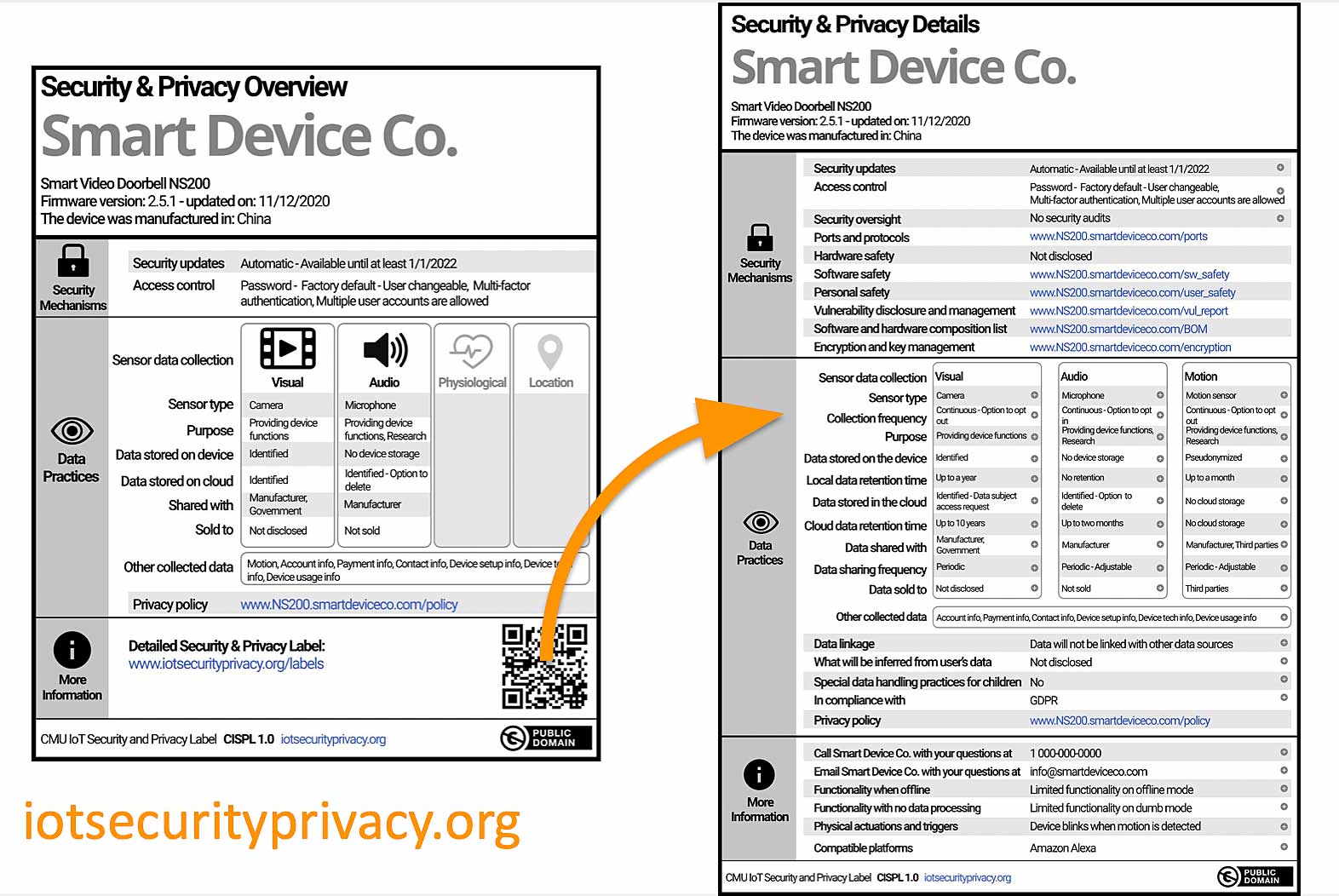
The CMU researchers didn’t come up with this nutrition label out of a vacuum. It’s the result of the four studies below.

“Exploring how privacy and security factor into IoT device purchase behavior” 1/2019

The researchers found that privacy and security were among the most important factors that consumers consider when purchasing an IoT device. In fact, privacy and security are the most important factors, after features and price.

“Ask the experts: What should be on an IoT privacy and security label?” 12/2019

In this study, the researchers interviewed 22 privacy and security experts to ascertain what exactly to include in their label. There were experts from academia, NGOs, government, and of course various entities within the tech world, including several working in policy roles at hardware and software companies.

“Which privacy and security attributes most impact consumers’ risk perception and willingness to purchase IoT devices?” 6/2021

To improve their label design, this study helped the researchers learn which privacy and security label attributes influence consumer risk perception and willingness to purchase. The researchers learned that consumers were more willing to buy products when they knew their information wouldn’t be retained or shared with third parties.

As Emami-Naeini et al. write, “Participants frequently expressed concerns about not knowing how their information would be used if it was shared with or sold to third parties.”

“Are consumers willing to pay for security and privacy of IoT devices?” 10/2022

Through this study, the researchers learned that, yes, consumers are willing to pay a significant premium for security and privacy.

Given that privacy and security are admittedly related, it’s perhaps unsurprising that there was a lack of consensus as to whether or not privacy and security attributes should be presented in separate sections. Half of the experts felt separate sections were appropriate, and the other half wanted to combine them into one section.

An examination of the relationship between security and privacy

Through the course of these studies, there was quibbling among experts about the difference between privacy and security. Some believed that security was easier to quantify, and that privacy was more contextual and subjective.

As Emami-Naeini et al. write, “When defining security, almost all experts (21 out of 22) mentioned the CIA triad of confidentiality, integrity, and availability. However, experts had different definitions for privacy. Some experts (9 out of 22) defined privacy as having transparency and control over data practices and some experts defined privacy as the confidentiality aspect of security (8 out of 22).”

A few experts pointed out that privacy is inherently dependent upon individuals’ respective comfort levels and personal preferences. That’s technically true; however, the fact remains: it is quite simple to quantify privacy. Either a company is collecting consumers’ data or it is not. Companies either sell that data to third parties, or they do not. If companies are indeed collecting user data, they can gain consumer trust by explicitly laying out their methods and disclosing the reasons why they’re collecting user data in the first place.

Will we see security and privacy labels soon?

The ball is rolling, but the timetable for label adoption is unclear.

Voluntary label adoption seems unlikely, although CMU CyLab researchers believe that label adoption could come from retailers.

Cranor et al. write, “Retailers could incentivize adoption by requiring manufacturers of products they sell to label their products, or even by promoting labeled products; for example, by placing them at the top of search results.”

Now, big box stores, like Best Buy, certainly could refuse to carry IoT devices if the manufacturers refused to carry the privacy label. However, this seems a bit far-fetched unless retailers find a financial incentivize to to do so.

To be fair, retailers could theoretically mandate that IoT manufacturers place privacy/security labels on their packages. It’s not without precedent.

We’ve seen this with application developers and online app marketplaces

In December 2020, Apple famously began requiring that all applications in its App Store disclose data collection practices. To use the App Store, Apple required all third-party apps to disclose what type of data the app collects and whether that data is used to track users.

Shortly after Apple’s privacy nutrition label launch, Google followed suit with its own label initiative for Google Play.

A quick caveat: Washington Post tech columnist Geoffrey Fowler pointed out that Apple doesn’t immediately verify that the third-party apps’ privacy information on the Apple App Store is accurate. On the labels, there is a disclaimer that reads, “The developer indicated that the app’s privacy practices may include handling of data as described below. This information has not been verified by Apple.” Thus, even with Apple’s intervention, the nutrition label content is still based upon developer self-reporting, at least initially.

Like online marketplaces (e.g., Google Data Safety and Apple Privacy Nutrition), retailers could intervene and mandate that IoT manufacturers use privacy labels; however, the far more likely scenario is that widespread adoption of IoT privacy labels will come from a government mandate.

Another caveat: It’s worth emphasizing that these labels won’t be forced upon IoT manufacturers. All labels will be voluntary in nature.

The current state of security and privacy label legislation

Senator Ed Markey and Congressman Ted Lieu have been trying to get an IoT device certification law passed for years. Although their Cyber Shield Act never received a vote on the House or Senate floor in 2017 or 2019, they reintroduced the bill in March 2021.

According to the language in the bill, The Shield Act “requires the Department of Commerce to establish the Cyber Shield Program, a voluntary program to identify and certify covered products. These products are consumer-facing physical objects that meet industry-leading cybersecurity and data security benchmarks and that can (1) connect to the internet; and (2) collect, send, or receive data or control the actions of a physical object or system.”

Although unlikely to pass, the content within the Shield Act of 2021 is influencing the White House and CSC. Directly after the October 2022 White House workshop, Ed Markey’s camp issued a press release, praising the work toward what Markey describes as an “Internet of Things cyber label.”

According to the release, “As Americans install tens of millions of internet-connected devices for their homes, cybersecurity protections have never been more important. That’s why we introduced the Cyber Shield Act to create a voluntary consumer label indicating whether a device meets high cybersecurity benchmarks. We applaud the White House today on their announcement that they will adopt a similar approach and deliver a win for American families so that they have the information they need to safeguard their privacy at home. An Internet of Things cyber label is a critical step to returning power to consumers and strengthening cybersecurity protections.”

We’ll have to wait and see if this voluntary IoT label program ever comes to fruition; however, the ball does appear to be rolling.

Key takeaways

IoT privacy nutrition labels are coming down the pike; however, they will be voluntary at first. Keeping it voluntary isn’t necessarily a bad thing. Consumers will be certainly take notice of IoT manufacturers who opt not to use the labels.

If the privacy labels work as intended, IoT device manufacturers—and likely other industries—will be forced to compete on privacy and security, which is a net positive for consumers. Also, journalists will increasingly cover the security/privacy of specific devices, which will further drive consumer awareness.

Also, even if many consumers are initially confused by the labels, this will change over time. After all, we take food nutrition labels for granted today, when we go to the grocery store.

When mandatory food nutrition labeling came on the scene back in 1990 (the Nutrition Labeling and Education Act), it surely was met with resistance from reluctant actors in the food industry. We can expect that this privacy labeling initiative will be met with some similar resistance. Nevertheless, companies that operate in good faith would certainly be wise to embrace this labeling effort. It can only help them stand out from the pack.


John Donegan

John Donegan

Enterprise Analyst, ManageEngine

Want to read<br>this article on the go?

Want to read
this article on the go?

Do it on the ManageEngine
Insights app.

Published on January 25, 2023 | 5 min

The internet was created by the people and for the people. These days, it’s an integral aspect of our digital landscape and is so deeply ingrained in our daily routines that we can no longer envision completing tasks without it.

While the internet revolutionized life as we knew it, the Internet of Things (IoT) is going one step further to integrate our physical world into computer-based systems.

The IoT boom is taking place at a time where there are more things connected to the internet than there are people in the world. By 2025, there will be approximately 25 billion devices connected to the internet.

Unfortunately, as an increasing number of devices are connected to the internet, and as new AI technologies enter the market everyday to make our lives easier, policy-makers are struggling to catch up. Take the 2016 Mirai DDoS attack on Dyn, Inc., for example, where a global IoT botnet attack resulted in widespread disruption to internet service for users across North America and Europe. A study later found that after the 2016 attack on Dyn, 14,000 websites stopped using Dyn as their domain provider.

While this attack happened because of a combination of factors, including the vulnerabilities in IoT devices and the use of default usernames and passwords, it was also partly due to outdated security architecture and inadequate cybersecurity practices. An IT department may not always be aware of all the devices present on an organization’s network, or it may lack resources to fix security vulnerabilities. 

A double-edged sword for enterprises?

As IoT technology continues to become a vital part of enterprises’ push towards digital transformation, ethical considerations surrounding data and communication have become a significant concern.  

Using IoT data to personalize the customer experience can be a game-changer for businesses, enabling them to gain in-depth insights into their customers’ behavior and preferences. For example, a store can place IoT sensors at particular points to track customer behavior. These sensors can be placed at product displays, on shopping carts, or at checkout counters to collect data on customer movement, product interactions, and purchase decisions. By analyzing if customers are regularly buying a specific product, businesses can use this information to recommend similar products, promote cross-selling, or offer discounts on that product to boost sales.

The use of IoT data and other advanced data collection methods has made it easier for organizations to monitor and predict user behavior, with AI systems simplifying the process of understanding user needs.

The changes brought upon by these technologies represent a significant change in the way businesses engage with consumers and how consumers experience these interactions. However, this has also led to concerns about the potential for misuse of personal data and the perpetuation of biases.

Collecting and analyzing user data can be seen as a violation of privacy, which can damage the trust and reputation of an organization. Furthermore, using this data to coerce user behavior can be perceived as manipulative, as it can be used in ways that users may not fully understand.

From a cybersecurity perspective, such technologies increase enterprises’ attack surfaces because they collect and transmit vast amounts of sensitive information. Many of the devices that host this technology have weak security features, making them vulnerable to hacking and malware attacks.

Additionally, IoT devices transmit data over networks, and if these networks are not secure, it can allow hackers to gain access to the data and the devices themselves. According to a Forbes report, cyberattacks on IoT devices surged by 300% to more than 2.9 billion events in 2019 alone.

With the additional data and faster speeds offered by 5G, businesses may find it harder to detect and investigate any potential insider threats. A malicious employee or contractor could potentially access sensitive information and exfiltrate large amounts of data quickly before you or your team can even detect it.

Furthermore, it’s important for organizations to understand that the pace at which 5G and IoT have been developing has far outpaced the creation of security standards. With security gaps, vulnerabilities, and thousands of endpoints popping up every day, it leaves organizations vulnerable to data breaches and cyberattacks.

Mitigating risks for organizations

As we increasingly rely on digital technology to manage aspects of our lives, we are entrusting more of our personal information to these connected devices. It’s crucial to stay vigilant and continuously assess and update your organization’s security measures to protect against potential threats. It’s important to stay informed, educated, and proactive with your security approach. 

At this point, there is a lack of a uniform standard across the industry to evaluate the security of IoT devices, making it difficult for consumers to know if their devices and online habits are effectively protecting their data.

So, where do we begin? As a rule of thumb, organizations should be transparent with customers about how their data is being collected, used, and shared. They should also consider hiring data experts to help them manage and analyze the data effectively and in compliance with laws and regulations.

You could also start with your people. Be aware that employees who are responsible for the proper use of IoT devices within organizations, as well as those who are deploying IoT devices and 5G networks in your organization, may lack proper security training. This lack of knowledge can lead to vulnerabilities that can be exploited by cyberattackers. This is a common issue since often new technologies are deployed before adequate security measures can be put in place.

It’s crucial to make sure your staff are properly trained and are aware of the security risks of IoT devices and 5G networks. This includes providing regular training, hiring staff with a security background, or using third-party experts to assist with deployment and configuration.

To mitigate these risks further, businesses can implement other robust security measures to protect the integrity of their systems and devices from cyberthreats; this includes implementing privileged access controls, encrypting all sensitive data, identifying and patching vulnerabilities even before they can occur, crafting the most appropriate incident response plans, monitoring third-party vendors, and implementing a continuous monitoring program. These measures should regularly be reviewed and updated to adapt to new threats and technologies.

By ensuring that your team is equipped with the knowledge and skills to secure these new technologies, you can protect your organization from potential cyberthreats.

Related reading:

Samudhra Sendhil

Samudhra Sendhil

Enterprise Analyst, ManageEngine

Want to read<br>this article on the go?

Want to read
this article on the go?

Do it on the ManageEngine
Insights app.

Published on August 09, 2021 | 6 min

The information technology industry is ever-evolving. We have come a long way from mainframe applications and relational databases to SaaS and mobile applications. Each of these developments offered significant competitive advantages to organizations. Now, artificial intelligence is being hailed as the next important innovation of the industry. Over the last few years, organizations have been rushing to adopt AI solutions to maintain their competitive edge in the market and keep their ability to offer unrivaled services intact.

AI can offer intelligent insights, help organizations make more informed decisions, greatly enhance operational efficiency, and much more. In fact, a recent survey conducted by ManageEngine found that 86% of organizations have increased their AI usage over the last two years. Businesses all across the world have high hopes from AI solutions. However, as with any technology, there are challenges to its implementation and performance.

Regulatory concerns hinder AI progress

One of the main issues with enterprise AI initiatives is the need to aggregate vast amounts of “clean” data from diverse reliable sources and pool this data in one central server, but these requirements raise multiple challenges. To start, data privacy regulatory bodies across the globe have voiced concerns regarding data sharing, usage, and storage practices. Almost every nation has already implemented or is in the process of implementing privacy regulations that have far-reaching effects on the data management practices of organizations.

Existing privacy regulations such as the GDPR and the CCPA are also constantly evolving to accommodate the demands of an increasingly privacy-conscious world. Take the EU-US privacy shield, for example, the privacy shield enabled organizations from the United States of America and the European Union to transfer personal data between themselves. However, this EU-US privacy shield was invalidated by the European Court of Justice in July 2020 on the grounds of inadequate privacy protection.

Most data privacy regulations also have data residency and data localization requirements. This means that personal data will need to remain in the same jurisdiction where it was created and cannot be transferred anywhere else. This presents significant challenges for the development of AI models, the performance of which depends upon this very data.

Privacy by design is becoming a mandate

With the rise of these privacy regulations, embedding privacy into every operation and every workflow of your organization is not only ethical but will also help your business gain a competitive edge over others. There’s a new breed of solutions called privacy-enhancing technologies (PETs) that are designed to help organizations minimize their privacy risk and ensure that their data management practices aren’t flouting any laws.

PETs allow businesses to leverage the ever-increasing amounts of data while guaranteeing personal information stays private. For AI projects, organizations can securely train their models on sensitive data with the help of PETs.

One such PET that takes traditional machine learning a step further is federated learning.

Standard machine learning models require data to be centralized in one server or data center. The entire process of training the model and analyzing the data usually takes place in this central server. For example, if an e-commerce organization wants to predict its customers’ propensity to buy a specific product, it will train its model on data collected from the website and the app.

It can collect thousands of data points about its customers such as products purchased most often, time spent on product pages, products added to wish lists, and more. This data set is then fed back to the central server where it is processed and used for building predictive models. When the model is ready, it is sent back to the devices in order to show the predictions it was made for. The downside of this round-trip process is that it can limit the model’s ability to learn in real-time. It also often requires sensitive data to be sent to a different location (that of the central server).

These challenges are addressed by federated learning. Federated learning takes the machine learning model and brings it to the edge of the network.

Understanding federated learning

In federated learning, the model is downloaded onto the edge device, such as mobile phones, which then develops an updated model using data gathered by the local device itself. The edge device essentially improves the model by learning from the data it has collected. This takes place across multiple edge devices, each of which computes its own version of the updated model. These locally trained models are then sent from the devices back to the central server where they are aggregated. Finally, a single consolidated and improved global model is sent back to the devices.

This means instead of being limited to large, central machines, the model is distributed across mobile devices for real-time computation. Federated learning enables machine learning algorithms to learn from a wide range of data sets sourced from different locations. This approach also makes it possible for multiple organizations to collaborate without needing to share sensitive data with each other directly. The raw training data always remains on the user’s device, and no individual updates are identifiably stored in the cloud.

As several training iterations take place, the shared models can train on a significantly broader range of data than what a single organization can possess in-house. In other words, federated learning decentralizes machine learning by removing the need to aggregate data in a single location.

This decentralization enables faster deployment and testing, lowers latency, and lessens power consumption while ensuring privacy. In addition to this, the enhanced local model on the edge device can be used immediately, powering experiences personalized by the data the mobile device collects.

Real-time use cases of federated learning

Federated learning truly takes AI to its next generation. The enterprise AI landscape today is limited by its inability to train ML models on user-generated data. Organizations have to rely on synthetic data, which is seldom an accurate representation of real-world data.

With federated learning, models can now be built upon huge amounts of real-time data without having to worry about the privacy aspect since the raw data never leaves the edge device. This, in turn, also addresses ethical AI concerns as organizations can go beyond their data boundaries and collaborate with diverse data sources.

This greatly benefits industries, such as healthcare, which are bound by strict privacy constraints, given the nature of data they operate with. With federated learning, healthcare organizations can collaborate to build intelligent models trained upon data collected from multiple healthcare organizations.

One of the biggest potential applications of federated learning can be found in consumer health applications. With the rise in the Internet of Medical Things, there’s been a boom in the usage of healthcare wearables and applications. With many big brands making cardiac health trackers, sleep quality trackers, fall detection systems, and emergency SOS solutions major products of their portfolio, federated learning can enhance the functioning of this segment without risking the safety of personal health information.

Another example of an industry that deals with highly sensitive information is the financial sector. Take the example of a credit scoring agency. Various financial institutions such as banks, card issuers, and auto finance companies send people’s data to credit scoring agencies to request their credit scores. These credit scores are then used to assess a consumer’s default risk, determine if credit should be extended to the consumer, and so on.

This process also requires sensitive financial information to be shared among organizations. However, instead of financial institutions sending data to credit score agencies, the agencies can employ federated learning to generate the credit scores of consumers. The agencies can thus create a single, holistic credit scoring model without having to access consumer data.

Given the age of data explosion that we live in, the applications of federated learning can be many and varied. For the enterprise AI roadmap, this new technology presents a beautiful opportunity to democratize AI. It also opens up new avenues for new applications and provides a novel way of solving large-scale ML problems. In a world where hyper-personalization and highly contextual recommendations are going to help set companies apart, federated learning will play a vital role in the future.

Priyanka Roy

Priyanka Roy

Senior Enterprise Evangelist, ManageEngine

Want to read<br>this article on the go?

Want to read
this article on the go?

Do it on the ManageEngine
Insights app.

Subscribe to internet of things

Thanks for subscribing to ManageEngine Insights. If you do not receive our welcome email, please check your SPAM folder.