

Published on July 20, 2021 | 4 min

Not to be outdone by California and Virginia, legislators in Colorado recently passed a data privacy law, making Colorado the third state with comprehensive data privacy legislation. Bill SB 21-190 unanimously passed the Colorado state Senate on May 26. Then, with a vote of 57-7, the state legislature passed it on June 8, and it was signed into law by Governor Jared Polis early this month.

Although the Colorado Privacy Act (CPA) closely mirrors Virginia’s Consumer Data Protection Act (CDPA) and California’s CPRA, it is not a direct copy of these laws.
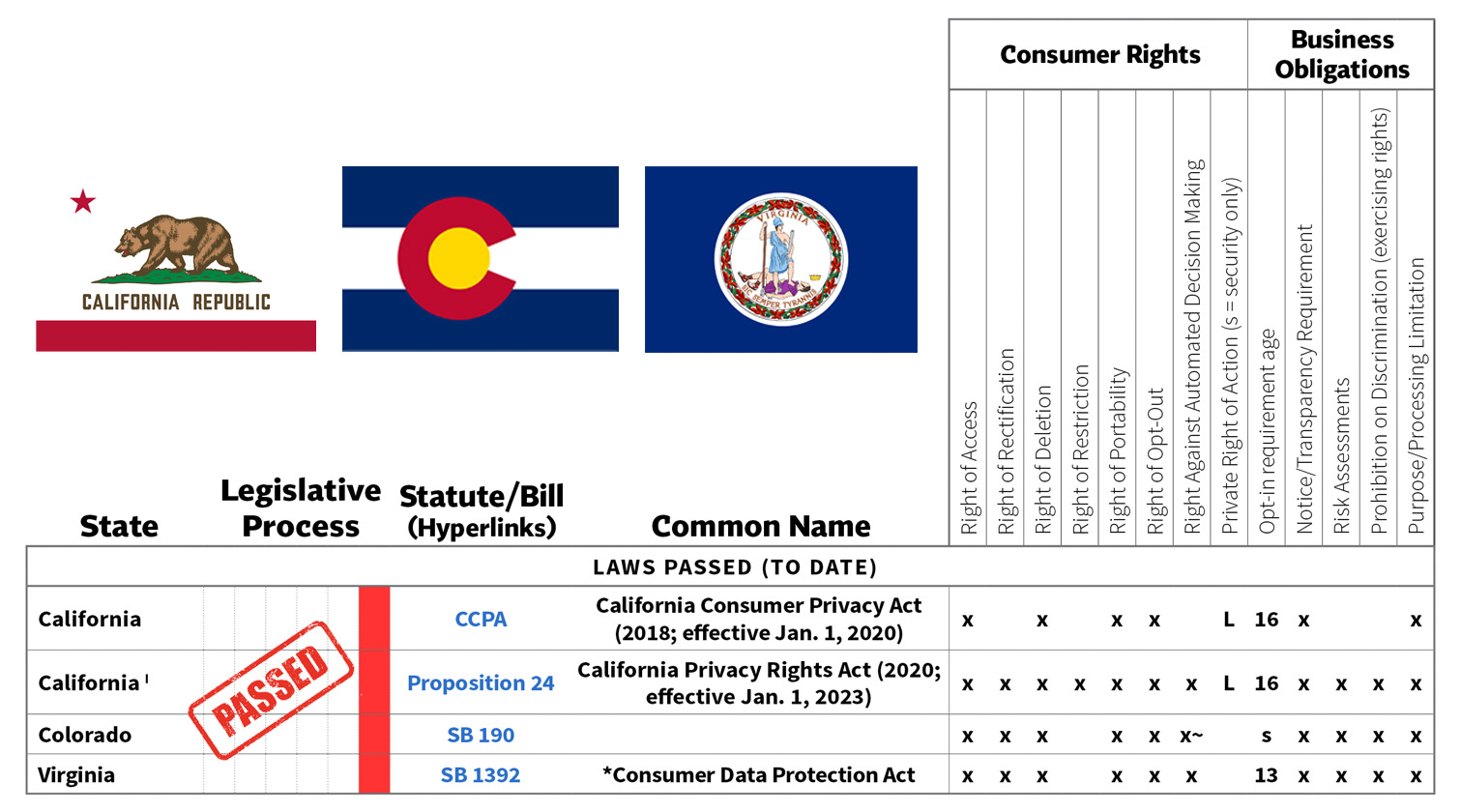
CA, CO, VA¹ — CPRA’s right of restriction/limitation is only applicable to sensitive personal data; * — Continued to 2021 Special Session; ~ — Right to opt out of certain automated decision-making activities

Consumer benefits of the Colorado Privacy Act

Much like the CPRA, the CPA allows consumers to opt out of the processing of certain personal data. Consumers have rights of data access, correction, deletion, and portability. This means that consumers can access their data up to twice per calendar year. They can delete their data, correct any inaccurate information, and move their personal data from one location to another, if they choose to do so. That said, there are a few exemptions to these rules.

Businesses’ obligations under the CPA

The CPA pertains to any company that conducts business in Colorado and meets one of the following two criteria: (1) The company controls or processes personal data of at least 100,000 consumers; or (2) the company receives revenue from the sale of personal data of at least 25,000 consumers.

These companies, or “controllers” as they’re called, must conduct data protection assessments for certain types of data processing. These assessments are mandatory for any processing that presents a heightened risk of harm, including the processing of sensitive data; processing data for targeted advertising, and processing data to sell to a third party. As a caveat, companies can always process their consumers’ sensitive data if the consumers choose to opt-in.

Under the CPA, controllers also have the following obligations:
• A duty of transparency, whereby controllers must provide privacy policy disclosures to their consumers.
• A duty of purpose specification, which mandates that controllers explicitly state their purposes for collecting and processing customer data.
• A duty of data minimization, which requires that controllers only collect the customer data that is reasonably necessary.
• A duty to avoid secondary use, which essentially means that the controllers cannot process the customers’ data for any reason(s) other than the controllers’ specified purposes—unless, of course, consent is obtained.
• A duty of care, whereby controllers must implement reasonable measures to secure their customers’ data.

Exemptions, exclusions, and enforcement

It’s important to note that there are a few exceptions to the aforementioned business obligations. Publicly available information, employee data, and de-identified data are all exempt from the CPA. Also, any data governed by federal laws, such as the Health Insurance Portability and Accountability Act (HIPPA), the Gramm-Leach-Bliley Act (GLBA), the Children’s Online Privacy Protection Act (COPPA), and the Securities Exchange Act of 1934 are not subject to CPA, as these federal privacy laws take precedence.

Colleges, non-profits, and state and local governments are also exempt from CPA. Additionally, certain processing activities are excluded from the CPA, including detecting fraud or illegal activity, and conducting internal research to develop products.

Perhaps the most egregious omission in the CPA lies in its enforcement. Unlike the CPAA, there is no private right of action clause in the CPA, making it difficult for individuals to sue companies. Consumers must rely on the Colorado Attorney General or the District Attorney’s office to handle enforcement.

Lastly, from January 1, 2023, (when the CPA goes into effect) to January 1, 2025, companies will have a 60-day window to address and remedy any infractions before the Colorado AG or DAs are able to hit them with a violation. On January 1, 2025, this 60-day “cure period” will be automatically repealed.

Important takeaways

Although the Colorado law will not be enforced until January 1, 2023, companies should adhere to its statutes as soon as possible. Until the U.S. gets a federal data privacy law, these state-level data privacy laws will continue to come down the pike.

The growing patchwork of US data privacy laws will only get more confusing for businesses that ignore them, or choose to operate differently in various states. The most prudent thing to do is to voluntarily comply with the most rigorous data privacy regulation in the US and then practice that compliance in all 50 states as soon as possible. By doing so, businesses can be sure to avoid expensive fines, interruptions to their business operations, and general aggravation in early 2023.

— Chart via IAPP.org and featured image via Andrew Coop, Unsplash

John Donegan

John Donegan

Enterprise Analyst, ManageEngine

Want to read<br>this article on the go?

Want to read
this article on the go?

Do it on the ManageEngine
Insights app.

Published on June 16, 2021 | 5 min

In what would be the biggest GDPR fine of all time, Luxembourg’s data protection commission (CNPD) recently levied a $425 million fine on Amazon. Although the CNPD’s draft decision still needs to be approved by other EU privacy regulators, it begs the question: Is this the best way to rein in Big Tech’s misuse of user data? After all, $425 million only accounts for 2% of Amazon’s 2020 net income ($21.3 billion). In order to make powerful tech conglomerates take consumer privacy seriously, we need to rely on more than GDPR enforcement.

In the United States, we’re seeing the emergence of a patchwork of data privacy laws at the state level. Just last week, the Colorado Senate passed bill SB21-190, the Colorado Privacy Act (CPA), which Governor Jared Polis is expected to sign into law. Colorado is poised to join California (CPRA) and Virginia (CDPA), likely becoming the third state to pass consumer data privacy legislation. Like the CPRA, the CPA allows consumers to opt-out of the processing of personal data, and it mandates that businesses obtain consumers’ permission before they collect certain sensitive personal data. Similar bills in Florida and Washington recently failed; however, a pattern is certainly emerging.

There is not widespread agreement as to whether or not the United States should adopt a federally mandated consumer data privacy law like the GDPR. That said, there is agreement on both sides of the aisle that Big Tech’s largest players—Alphabet, Facebook, Amazon, and Apple—have too much unbridled access to consumer data. Part of the problem lies in monopolistic practices and allegedly anti-competitive behavior; so in addition to fining large companies for misuse of user data, some legislators are concurrently calling for antitrust intervention. Just last week, senators Mike Lee (R-UT) and Chuck Grassley (R-IA) introduced a bill that would move antitrust enforcement to the DoJ, effectively stripping the FTC and FCC of their antitrust authority. Although politicians may disagree on the fine print, both sides of the aisle agree that something needs to change when it comes to Big Tech and user data privacy.

Widespread M&A has exacerbated Big Tech’s reliance on consumer data

We’ve witnessed a tidal wave of M&A activity in recent years. Facebook bought Instagram and WhatsApp; Amazon acquired WholeFoods and Zappos, and Google picked up Waze, DoubleClick, Nest, and FitBit. There was a great deal of scrutiny around the FitBit acquisition, which makes sense, as the deal gave Google access to the health data of over 28 million users.

Detractors view acquisitions like these as anti-competitive maneuvers that stifle innovation, hurt small businesses, and provide consumers with less choices. Lina Khan, an academic fellow at Columbia Law School, supports a breakup of Amazon. In her celebrated 2017 Yale Law Review Journal essay, “Amazon’s Antitrust Paradox,” Khan argues that Amazon shouldn’t be allowed to operate anticompetitively with impunity just because their prices are low and customers are pleased. As expected, Amazon is quick with a rebuttal: Amazon’s businesses only account for roughly 4% of all U.S. retail transactions. Nevertheless, Khan posits that market share is not a strong enough benchmark for antitrust. Comparing Amazon to the railroad behemoths at the turn of the century, Khan writes, “The thousands of retailers and independent businesses that must ride Amazon’s rails to reach market are increasingly dependent on their biggest competitor.” Khan argues that regulating Amazon as if it were a utility company is a viable, and legally sound, option.

Whether a court will rule that Amazon can be regulated like a utility company remains to be seen. As an aside, just last week, Ohio’s attorney general, Dave Yost, filed a lawsuit, attempting to get Google declared a public utility—and in turn, subject to government regulation. Nevertheless, the strength of Amazon’s (as well as Facebook’s and Google’s) business model certainly involves the monetizing of consumer data.

Not everyone is worried about how Big Tech monetizes our personal data

The effects of M&A within Big Tech isn’t all negative. As Information Technology & Innovation Foundation (ITIF) president Rob Atkinson notes, consumers benefit when tech conglomerates’ subsidiaries work in tandem, and economies of scales provide consumers with lower prices. The question is—at what cost? At a certain point, surely many consumers would pay more for goods and services if it meant their personal data would be protected?

Tech entrepreneur Mark Cuban has argued that if Facebook/Instagram/WhatsApp isn’t able to sell our data to third-party advertisers, then they will harvest the data themselves, positioning it as an all-too-powerful player in the space. Also, Cuban notes that while the U.S. is in a race with China, Russia, and other nations to harness the power of AI, it is currently US-based companies—Google, Facebook, and Amazon—who are leaders in the space. Cuban claims it would be a fatal error to break these companies up, as it would jeopardize the US’ standing in this AI race. Lastly, he argues that Facebook and Amazon are not technically noncompetitive because people do not have to use their services and platforms. Whether or not we agree with his arguments here, one thing many of us can agree on is that Big Tech’s (often surreptitious) monetization of consumer data has gone too far.

A partial solution: a federal data privacy law

If designed well, a federal user data privacy law would put consumers and media conglomerates on the same page. Ideally, users would have the rights enabled by the CPRA, including, “(1) the right to know how their personal information is collected, used, and shared; (2) the right to delete certain personal information that businesses collect; and (3) the right to opt out of the sale of their personal data.” Over the past few years, industry-affiliated lobbyists have helped draft several versions of a federally mandated privacy law, such as Intel’s proposed “Ethical Data Use Act of 2019.” Last year, Senators Blackburn (R-TN), Fischer (R-NE), Thune (R-SD), and Wicker (R-MS) introduced the SAFE DATA Act. More recently, this past March, former Microsoft executive and current state representative Suzan DelBene (D-WA) put forth the Information Transparency and Personal Data Control Act (ITPDCA).

Importantly, there’s an argument that businesses stand to gain from such a federally mandated privacy law. With the passing of a federal law, businesses wouldn’t have to worry about complying with a patchwork of state laws. Having one single set of data privacy requirements would allow businesses to streamline their compliance framework. Additionally, for many businesses, this law would result in a much-needed analysis of their data collection and processing practices; not only would this help protect their customers’ data, but it would also make their own internal data more safe. So, it’s the opinion of this author that a federal data privacy law is a good start for all parties concerned.

John Donegan

John Donegan

Enterprise Analyst, ManageEngine

Want to read<br>this article on the go?

Want to read
this article on the go?

Do it on the ManageEngine
Insights app.

Subscribe to user data privacy

Thanks for subscribing to ManageEngine Insights. If you do not receive our welcome email, please check your SPAM folder.