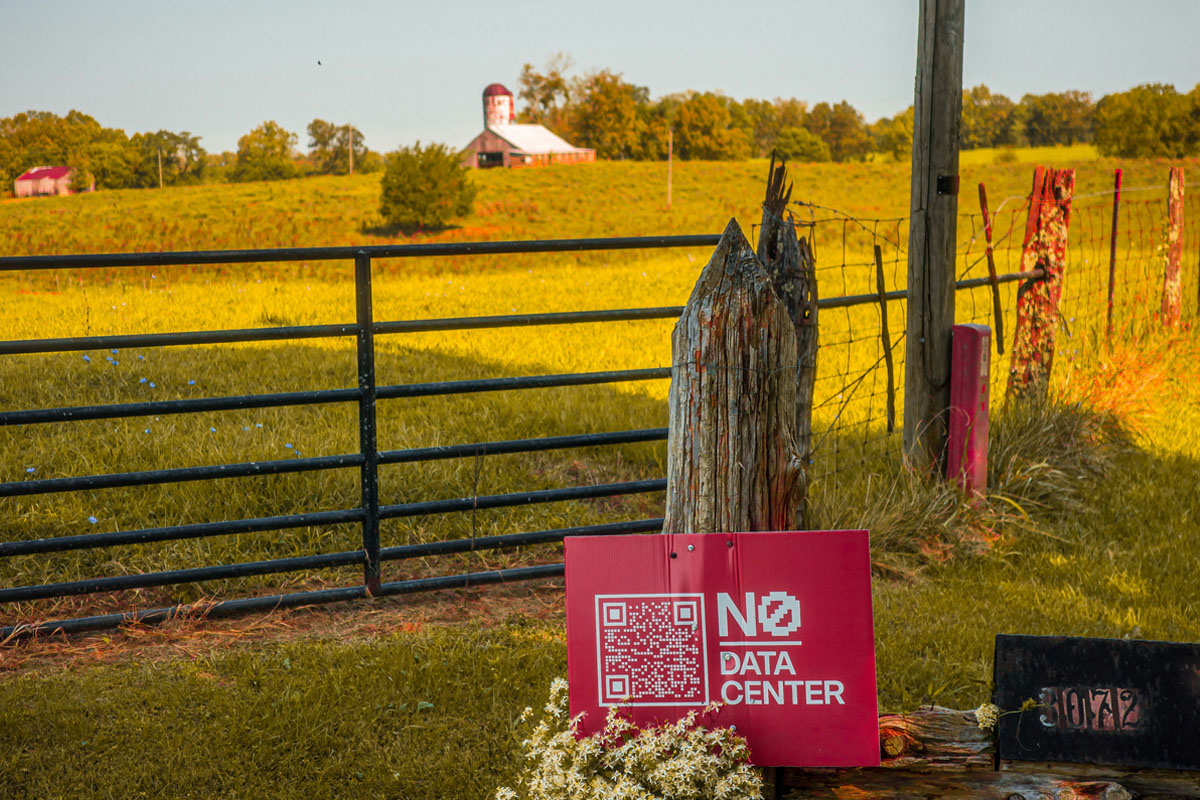
Over the past six months, Americans' support for data center construction has plummeted. In fact, when it comes to data center backlash, no other country comes close to the United States.
According to UK-based consultancy Public First's August 2026 study, The Opposition to Data Centers, the scale of opposition to data centers in the U.S. is off the charts. Americans are more supportive of power plants, electric infrastructure, and office complexes; most survey respondents said they'd rather see land go undeveloped than to see a data center built.
Opposition to data centers is highest when the construction is within ten miles of a respondents' house, suggesting that Americans overwhelmingly don't want them in their backyards. Interestingly, rural respondents are the demographic most against new data center construction, and perhaps unsurprisingly, those who don't trust tech companies are especially wary of data centers.
The American respondents' biggest concerns are higher energy bills, water shortages for households, and negative impacts on the environment. That said, I believe this American resistance to data centers is also a referendum on Big Tech and a trust in these American CEOs' efforts to build out more AI.
In an August 26 Information Technology and Innovation Foundation (ITIF) webinar, "Can the United States win the AI race if Americans oppose data centers?," Paul Lekas, an EVP at the Software & Information Industry Association (SIIA) says, "Populist opposition to Big Tech is definitely a factor [...] There is apprehension in society around AI."
Data center opposition is a uniquely American phenomenon at the moment
Public First's data shows that there is not nearly as much data center opposition in other parts of the globe. For example, survey respondents in India, Nigeria, Vietnam, Indonesia, and many parts of southeast Asia are extremely supportive of new data center construction.
By no means is Public First's study the only data point. A recent NBC News Decision Desk Poll of U.S. adults found that 69% were opposed to data center development, and 70% of these respondents said they were more worried about AI than excited by it. Put simply, a lack of trust in tech companies is driving this data center opposition.
Data centers are a contentious political issue
According to Public First's study, data center support has plummeted since January, particularly among Democrats. However, in the run-up to the midterm elections, politicians from both parties are souring on data center support.
Writing for Politico, Andrew Howard explains, "There’s no clean ideological lane. From MAGA Republicans to far-left Democrats, there are strange bedfellows joining forces against data centers, further complicating the narrative with voters."
In Texas, Republican Gov. Greg Abbott recently paused approval for new data center construction, opting to wait for regulators' audits of these projects' tax breaks and water use. This decision came after Abbott received complaints from longtime conservative voters in remote parts of Texas.
Some politicians are pushing for moratoriums, while others are campaigning against tax incentives and carve-outs. In Michigan, GOP Senate nominee Mike Rogers recently called for a one-year moratorium on new data center construction. And in Ohio, GOP Sen. Jon Husted is facing debilitating data center backlash during his reelection campaign. Husted's competitor, Sherrod Brown, has tried to cash in on this, labeling Husted "the face of data centers."
Caught in a tight race in Nevada, Republican Gov. Joe Lombardo issued a statement on September 18, saying, “Data centers must pay their share, protect our water resources, keep costs from being passed on to ratepayers, and protect the communities that host them.” To be sure, data center construction is now a flashpoint issue for pols on both sides of the aisle.
The pro-data center contingent is yet to find its footing
Generally speaking, the tech industry has been caught off guard, and there is not a lot of effective messaging out there from tech companies and the data center builders. Americans are worried that data centers will raise their electricity bills, drain their water supplies, and help Big Tech build advanced AI tools that some people don't want in the first place.
According to the Center on Budget and Policy Priorities, eight states enacted legislation to reel in data center tax subsidies, and seventeen other states considered, but ultimately did not pass, similar laws last year.
There are ways that data center builders, tech companies, and lobbyists can change the narrative around data centers. For example, according to Public First's study, Americans are most concerned with electricity costs. To assuage these fears, data center companies should promise to cover any electricity grid increases that their data centers would cause, effectively guaranteeing that local electric bills won't rise; in a perfect world, data centers would generate all their own power on-site and not pull from the grid at all. Such messaging would be a boon to the pro-data center movement.
Data center proponents could also bring attention to the examples of data centers being a win-win for tech companies and the surrounding communities.
Loudoun County, Virginia
Thirty-five miles southwest of D.C., this northern Virginia county is poised to bring in $1.1 billion in tax revenue from data centers in 2026. In fact, data centers currently account for 38% of Loudoun County's General Fund. The tax benefits from data centers have allowed Loudoun residents to build roads, schools, libraries, parks, and a new recreation center. What's more, the residential property tax has dropped significantly over the past decade, from $1.14 per $100 of assessed home value in 2016 to $0.805 per $100 of assessed value in 2026. According to Jared Walczak, vice president of state projects at the Tax Foundation, without data center development, the average homeowner in Loundoun County would pay roughly $5,800 more in property taxes.
Quincy, Washington
Another good example is Microsoft's activity in Quincy, Washington. A small farming town before the tech behemoth set up shop, Quincy now generates 57% of its property tax revenue from data centers. In 2018, Quincy collected $9.8 million in tax revenue; six years later, that number ballooned to $20 million. These funds have funded a new high school, a hospital, and other town infrastructure without raising taxes on residents.
Cedar Rapids, Iowa
Another interesting case study can be found in Cedar Rapids. On one hand, Google's data center development in the region is expected to create 1,000 new construction jobs, and a partnership with the Cedar Rapids Electrical Trade Center should create 700 electrician apprentices by 2030.
On the other hand, the Google data center deals are under scrutiny due to allegations of kickbacks and non-disclosure agreements. Cedar Rapids Mayor Tiffany O'Donnell has effusively denied the kickbacks; however, she concedes that Google (and QTS Data Centers) will receive a 15-year-long tax break.
Gubernatorial nominees Rob Sand (D) and Zach Lahn (R) are each calling for an end to Iowa's tax breaks for these data centers. It is a huge issue in the current Iowa race. In his policy plan, Sand writes, "Right now, Iowa faces a nearly $1.4 billion budget deficit. We shouldn’t be handing out more tax breaks for major corporations at the expense of Iowa taxpayers. These data centers are also getting huge sales tax breaks on everything inside the data center.”
The Republican candidate's camp has responded in kind, telling The Gazette, “From day one, Zach Lahn has called for a moratorium on data centers, ending their unfair tax incentives, restoring local control to communities, and setting the ‘rules of the game’ at a state level, so these large data centers cannot raise taxes or increase electricity costs for Iowans. Once again, Rob [Sand] is copying our campaign and mirroring our policy.”
So, clearly the Iowan candidates are cognizant of the data center backlash and trying to win over angry voters.
The U.S. data center backlash is likely a referendum on some tech companies' AI goals
More than any other country in the world, the United States is increasingly opposed to data center construction. As Seb Wride, head of polling at Public First, points out, "This is not a flashpoint issue in the UK or France or in Germany."
I believe that the uniquely American opposition to data centers is a referendum on AI more generally. And Wride's data supports this. He says, "The root cause of a lot of this data center opposition is coming from AI in general."
In the same conversation, Paul Lekas at the Software & Information Industry Association, says, "I think that it's important for industry to meet people where they are and listen to their concerns. And I think we need to look at these concerns as solvable problems. And then there's this bigger issue of trust and 'how is AI going to benefit me?' which is a much bigger conversation."
To be fair, it's hard for people to be excited about tech CEO's trailblazing AI initiatives when they publicly say things like, “I think that AI will probably, most likely, sort of lead to the end of the world. But in the meantime, there will be great companies created with serious machine learning.” This was Sam Altman at Airbnb's Open Air conference in 2015.
Or how about Elon Musk being asked on Ted Cruz's podcast about the possibility of killer robots annihilating humanity? "20% likely," Musk said. "Maybe 10%," And it could happen in "five to 10 years." Meanwhile, Musk is actively building humanoid robots. If this is the tech CEOs' endgame, perhaps Americans are right to be wary of non-stop AI development.
Looking forward
The pro-data center contingent is certainly aware that they have a messaging problem. In an attempt to rein in the data center backlash, QTS Data Centers, Compass Datacenters, Digital Realty, and Vantage Data Centers recently joined forces to create a nonprofit called Infrastructure for America. Similarly, Build American AI, which is an off-shoot of the pro-AI super PAC "Leading the Future," is launching a multi-million dollar pro-data center ad campaign in Kansas, Ohio, and Wisconsin.
Given that data centers are such a flashpoint issue in the United States, I agree with Lekas when he says, "It will be hard to have any turnaround before the midterm elections, but I do think this is possible." That said, at this moment, the folks in the pro-data center contingent have an uphill battle on their hands.
Related reading