
Published on March 08, 2025 | 7 min

We say technology has no gender. But here’s a question: Why does the industry still look like a boys’ club?  

Women have been inventing, pioneering, and disrupting tech for centuries—writing the first lines of code, designing the backbone of the internet, and literally launching humans into space. But history has a habit of crediting only men for their breakthroughs (looking at you, workplace bias).

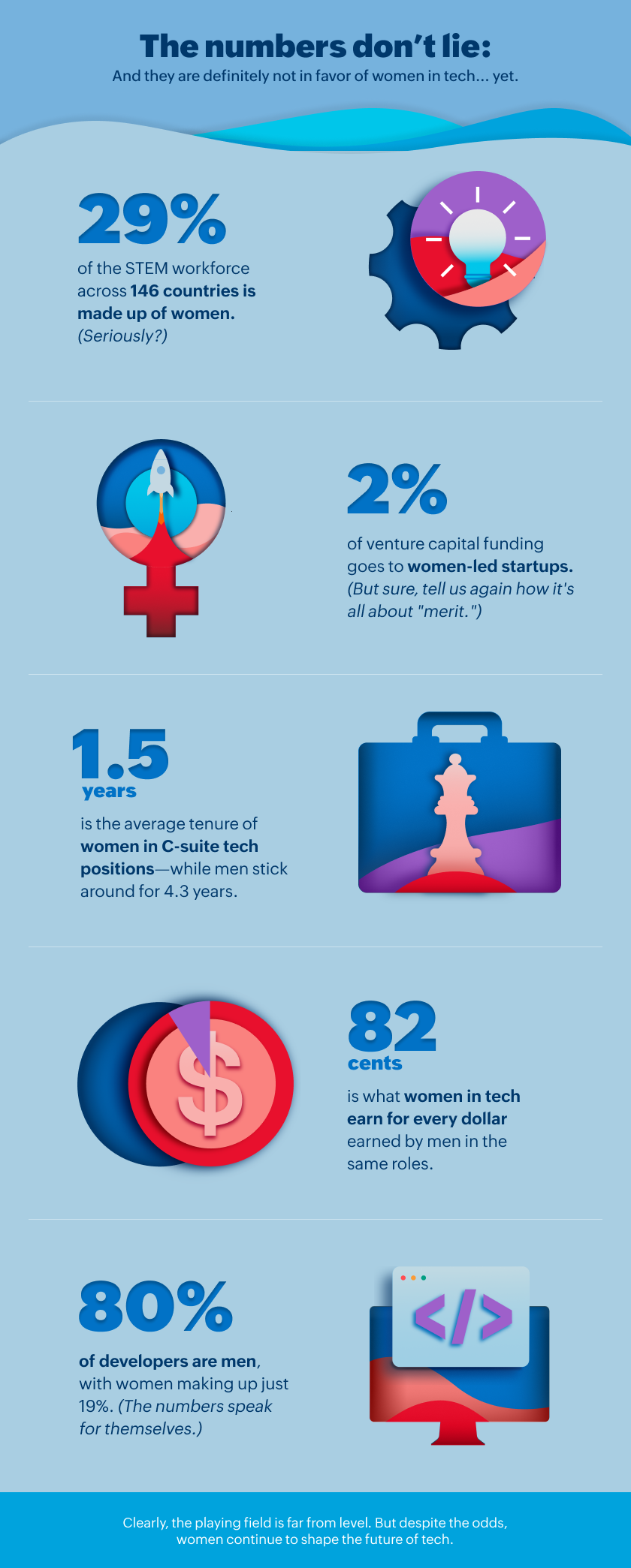
Even now, bias and systemic barriers keep women from advancing in tech. They receive less funding, fewer promotions, and lower pay, all while driving some of the most groundbreaking innovations in the industry.

And yet—against all odds—they keep innovating, leading, and proving that tech’s future isn’t just male. It’s diverse, bold, and absolutely unstoppable.

But history has a pattern: Their contributions get overlooked, their breakthroughs downplayed, and their careers cut short.
The firsts: Historic trailblazers who changed the game  

When we talk about the history of technology, women haven’t just been part of the story—they’ve written entire chapters. Long before diversity was a corporate buzzword, these women were breaking barriers, shattering stereotypes, and changing the game.

Before tech had rules, these women were out here rewriting them. They weren’t just ahead of their time—they defined it. And they didn’t just set records for women. They set records, period.

Let’s meet some of the women who did it first and did it best.

  • Ada Lovelace: The world’s first computer programmer, Ada Lovelace, envisioned the power of algorithms long before computers even existed. She wrote the first-ever machine-executable program for Charles Babbage’s Analytical Engine and predicted that computers could do more than just crunch numbers.
  • Grace Hopper: This “Queen of Code” invented the first compiler in 1952, a program that translates human-readable code into machine code, revolutionizing programming. In fact, she also coined the terms “compiler” and “debugging” and championed accessible software development.
  • Radia Perlman: She created the Spanning Tree Protocol (STP), which is essential for network bridges and the functioning of the modern internet. She’s often called the “Mother of the Internet” for her contributions.
  • Marian Croak: Marian Croak is a pioneer in Voice over Internet Protocol (VoIP) technology, which powers services like Zoom, Skype, and WhatsApp. Her work transformed how we communicate, making voice and video calls accessible and affordable worldwide.
  • Margaret Hamilton: Considered the first software engineer, she was a computer scientist who coined the term. She led the team that developed the onboard flight software for NASA’s Apollo missions, including Apollo 11.

The women of today: Leaders in tech  

And now the torch has been passed. The pioneers laid the groundwork, but today’s women are taking it to the stratosphere.

They’re shattering limits, rewriting the rules, and innovating faster than the world can keep up. From reshaping AI ethics to leading multi-billion-dollar tech giants, these women aren’t waiting for the future to happen—they’re making it happen!

Let’s meet the women who are setting the course for the future, and trust us, it’s a wild ride.

Women in AI: 

Mira Murati: As the former CTO at OpenAI, Murati didn’t just sit at the table—she built it. She played a crucial role in creating ChatGPT and DALL-E, pushing the boundaries of AI and human-AI collaboration to places we never thought possible. Her work isn’t just about coding; she’s reshaping how we think about AI’s place in society.

Dr. Joy Buolamwini: Founder of the Algorithmic Justice League, Buolamwini is the one who called out the gender and racial bias in AI long before it was trendy. Her pioneering research has led to a global movement pushing for more ethical, inclusive AI. She’s not just questioning how AI is built—she’s demanding that we build it right from the start.

Women in cybersecurity: 

Tanya Janca (SheHacksPurple): Founder of We Hack Purple, Janca is a cybersecurity force. As a security director, she’s dedicated her career to empowering developers with the knowledge to build secure software from the ground up. Janca’s mission goes beyond teaching—it’s about creating a community where security best practices are the foundation of every piece of code.

Caroline Wong: As a leading cybersecurity strategist, Wong has played a pivotal role in transforming how companies approach penetration testing and risk management. With over two decades of experience, she’s led teams to identify and defend against some of the world’s most sophisticated cyberthreats. Wong has written extensively about building secure infrastructures and is a vocal advocate for diversity in cybersecurity, pushing for more women and underrepresented groups to enter the field.

Women in engineering:

A. Lalitha: India’s first female electrical engineer, Lalitha broke through barriers that many thought impossible. In an era where women were rarely seen in technical fields, she not only earned her degree in electrical engineering but also became a trailblazer for women in STEM. Lalitha’s contributions to power grid development in India were crucial during the nation’s early years of industrialization. Her work helped lay the foundation for modern electrical infrastructure, providing reliable power to countless communities.

Gwynne Shotwell: As the President and COO of SpaceX, Shotwell has been instrumental in revolutionizing space travel. She played a key role in making reusable rockets a reality, overseeing the development of the Falcon and Starship programs and securing NASA contracts that made SpaceX the first private company to send astronauts to the International Space Station. Her leadership has helped reshape the future of space exploration, proving that engineering isn’t just about building machines—it’s about breaking boundaries and redefining what’s possible.

Women in data science:

Fei-Fei Li: A true pioneer in computer vision and ethical AI, Li has fundamentally shaped how machines perceive and understand the world. As a professor at Stanford, she headed the creation of ImageNet, a dataset that transformed the field of deep learning and is now a cornerstone of modern AI applications, including everything from facial recognition to self-driving cars. Beyond her technical expertise, Li is a fierce advocate for human-centered AI, fighting for a future where AI benefits everyone—not just the few.

Cynthia Dwork: A trailblazer in differential privacy, Cynthia Dwork’s research has made it possible to analyze sensitive data while still safeguarding individuals’ privacy. Her groundbreaking work has become a bedrock of data protection and has shaped the security standards for industries that handle vast amounts of personal information. Dwork’s innovations have allowed for safe, privacy-preserving data analysis, making it possible to unlock insights from big data without exposing the identity of individuals.

Women in tech leadership:

Lisa Su: As CEO of AMD, Su didn’t just lead the company—she redefined the semiconductor industry. Under her leadership, AMD surged to the forefront of high-performance computing and gaming chips, challenging industry giants like Intel and Nvidia. Su’s vision brought groundbreaking innovations in chip design, making AMD the go-to choice for everything from gaming consoles to data centers.

Monique Morrow: A tech innovator and digital inclusion advocate, Morrow has dedicated her career to ensuring that technology serves everyone—not just the privileged few. Leading initiatives in blockchain, cybersecurity, and ethical AI, Morrow has worked to make sure emerging technologies are built with inclusivity and accessibility at their core.
The way forward: A more inclusive future  

Progress is happening, but we’re only scratching the surface.

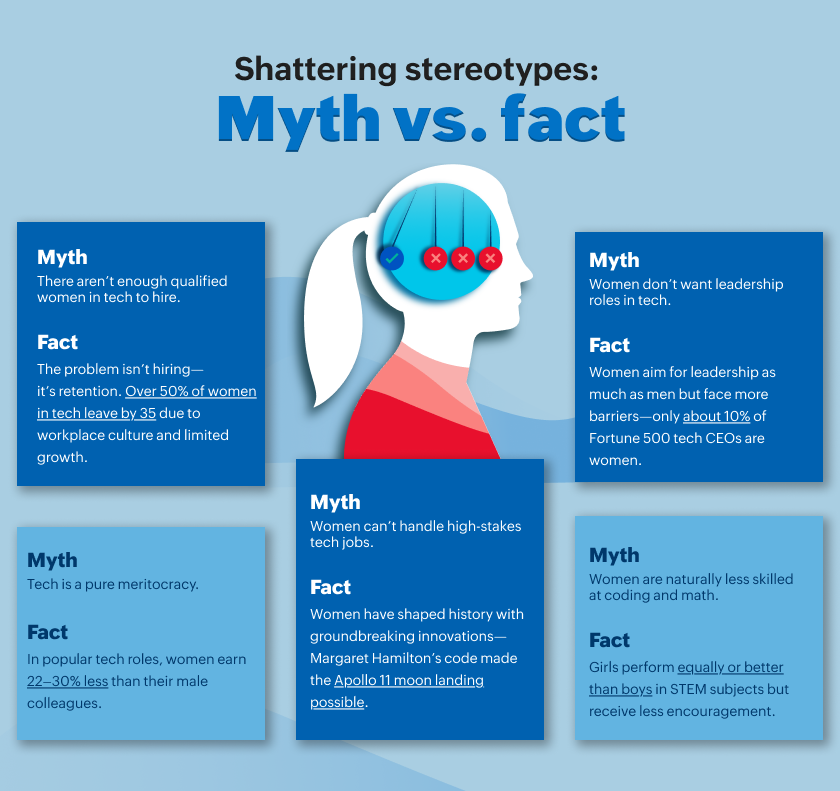
The gender gap in tech isn’t going to close by itself—it’s going to take intentional, bold action to ensure women not only enter tech but thrive in it.

Here are the critical steps to accelerate progress:

  • Advancing AI bias research: AI isn’t neutral. In fact, most AI systems inherit the biases of the humans who design them. To ensure fairness, we need comprehensive research that addresses racial, gender, and socioeconomic biases. Investing in ethical AI will level the playing field, allowing women to rise without being held back by technology designed with inherent inequalities.
  • Increasing women-led startups: By increasing access to funding, mentorship, and networking opportunities for female entrepreneurs, we can create a new generation of women who not only build companies but reshape industries.
  • Diversity in hiring and leadership: Companies must commit to equitable hiring practices, ensuring that women have an equal shot at leadership opportunities. Equity in leadership isn’t just about filling quotas—it’s about bringing diverse perspectives to the table, driving better decisions and more innovative solutions.
  • STEM education investment: Women in STEM remain underrepresented, but it all starts with early exposure and investment in education. Scholarships, mentorships, and outreach programs tailored to young girls can spark a passion for STEM fields before stereotypes set in.
  • More role models and visibility: Representation matters—you can’t be what you can’t see. Highlighting female tech leaders—from CTOs to start-up founders—will not only inspire the next generation but also normalize women in leadership roles. By amplifying the voices of women who have broken barriers, we can create a new culture of inclusivity where every young girl sees herself in the tech industry.

The momentum is building, and there is no turning back. We are just getting started.

Women have been driving innovation in tech from day one, and now, the world is finally waking up. As we dismantle the barriers and shatter the status quo, the future of tech is bold, diverse, and full of unstoppable potential.

The next chapter is ours to write, and it’s going to be legendary.

Related reading:

Sneha Banerjee

Sneha Banerjee

Enterprise Analyst, ManageEngine

Want to read<br>this article on the go?

Want to read
this article on the go?

Do it on the ManageEngine
Insights app.

Published on March 12, 2024 | 4 min

The realms of identity management and security are critical components of our digital age, safeguarding the information and access points that connect us to the world. These fields, rich with challenges and opportunities, are increasingly attracting women who are leaving a profound impact on their evolution. This journey is not just about overcoming obstacles; it’s a testament to the inspiring role women play in shaping a secure digital future, offering valuable lessons and encouragement for future generations.

Breaking ground in cybersecurity  

Cybersecurity, a critical domain in our increasingly digital world, has benefited immensely from the contributions of women. Dorothy E Denning’s profound contributions to cryptography and information security has been instrumental in shaping cybersecurity policies and practices, including encryption standards and ethical considerations in information warfare.

Women have also been at the forefront of addressing cyberthreats, leading cybersecurity firms, and directing government agencies to safeguard against digital attacks. Katie Moussouris, a well-known figure in the cybersecurity world, has made significant contributions to the field of digital security through her work on vulnerability disclosure and bug bounty programs. She founded Luta Security, a company specializing in helping businesses and governments understand and implement coordinated vulnerability disclosure policies.

The strategic vision and leadership these women demonstrate have been pivotal in navigating the complex challenges of digital security, ensuring the protection of sensitive information and maintaining trust in digital infrastructures.

Challenging and changing the status quo

Women in identity and security are not just participating; they’re leading the charge in challenging and changing the status quo. By breaking down barriers and disproving stereotypes, they pave the way for a more diverse and dynamic industry. Window Snyder, a highly respected expert in cybersecurity, has held senior security positions at some of the biggest names in tech, including Microsoft, Apple, and Intel. Her work has focused on developing strategies and systems to counteract a wide range of cyberthreats, making her a key figure in the field of digital security.

This role of protector resonates with many women, inspiring more women than ever to pursue careers that allow them to make a tangible impact on the privacy and security of digital information. This evolving landscape is a beacon of hope for future generations, illustrating that through perseverance and talent, it is possible to make significant contributions and reshape the field.

Fostering a supportive community

One of the most compelling aspects of women’s involvement in identity management and security is the strong sense of community that has emerged. Women across the globe are supporting each other through mentorship, networking, and advocacy, building a resilient and inclusive culture. This community not only helps current professionals thrive but also opens the door for newcomers, making the field more accessible and appealing to young women considering a career in tech. The message is clear: there is a place for you here.

Encouraging diversity and inclusion

The success of women in cybersecurity is also reshaping the industry culture, emphasizing the importance of diversity and inclusion. By excelling in their roles, women are proving that the ability to protect the digital realm knows no gender.

For instance, Ann Cavoukian’s work on Privacy by Design has been influential in integrating privacy into the development of technology, business practices, and networked infrastructure. Amanda Rousseau, also known as Malware Unicorn, is recognized for her work as a security researcher specializing in malware analysis and reversing engineering, contributing significantly to the understanding and mitigation of malware threats.

Their work not only strengthens cybersecurity defenses but also promotes greater diversity and inclusion within the field. Their achievements serve as inspiration for future generations, highlighting the vital contributions women can make to cybersecurity. This shift towards a more inclusive industry not only enriches the cybersecurity talent pool but also ensures a broader range of perspectives are brought to bear on complex security challenges.

Trailblazers in the field

The increasing presence of women in identity management and security is a powerful narrative of progress, innovation, and community. Women are increasingly finding their place and voice in the identity management and security space, drawn by its relevance to their lives, its challenges, and the meaningful opportunities it presents. Through their work, they are not only protecting digital identities but also driving the evolution of the field toward greater inclusivity and equity. As more women enter and shape this domain, their inspiration and innovation signal a promising future for identity management and security—a future where digital spaces are safe, respectful of privacy, and accessible to all.

As we commemorate Women’s History Month, let’s take a moment to applaud the women who have made significant strides in the identity management space. Their achievements are not just milestones for gender equality but also key drivers of technological advancement and security in our increasingly digital world. The rise of women in identity is a testament to the progress we’ve made and a reminder of the work that remains to achieve true equality. Here’s to celebrating their success and supporting the journey of countless women who will follow in their footsteps, further enriching the world of technology with their talents and visions.

Debanjali Ghosh

Debanjali Ghosh

Technical Evangelist, ManageEngine

Want to read<br>this article on the go?

Want to read
this article on the go?

Do it on the ManageEngine
Insights app.

Published on March 09, 2023 | 6 min

It’s Women’s History Month again, and here we are, talking about the same issues again.

Although there has been significant progress over the years, the gender gap in the tech industry remains a grim reality, even in 2023. Women make up less than 30% of the tech workforce but those who do make it into the industry often face harassment, unequal pay, and limited opportunities for advancement.

While efforts have been made to attract more women to the tech industry, retaining them has been a challenge for organizations. A survey by MetLife shows that women in STEM careers are more likely to leave their jobs compared to women in other industries, citing a lack of growth, role models, and mentors. These factors make it difficult for women to see a clear path to advancement in the industry and can lead to burnout and frustration. Addressing these issues is crucial for promoting gender diversity and creating a more equitable tech industry. So, where do we begin? Feminist principles might hold the answers.

But what are feminist principles, anyway?

Feminist principles are a set of values and beliefs that center around promoting gender equality and challenging patriarchal structures and norms. Feminist principles recognize that gender inequality is not just a personal issue, but a societal one that is perpetuated by systems and structures that reinforce power imbalances and discrimination. Some examples of feminist principles include valuing diversity and inclusivity, promoting work-life balance, and advocating for equal pay.

Traditional organizational principlesFeminist principles
Efficiency and profitability are prioritizedEquity and collaboration are prioritized
Employee well-being may be overlooked in favor of productivityWork-life balance and the personal and social costs of burnout and overwork are recognized
Power imbalances may be perpetuated through hierarchical structures and top-down decision-makingParticipatory decision-making and shared leadership are emphasized to reduce power imbalances
Individual achievement is often emphasized over collective achievementCollective achievement and collaboration are prioritized over individual achievement
Workplace policies may not consider the needs of marginalized groupsPolicies and practices are designed to address the needs and experiences of all employees, particularly those who are marginalized or underrepresented
Competition and individualism are often prioritized over cooperation and community-buildingCooperation, community-building, and interdependence are valued over competition and individualism


The intersection of feminism and technology

Feminist principles are playing a key role in driving progress and equality in the tech industry by promoting diversity, inclusivity, and equity. These principles are leading to more gender-inclusive design, promoting greater representation of women in tech roles, addressing bias and discrimination in workplace practices and culture, and advocating for policy changes that support gender equality. 

Applying feminist principles to technology design and development involves developing products and services that are accessible and user-friendly for a diverse range of users. This includes addressing bias and discrimination in algorithms and data, and creating products that better meet the needs and perspectives of diverse groups, including women.

In terms of employment and leadership positions, feminist principles also advocate for equal representation of women in organizations. Several initiatives are working to address the underrepresentation of women in tech, such as Girls Who Code, which offers coding education and resources to girls and young women. The National Center for Women & Information Technology (NCWIT)  promotes women’s participation in computing and technology through initiatives such as the Aspirations in Computing program and the NCWIT Award for Aspirations in Computing. 

Some major tech companies have also implemented policies and initiatives to address harassment and discrimination. One example is the People & Culture Report that Uber releases every year. This report outlines Uber’s commitment to creating a diverse and inclusive workplace, and highlights the progress that had been made in achieving these goals. The report includes data on the company’s employee demographics, as well as initiatives that had been implemented to address issues such as pay equity, bias in hiring, and harassment.

Another example is Google’s Code of Conduct, which outlines the company’s expectations for employee behavior and interactions with others. The code of conduct includes specific guidelines for preventing harassment and discrimination, and sets out consequences for employees who violate these guidelines.

By implementing policies and initiatives like these, tech companies can create a more inclusive and respectful workplace environment for all employees, regardless of their gender or other characteristics. This can help to address the underrepresentation of women in the tech industry and promote gender equality by providing a more supportive workplace culture for women.

How practical is it?

Feminist principles such as equity, diversity, and inclusivity are being applied to the development of new technologies, from AI to blockchain to virtual reality. These principles recognize that technology is not neutral and that it can reproduce and amplify existing social inequalities. 

It can lead to more equitable and inclusive technologies that better meet the needs and perspectives of women. Speech recognition software is a great example of this. In the past, speech recognition software was often developed with male voices as the default, leading to inaccuracies and frustration for female users. This was because the data used to train the algorithms was predominantly based on white male voices.

Now, speech recognition software can better recognize and interpret the voices of female users because software developers began using data sets that include more diverse voices, including those of women, people of color, and non-native English speakers. This can help ensure that speech recognition software is more accessible and user-friendly for a wider range of users.

Incorporating feminist principles into tech development can also promote innovation in organizations. By valuing diverse perspectives and experiences, and bringing it into the design process, tech companies can develop products and services that are more innovative and responsive to the needs of a broader range of users.

The online customer service help desk, Zoho Desk, is a pioneer in making digital resources accessible to those with special needs. The software provides a range of accessibility features that make the platform more user-friendly for people with disabilities. This includes features such as screen readers that render speech and Braille outputs, reading masks that enhance focus, motion sensitivity sensors that help reduce the risk of seizures, and font size adjustments that improve the overall visibility of the content.

The Algorithmic Justice League, founded by Joy Buolamwini, an MIT researcher, is a testament to how incorporating feminist principles into tech development can be accomplished practically. It does not have to be a far-fetched idea. Buolamwini’s discovery that facial recognition technology was much less accurate at identifying her face led her to investigate bias and discrimination in AI systems. The organization has conducted audits of commercial facial recognition systems and developed resources such as the AI Ethics Tool Kit to help developers and data scientists identify and address potential sources of bias in their algorithms and data sets.

Organizations in the tech industry still have a long way to go to promote gender equity and diversity. By embracing feminist principles, organizations not only improve their products and services, but also help create an equitable society.

Incorporating feminist principles into organizational values and practices can drive progress and equality by creating a more inclusive, equitable, and sustainable workplace culture that benefits everyone. It is up to individuals, organizations, and society as a whole to work towards this goal and create a better future for all.


Related reading section

Samudhra Sendhil

Samudhra Sendhil

Enterprise Analyst, ManageEngine

Want to read<br>this article on the go?

Want to read
this article on the go?

Do it on the ManageEngine
Insights app.

Published on March 12, 2022 | 5 min

March is celebrated as Women’s History Month, a time when we celebrate the contributions women have made through important historical events and in contemporary society. It’s also an opportunity for us to reflect upon our progress as individuals, societies, countries, and industries across the globe. Just how far have we come as a society in enabling women to realize the best of their potential?

People might argue that there are sectors that are primarily dominated by women, such as nursing, public relations, primary school teaching, or human resources. While this is undoubtedly admirable and needs to be lauded, if you look closely, you’ll realize that most of these are jobs that place a lot of emphasis on soft skills. This begs the question that even in 2022, are there certain kinds of jobs and industries that the world feels should be naturally accorded to women? Are we still not considered “smart” enough or “savvy enough” for other male-dominated industries, like technology?

While women represent nearly 50% of the global population, they made up only 25% of the global cybersecurity workforce in 2021. That’s still a long way to go for the 50-50 ratio we aspire towards. This is not due to a lack of jobs, mind you. As per recent research conducted by Cybersecurity Ventures, the number of unfilled cybersecurity jobs has grown by 350% in the last 8 years, from 1 million positions in 2013 to 3.5 million in 2021. Now, that’s a staggering number! That many jobs, so many qualified women candidates out there, and there’s still a growing skill gap in the sector.

A long way to go

There is no doubt that the technology sector and the cybersecurity industry, in particular, have realized the importance of equal gender representation. However, there is still room for improvement. The sector needs to make a concentrated effort to address its gender disparity by creating equal opportunities, providing equal access to training, and introducing skill development initiatives and projects for women.

It’s essential to keep in mind that organizations should not approach diversity and inclusion initiatives with the mindset of merely ticking off another thing from their checklist. This is not just a marketing campaign that’s going to improve your gender ratios and propel your brand into the limelight. It’s not something that needs to be done just to avoid facing public scrutiny and/or backlash. There are real, tangible benefits that women bring to the table, benefits that will translate into better business for your organization.

Benefits of gender diversity in cybersecurity

It’s easy to think, “What’s in it for me?” or “Why should I make an effort to go the extra mile when I have perfectly decent male candidates available at a moment’s notice?” This often happens because top management or hiring managers lack awareness of the advantages of recruiting women for cybersecurity roles. The argument for greater gender equality in cybersecurity should not be reduced to a men versus women debate. The debate has never been that, in the first place. In fact, it’s about the fact that having more women in the workplace is beneficial for business. Diversity in perspectives, leadership, and experience is excellent for businesses.

Not only do women bring a wide range of experience and technical skills to the table, but they also possess broad essential soft skills that make teams more diverse and productive. Women also bring more tangible benefits to the industry. In a recent podcast with ManageEngine Insights, Jane Frankland, founder of the IN Security Movement and a UNESCO Trailblazing Woman in Tech, says, “Women see risk in a different way to men. Women are very accurate in terms of risk management…we are highly attuned to risks, and we can spot anomalies very easily.” She goes on to add, “If we’ve got hackers who are profiling us, they’re basically modeling it on men because the majority of the industry is male. So when we have more men, if there has been an attack that has been written purely for a male receiver, then a woman will be able to spot that more easily.”

In addition to this, there are numerous different factors that are worth ensuring that more women are given a seat at the table. Gender and diversity balanced teams are known to be better at decision-making and, as a result, perform better. The social and emotional intelligence that women bring into the equation is also worthy of mention.

Moving forward

Keeping these benefits and the challenges that women in tech face, we must collectively pledge to adopt more focused and inclusive recruitment strategies to hire more women into the cybersecurity industry. And this is where the leadership teams, human resources policies, and hiring practices come into the picture. Organizations often do not approach the hiring process equally, as many women feel that men are more often hired based on mere “potential”, while the same consideration is not extended to women.

The importance of gender equality is a mindset that needs to be driven from the top. It requires a cultural and social shift in perspective that can only be lastingly achieved when it’s coming from the very founders of the organization. When businesses include diversity and gender equality in their core values, in their overall mission statements, women and other under-represented groups feel seen and feel that they are welcome and valued in the organization. These changes can leave a lasting positive impression on individuals considering applying to jobs.

To start with, organizations should scrutinize their current hiring practices, their human resource policies, the existing culture and try to determine the root cause of the issue. Identify the good and bad practices, and assess the impact they are having on your employees. It might take time, and it might require multiple iterations, but as more women enter the industry, they pave the way for others to do the same. This creates a chain-reaction of female advancement that in turn fosters sustainable diversity. The result is a rich and diverse work environment where every individual feels confident, welcome, and empowered to succeed.

Priyanka Roy

Priyanka Roy

Senior Enterprise Evangelist, ManageEngine

Want to read<br>this article on the go?

Want to read
this article on the go?

Do it on the ManageEngine
Insights app.

Leadership and Culture

Moving beyond the buzzwords hype: The reality of gender equality in cybersecurity

Published on February 02, 2022

Organizations have been grappling with diversity and inclusion issues for a long time now. When it comes to gender equality in the tech industry, particularly the cybersecurity sector, companies have a lot of room for improvement. While the numbers are improving, there’s still a long way to go before we reach satisfactory numbers that ensure gender equity in the workplace. What’s more, in the face of increasing digital innovations and the alarming rise in cybersecurity threats, the industry is in dire need of skilled cybersecurity professionals, a need that a wider and more inclusive talent pool can address.

In this episode of the ManageEngine Insights podcast, we’ll understand the benefits that women bring to the tech industry, the challenges they face, and how the world of cybersecurity can benefit from gender parity.

Agenda

  • Women in tech and cybersecurity
  • The challenges women face in the tech industry
  • The benefits and advantages women bring to the table
  • Women in leadership roles in cybersecurity
  • What do women in tech want
  • How can organizations empower their female employees
  • How can organizations achieve gender balance
WATCH NOW
Priyanka Roy

Priyanka Roy

Senior Enterprise Evangelist, ManageEngine

Catch up on expert <br> videos like this anytime<br>with the ManageEngine <br> Insights app.

Catch up on expert
videos like this anytime
with the ManageEngine
Insights app.

Subscribe to women in tech

Thanks for subscribing to ManageEngine Insights. If you do not receive our welcome email, please check your SPAM folder.