
Published on February 12, 2025 | 6 min

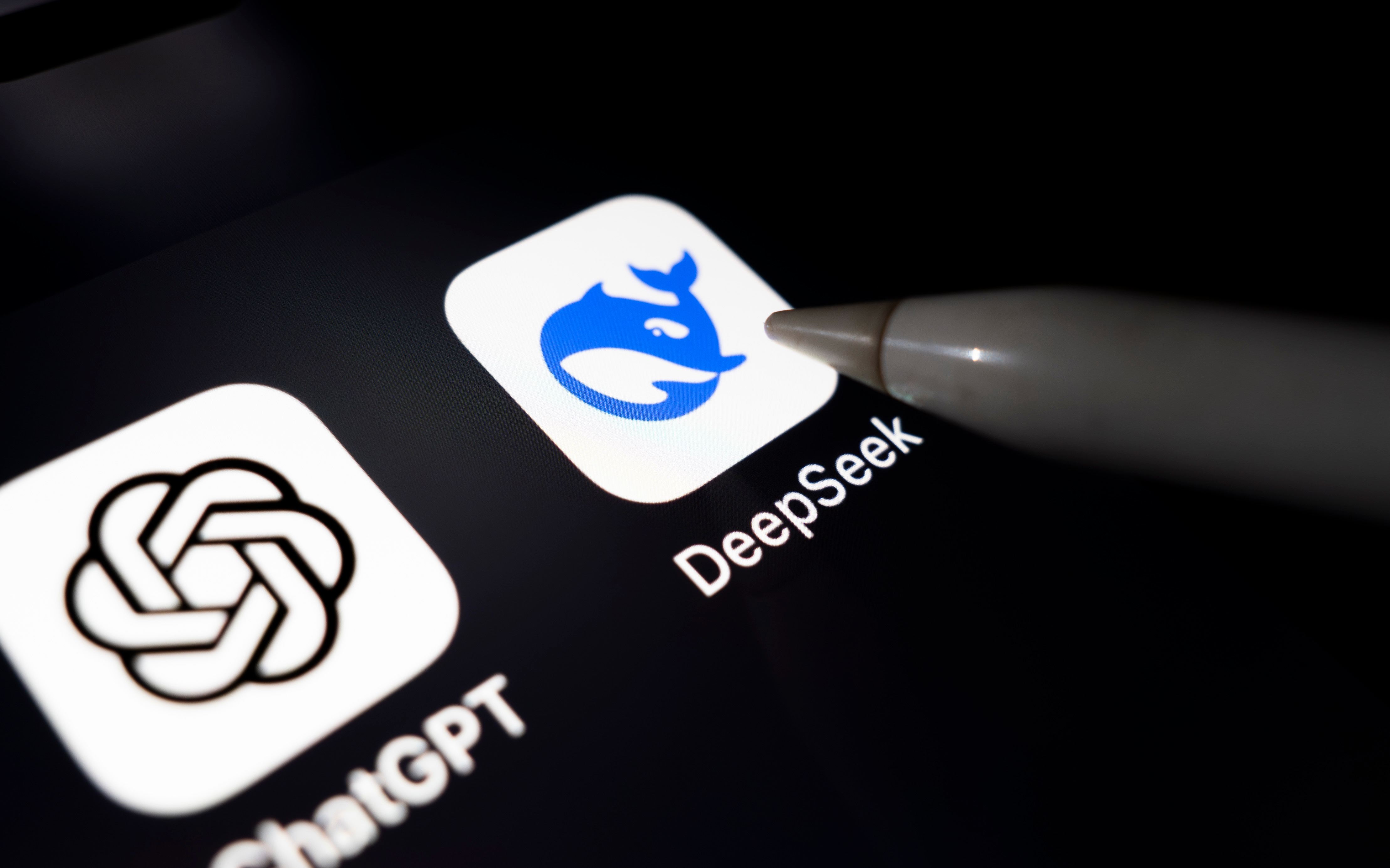
If you’ve been keeping an eye on the AI world, chances are you’ve heard of DeepSeek. This Chinese AI startup has been sending shock waves through Silicon Valley big enough to cause some major stock market turbulence. But what exactly is DeepSeek, and why is it giving tech behemoths like OpenAI, Microsoft, and NVIDIA a run for their money? We’ll break it down for you.

A giant leap for AI—at a fraction of the cost 

DeepSeek’s claim to fame is its latest AI models, DeepSeek-V3 and DeepSeek-R1, which have been touted as on par with (some say even better than) leading AI models from OpenAI and Meta. What truly shocked everyone was that while OpenAI reportedly spent somewhere north of $100 million training GPT-4, DeepSeek claims to have trained its model for under $6 million—a fraction of the cost—and that it was developed by a group of hedge fund managers as a side project.

This efficiency stems from a combination of technical optimizations. Instead of relying on the most expensive AI chips, DeepSeek reportedly made use of around 2,000 NVIDIA H800 GPUs. This is significant because these are modified versions of NVIDIA’s H100 chips, designed to comply with United States export restrictions. By working within these constraints, DeepSeek found innovative ways to make the most of its computing power.

Additionally, the company has implemented an approach known as “mixture of experts”, where different sections of the AI model specialize in specific tasks. This method not only reduces computational costs, but also enhances the efficiency of responses, particularly in complex reasoning tasks.

With that said, it’s also important to note that the $6 million estimate is now under scrutiny, with some industry experts suggesting that the true cost of developing and operating DeepSeek could be well over a billion dollars. OpenAI has also accused DeepSeek of unlawfully using data from ChatGPT to develop its own AI chatbot. This method, known as distillation, is often used to improve performance while cutting costs.

Though distillation is a common, yet controversial practice in the LLM industry, it frequently falls into a legal gray area. Ironically, ChatGPT itself has faced allegations of training on content it didn’t have the rights to access. If these claims hold up, it would be a case of the pot calling the kettle black—AI edition.

The chatbot that dethroned ChatGPT as AI’s poster child 

DeepSeek’s AI assistant quickly became the most downloaded free app on Apple’s App Store and Google’s Play Store, overtaking ChatGPT. This unexpected surge rattled tech investors, causing NVIDIA’s stock to plummet nearly $600 billion in a single day—making it the biggest one-day loss in U.S. market history. This was because DeepSeek claimed it upended the long-held belief that building powerful AI models required massive investment. The AI software company reported that high-performance AI could be developed at a fraction of the cost of OpenAI’s models, making top-tier AI more accessible and competitive than ever. 

But why do users flock to DeepSeek over more established options? One key reason is accessibility. Unlike ChatGPT, which introduced paid tiers to access advanced models, DeepSeek remained entirely free at launch. A key distinction that sets DeepSeek apart from other competitors is that it is a free-to-use, open source AI model available on web, mobile app, and API. The model can run locally and offline with limited compute power, making it an attractive alternative for users seeking high-quality AI responses without a subscription fee.

Moreover, some early testers reported that DeepSeek outperformed ChatGPT in certain areas, particularly mathematical reasoning and coding tasks. It also had the ability to search the web, reason, and “think” before responding—features initially only available on the premium ChatGPT-4 model but which were made free to users after DeepSeek’s launch, perhaps to help it retain market share.

Innovation or cause for concern? 

Despite its success, DeepSeek is not without safety controversies. Security researchers discovered that its web login page contains code linked to China Mobile, a state-owned telecom company that has been banned from operating in the U.S. There are concerns that user data might be accessible to the Chinese government, which has led to calls for banning the app on U.S. government devices. Lawmakers in multiple countries, including Australia, South Korea, and Taiwan, have already restricted or banned DeepSeek over security concerns.

Adding to this, an independent cybersecurity audit revealed that the DeepSeek iOS app transmits user and device data without encryption. This makes it vulnerable to interception, putting sensitive user information at risk. Some experts argue that these privacy flaws are not accidental but rather indicative of a deliberate design choice that prioritizes data collection over user security.

The tech behind DeepSeek: smarter, leaner, and more transparent? 

DeepSeek has adopted innovative approaches to AI efficiency. Unlike many AI models that require massive computational power, DeepSeek has optimized its training methods, significantly reducing the costs of running large-scale AI.

One of its most noteworthy features is its transparency. Unlike OpenAI, which keeps the specifics of its training data and methodologies under wraps, DeepSeek has openly released details of its AI model’s architecture. This allows researchers worldwide to study, modify, and improve upon its technology. Additionally, DeepSeek has experimented with alternative approaches to improving reasoning in AI, such as Monte Carlo Tree Search, which has been used in strategic AI applications, but now is also garnering attention for being used in LLMs.

However, while DeepSeek has shared its AI model weights, it has not disclosed its training datasets. This lack of clarity raises concerns about biases in the model and the potential use of proprietary or sensitive data sources. The question remains: can an AI model truly be transparent without revealing its entire dataset? Many experts argue that full transparency is necessary to ensure AI safety and fairness in deployment.

The political and economic fallout 

DeepSeek’s rise is not just a technological story—it has significant geopolitical implications. The U.S. government has already begun investigating potential national security risks associated with Chinese AI development. A bipartisan congressional bill is being pushed by lawmakers to ban DeepSeek entirely from government devices, citing risks of espionage and data leaks. This comes just days after the TikTok ban was passed, enforced, and ultimately reinstated in the U.S. Of course, the TikTok comparisons were inevitable, with many seeing DeepSeek as the latest episode in the U.S. vs. Chinese tech showdown.

Economically, DeepSeek’s efficiency model has created ripples in the tech industry. Its claims to be able to produce a high-performing AI model at a fraction of the cost has forced U.S. tech firms to reassess their own strategies. If AI breakthroughs can be achieved at the low costs DeepSeek claims, what does this mean for companies like OpenAI, Google, and Meta? Some analysts believe this could lead to a shift in AI research priorities, emphasizing cost-efficient methodologies over brute-force computational power.

Furthermore, DeepSeek’s success has led to significant market reactions. The AI startup’s rapid rise caused NVIDIA’s stock to experience historic losses, shaking investor confidence in the profitability of AI hardware manufacturers. As the AI landscape evolves, the industry must balance efficiency, security, and regulatory considerations to ensure long-term sustainability.

Additionally, some analysts believe that DeepSeek’s efficiency model will push U.S. companies to rethink their spending habits on AI infrastructure. If a Chinese startup can develop cutting-edge AI for a fraction of the cost, why are American firms pouring billions into similar models? This question is likely to fuel both investment strategy shifts and regulatory scrutiny

What’s next for DeepSeek? 

Despite its controversies, DeepSeek is undeniably the underdog which has become OpenAI’s largest competition. Its cost-efficient, high-performance models have forced the industry to reconsider the economics of AI development. Meanwhile, its meteoric rise has put pressure on U.S. lawmakers to scrutinize AI security risks more closely.

However, DeepSeek’s future remains uncertain. Will regulatory pressure slow its momentum, or will it continue to disrupt the AI space? With governments, tech executives, and researchers closely watching, the next chapter of the DeepSeek story is bound to be just as fascinating as its debut.

One thing is for sure: the AI race just got a lot more interesting.

 Related reading

Samudhra Sendhil

Samudhra Sendhil

Enterprise Analyst, ManageEngine

Want to read<br>this article on the go?

Want to read
this article on the go?

Do it on the ManageEngine
Insights app.

Published on June 15, 2022 | 7 min

Over the last two years, there has been a rapid shift in the IT operations landscape. As workforces migrated to remote work, IT personnel teams made a series of adjustments in order to keep their enterprises running smoothly.

In order to better understand how IT service delivery and support capabilities have changed, ManageEngine conducted a global IT service management survey in late 2021. This survey, The State of ITSM: Two Years into the Pandemic, was taken by 437 IT professionals, the majority of which were from the United States, India, Australia, Canada, South Africa, and the United Kingdom.

The survey focuses on several important facets of IT service management: work locations, the impact of remote work, asset management implications, the perceived impact of IT personnel, third-party services, technology assistance, and business continuity success levels.

After looking at the survey results, it became clear which priorities are particularly important for IT personnel in this new era of hybrid work.

1. Asset management needs to remain a focus
While offering IT support during the pandemic, organizations of all sizes faced a bevy of challenges. According to the survey responses, IT professionals’ top challenge was “managing IT assets, ” followed by “communication and collaboration,” and “user training and knowledge management.”

Although “managing IT assets” was listed as IT professionals’ top challenge, 47% of respondents have been able to successfully change their IT procurement policies to support hybrid workers.

Prior to the pandemic, 29% of organizations provided their employees with mobile-capable assets (e.g., laptops, mobile devices, tablets); by 2022, that percentage rose to 76%. Nearly all companies adjusted their procurement policies. In fact, only 16% reported that they didn’t change their procurement policies from those used to procure desktops and on-premises devices.

Given that hybrid work is here for the foreseeable future (per the survey, 59% of the workforce are engaged in hybrid work), asset management absolutely needs to remain a focus.

2. Specific bring-your-own-device policies should be in place
In 2020, more than half of the surveyed organizations did not have a bring-your-own-device (BYOD) policy in place. Quite shockingly, two years have passed, and 39% of organizations still do not have BYOD policies in place.

Everything else being equal, companies that did have BYOD policies in place fared better than those that did not. Roughly 80% of the organizations with BYOD polices in place reported that their networks held up well over the past two years.

3. Chatbots are helpful—especially for larger organizations
For larger businesses—those with 5,000 employees or more—chatbots were a particularly effective way to provide IT service and support. Larger enterprises had the highest level of usage, as well as the lowest amount of negative feedback. However, this was not necessarily the case with smaller organizations.

Although 39% of companies rely on chatbots overall, only two-thirds (69%) of these companies said these tools helped with remote support during the pandemic. Again, the businesses who seemed to benefit the most were generally larger in size. It could be the case that larger, well-capitalized organizations have been using chatbots for a longer time; perhaps these companies have worked out the kinks, so to speak.

4. For most businesses, user experience can be improved 
Thirty-four percent of organizations still do not offer users self-help capabilities.

Much like the chatbot findings, the largest surveyed organizations (5,000+ employees) experienced the highest level of self-service use and success.

Quite strangely, the organizations with the most remote workers also had the highest levels of self-service use; however, these organizations also were far more likely to say that their self-help tools were less effective than anticipated.

Thus, perhaps, these organizations’ self-help tools need modifications. Across the board, it is safe to say that organizations should implement—and in some cases, modify—IT service management self-help capabilities.

The fact remains: IT teams are valued highly across the board
In an attempt to discover how other departments view IT personnel after the pandemic, respondents were asked: “Do you think IT teams have been taken more seriously in terms of budgets, salaries, and recognition of effort?” To which 52% of respondents said that IT departments are, in fact, now viewed more highly as a result of the pandemic.

As a quick caveat, another 14% of respondents asserted that IT personnel have always been considered highly.

For the most part, IT personnel have successfully adapted to the new hybrid landscape. Nevertheless, by continuing to focus on asset management, BYOD policies, and the efficacy of chatbots and other self-help capabilities, IT personnel can ensure that they continue to be valued so highly in the future.

You see the following because WP_DEBUG and WP_DEBUG_DISPLAY are enabled on this site.

  •  
  •  
  •  
  •  
  •  
  •  
  •  
  •  
  •  
  •  
  •  
  •  
  •  
  •  
  •  
  •  
  •  
  •  
  •  
  •  
  •  
  •  
  •  
  •  
  •  
  •  
  •  
  •  
  •  
  •  
  •  
  •  
  •  
  •  
  •  
  •  
  • true
  • Post type is.
  • Post type is.
  • Post type is.
  • Post type is.
  • Post type is.
  • Post type is.
  • Post type is.
  • Post type is.
  • Post type is.
  • Post type is.
  • Post type is.
  • Post type is.
  • Post type is.
  • Post type is.
  • Post type is.
  • Post type is.
  • Post type is.
  • Post type is.
  • post
  • Is supported post type?
  • Is supported post type?
  • Is supported post type?
  • Is supported post type?
  • Is supported post type?
  • Is supported post type?
  • Is supported post type?
  • Is supported post type?
  • Is supported post type?
  • Is supported post type?
  • Is supported post type?
  • Is supported post type?
  • Is supported post type?
  • Is supported post type?
  • Is supported post type?
  • Is supported post type?
  • Is supported post type?
  • Is supported post type?
  • true
  • Is auto insert for post types?
  • Is auto insert for post types?
  • Is auto insert for post types?
  • Is auto insert for post types?
  • Is auto insert for post types?
  • Is auto insert for post types?
  • Is auto insert for post types?
  • Is auto insert for post types?
  • Is auto insert for post types?
  • Is auto insert for post types?
  • Is auto insert for post types?
  • Is auto insert for post types?
  • Is auto insert for post types?
  • Is auto insert for post types?
  • Is auto insert for post types?
  • Is auto insert for post types?
  • Is auto insert for post types?
  • Is auto insert for post types?
  • false
  • Not supported post type or insert TOC is disabled.
  • Not supported post type or insert TOC is disabled.
  • Not supported post type or insert TOC is disabled.
  • Not supported post type or insert TOC is disabled.
  • Not supported post type or insert TOC is disabled.
  • Not supported post type or insert TOC is disabled.
  • Not supported post type or insert TOC is disabled.
  • Not supported post type or insert TOC is disabled.
  • Not supported post type or insert TOC is disabled.
  • Not supported post type or insert TOC is disabled.
  • Not supported post type or insert TOC is disabled.
  • Not supported post type or insert TOC is disabled.
  • Not supported post type or insert TOC is disabled.
  • Not supported post type or insert TOC is disabled.
  • Not supported post type or insert TOC is disabled.
  • Not supported post type or insert TOC is disabled.
  • Not supported post type or insert TOC is disabled.
  • Not supported post type or insert TOC is disabled.
  • false
  • Post eligible.
  • Post eligible.
  • Post eligible.
  • Post eligible.
  • Post eligible.
  • Post eligible.
  • Post eligible.
  • Post eligible.
  • Post eligible.
  • Post eligible.
  • Post eligible.
  • Post eligible.
  • Post eligible.
  • Post eligible.
  • Post eligible.
  • Post eligible.
  • Post eligible.
  • Post eligible.
  • false
  • Found headings:
  • Found headings:
  • Found headings:
  • Found headings:
  • Found headings:
  • Found headings:
  • Found headings:
  • Found headings:
  • Found headings:
  • Found headings:
  • Found headings:
  • Found headings:
  • Found headings:
  • Found headings:
  • Found headings:
  • Replace found headings with:
  • Replace found headings with:
  • Replace found headings with:
  • Replace found headings with:
  • Replace found headings with:
  • Replace found headings with:
  • Replace found headings with:
  • Replace found headings with:
  • Replace found headings with:
  • Replace found headings with:
  • Replace found headings with:
  • Replace found headings with:
  • Replace found headings with:
  • Replace found headings with:
  • Replace found headings with:
  • Shortcode found, add links to content.
  • Shortcode found, add links to content.
  • Shortcode found, add links to content.
  • Shortcode found, add links to content.
  • Shortcode found, add links to content.
  • Shortcode found, add links to content.
  • Shortcode found, add links to content.
  • Shortcode found, add links to content.
  • Shortcode found, add links to content.
  • Shortcode found, add links to content.
  • Shortcode found, add links to content.
  • Shortcode found, add links to content.
  • Shortcode found, add links to content.
  • Shortcode found, add links to content.
  • Shortcode found, add links to content.
  • true
Kumar Ramakrishnan

Kumar Ramakrishnan

Contributor, ManageEngine

Want to read<br>this article on the go?

Want to read
this article on the go?

Do it on the ManageEngine
Insights app.

Published on April 14, 2020 | 3 min

Over the past few decades, AI has gone from science fiction to an integral part of everyday business operations. According to a recent report, “62% of organisations in India have implemented AI in some form, a figure which is not so far from the global figure (65%).”

Looking out a bit further on the horizon, a report predicts that by 2023, 40% of infrastructure and operations teams will use AI-augmented automation in enterprises, resulting in higher IT productivity. As companies proceed from narrow AI to general AI — and begin automating not only processes, but also decisions — it’s vital that AI tools explain their behaviour.

The importance of explainable artificial intelligence cannot be overstated; it is absolutely vital that AI tools justify their decisions by offering detailed explanations. If an AI tool fails to offer an explanation as to how it reached a given decision, users may lose faith in the tool altogether.

While implementing AI tools into your business, it is important to retrofit AI into your existing workflows. After processes are successfully automated, you can begin to automate decisions as well. Even if you have a 100-member team specializing in anomaly detection, computer vision, natural language processing (NLP), and other AI techniques, all AI decisions should require approval from a human—at least until you have fully honed the process. Ideally, one’s AI tools should be accurate at least 80% of the time, and for every single automated decision, your tools should offer an explanation, as well as confidence intervals.

Why is explainable AI so important?

In a recent report, Forrester notes that “45% of AI decision-makers say trusting the AI system is either challenging or very challenging.” Thus, there’s a need for transparent and easily understandable AI models. For all decisions made by AI, there needs to be readily available explanation.

Acknowledging this, you should offer pre-built explanations for all of your AI decisions. For example, perhaps you’re utilising NLP and chatbots to streamline processes for technicians; if a particular request is frequently raised and directed to the same sysadmin every week at the same time, the AI recognises this pattern, automates the process, and explains why it did so.

Through “explanation-ready” AI features, you will be able to effectively assist IT teams with a host of security concerns, including log management, insider threat analysis, user behaviour analysis, and alert fatigue management. And through AI monitoring tools, it’s easier than ever to predict anomalies, outages, combinatorial anomalies, and the root causes of outages. During all of these automated discoveries and decisions, an explanation for the course of action must be provided, along with confidence intervals.

Your robust solutions for DevOps and IT Operations can effectively use AI tools to assess past user behaviour and then ascertain whether an action is anomalous. While accounting for seasonality, changes in schedules and processes, and time of day, these AI tools effectively predict anomalies and outages, ultimately saving your IT teams copious amounts of time and energy.

As an example, perhaps your website monitoring tool notes that a web page loads slowly at the same time each week when it is accessed from a certain location. AI tools will acknowledge this pattern and automatically send a ticket to the web manager via your service desk software. By integrating with multiple tools, AI automates processes, saves time, and improves productivity.

Again, the important point to drive home is that the AI must be explainable. AI tools can suggest certain decisions; however, if these decisions don’t come with pre-built explanations, people will lose faith in the tools.

Disclosure: This article was originally published in Analytics India Magazine. 

Ramprakash Ramamoorthy

Ramprakash Ramamoorthy

Director of AI Research, ManageEngine, AI & Machine Learning, Zoho Labs

Want to read<br>this article on the go?

Want to read
this article on the go?

Do it on the ManageEngine
Insights app.

Subscribe to chatbots

Thanks for subscribing to ManageEngine Insights. If you do not receive our welcome email, please check your SPAM folder.